Menu
Store
Blog
Veliko Tarnovo region, Bulgaria

Veliko Tarnovo: Iron Age Echoes

A single Dzhulyunitsa individual offers a tentative glimpse into 8th–6th century BCE Bulgaria

771 CE - 541 BCE
Scroll to begin
Chapter I

The Story

Understanding the Veliko Tarnovo: Iron Age Echoes culture

Archaeological contexts around Veliko Tarnovo (Dzhulyunitsa) dated 771–541 BCE reveal Iron Age lifeways and mobility. Ancient DNA from one individual carries mtDNA H; genetic conclusions are preliminary but align with broader Balkan ancestry patterns influenced by local Neolithic and Steppe-derived gene flow.

Time Period

771–541 BCE (Iron Age)

Region

Veliko Tarnovo region, Bulgaria

Common Y-DNA

Undetermined (no male haplogroup recovered; sample n=1)

Common mtDNA

H (1)

Chapter II

Timeline

Key moments in the history of this culture

771 BCE

Earliest date in sampled range

Calendar start of the radiocarbon/archaeological range for the Dzhulyunitsa individual (771–541 BCE).

600 BCE

Regional hillfort and tumulus activity

Active hillforts and tumulus burials in the Veliko Tarnovo region reflect social stratification and regional networks.

Chapter III

Origins & Emergence

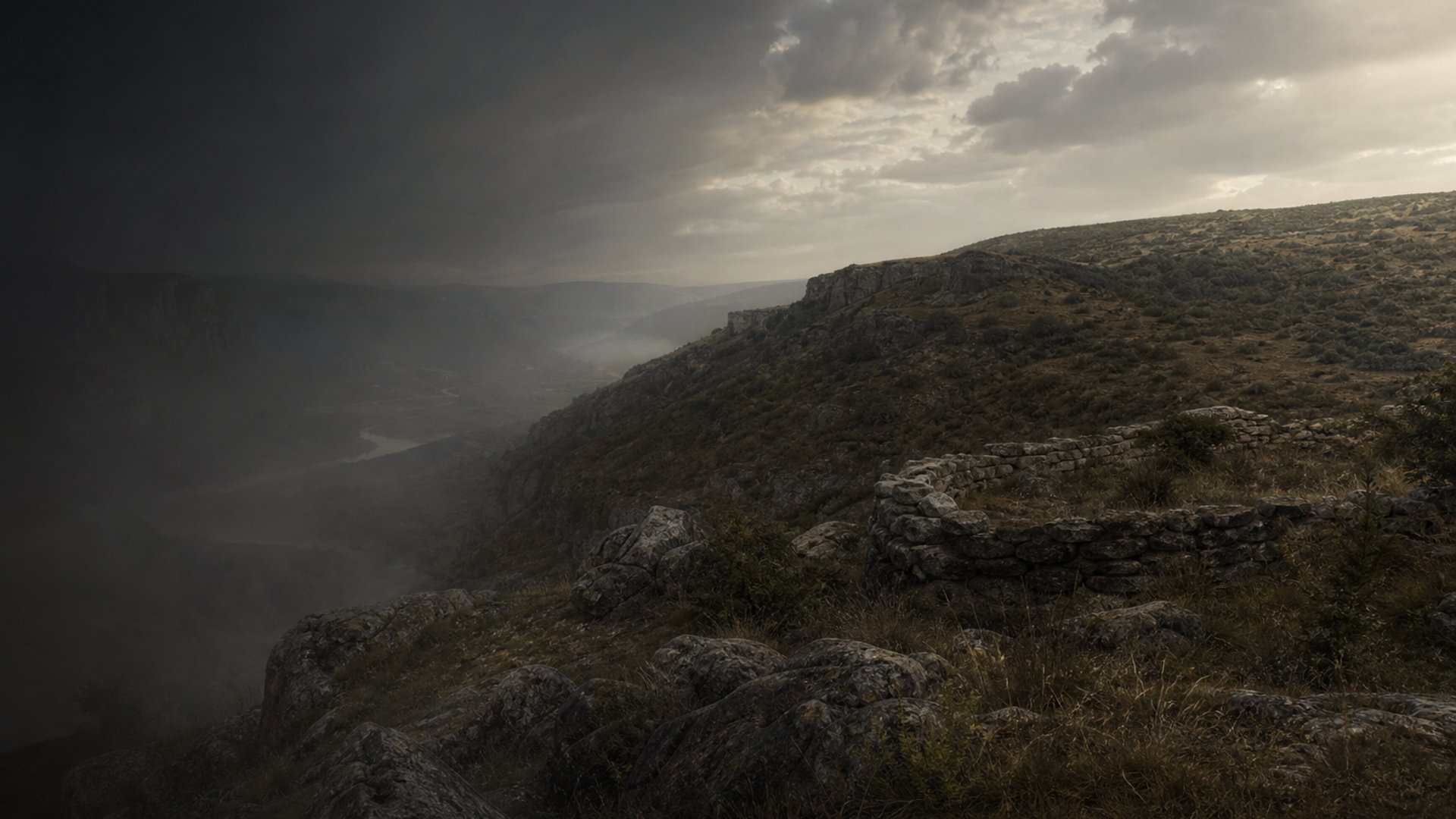
The individual from Dzhulyunitsa sits within the later Iron Age horizons of north-central Bulgaria, a landscape of river valleys and fortified hills that long served as crossroads between the Balkans and the Pontic steppe. Archaeological data indicates widespread hillforts, tumulus burials, and metalworking centers in the Veliko Tarnovo area during the 8th–6th centuries BCE. Limited evidence suggests local communities were heir to Bronze Age traditions while also participating in new networks of exchange and mobility: Greek colonists on the Black Sea coast, Scythian steppe groups, and neighboring Thracian polities left material traces that archaeologists read as trade, warrior exchange, and cultural borrowing.

Material culture — from distinctive pottery and weapon types to traces of iron metallurgy — frames an image of communities negotiating continuity and change. Fortified acropoleis near modern Veliko Tarnovo show long-lived settlement, while nearby cemeteries record variations in burial rite that hint at social differentiation. However, the precise pathways by which cultural traits spread — whether by movement of ideas, goods, or people — remain debated. The Dzhulyunitsa specimen adds a human voice to this picture, but with only one sampled genome the broader story of population formation in Iron Age Bulgaria remains provisional.

  • Located in Veliko Tarnovo region; dated 771–541 BCE
  • Archaeology shows fortifications, tumuli, and metalworking
  • Contacts with Thracian groups, Greeks, and steppe communities
Chapter IV

Daily Life & Society

Life across Iron Age communities near Veliko Tarnovo would have been textured and dynamic: villages cultivated cereals and pulses on river floodplains while hillforts controlled trade routes and seasonal pastures. Zooarchaeological remains from regional sites indicate mixed farming with sheep, cattle, and pigs; horse remains and bridling equipment appear in elite contexts, signaling the importance of mobility and mounted status in some groups.

Craft specialization is visible in local assemblages — smithing slag, molds, and finished iron tools — suggesting that ironworking reshaped economies and social hierarchies. Pottery styles show regional variation but also imported wares from the Greek world, implying active exchange. Burial evidence near Veliko Tarnovo and in the Dzhulyunitsa area presents a spectrum: flat graves, tumuli, and occasionally richly furnished elite burials. These differences indicate varying social roles, possibly reflecting emerging chieftaincies or warrior elites.

Ethnic labels are precarious in archaeology; material culture signals networks of interaction rather than tidy population boxes. Still, the daily rhythms preserved in dwellings, tools, and tombs speak to communities adapting to new technologies, shifting alliances, and long-distance connections across the Balkans.

  • Mixed farming with evidence for sheep, cattle, pigs, and horses
  • Ironworking and craft specialization reshape local economies
Chapter V

Genetic Profile

Genetic data from Dzhulyunitsa is extremely limited: a single individual dated to 771–541 BCE with mitochondrial haplogroup H. mtDNA H is widespread across Europe and common in later prehistoric and historic populations; its presence here is consistent with continuity of maternal lineages in the Balkans but alone cannot demonstrate population continuity or migration.

No robust Y-DNA haplogroup was recovered from this individual (or a male haplogroup could not be determined), so paternal lines remain unknown. Broader ancient DNA studies in the Balkan Iron Age indicate that regional genomes are typically a mosaic — a long-standing Neolithic farmer substrate mixed with Steppe-related ancestry introduced earlier in the Bronze Age, plus gene flow from neighboring regions such as the Pontic steppe and Anatolia. Common regional Y-DNA haplogroups reported in other Iron Age Balkan contexts include I2, R1a, and R1b, but these should not be attributed to the Dzhulyunitsa individual without direct evidence.

Because sample count is one, conclusions are preliminary. The single mtDNA H adds a data point that fits into known patterns but cannot resolve questions of migration, admixture proportions, or social structure. Future sampling from Veliko Tarnovo, nearby cemeteries, and contemporaneous sites will be essential to transform evocative hypotheses into robust population histories.

  • mtDNA H observed in the single sampled individual (n=1)
  • No Y-DNA assigned; regional Y haplogroups in other studies include I2, R1a, R1b
Chapter VI

Legacy & Modern Connections

The echo of Iron Age communities persists in the archaeological landscape and, in part, in modern genetic variation. Mitochondrial lineages like H remain common in contemporary Bulgarians, reflecting long, multilayered maternal histories in the region. Archaeological place continuity — hillforts later reused, burial grounds overlaying older cemeteries — suggests cultural landscapes were palimpsests where new identities wrote themselves atop inherited terrains.
Yet caution is essential: genetic continuity is rarely simple. Centuries of migrations, the Roman conquests, Slavic movements, and later medieval dynamics all reshaped gene pools. The Dzhulyunitsa individual illuminates one human life in a long series and points toward continuity of some maternal lineages. To clarify the threads connecting ancient inhabitants to modern populations requires larger, well-stratified genetic samples paired with careful archaeological context.


  • mtDNA H continuity suggests some maternal lineage persistence
  • Complex later history (Roman, Slavic, medieval) complicates direct ancestry claims
AI Powered

AI Assistant

Ask questions about the Veliko Tarnovo: Iron Age Echoes culture

AI Assistant by DNAGENICS

Unlock this feature
Ask questions about the Veliko Tarnovo: Iron Age Echoes culture. Our AI assistant can explain genetic findings, historical context, archaeological evidence, and modern connections.
Sample AI Analysis

The Veliko Tarnovo: Iron Age Echoes culture represents a fascinating chapter in human history...

Genetic analysis reveals connections to earlier populations while showing evidence of unique adaptations and cultural innovations. The ancient DNA samples provide insights into migration patterns, social structures, and the biological relationships between ancient populations.

This is a preview of the AI analysis. Unlock the full AI Assistant to explore detailed insights about:

  • Genetic composition and ancestry
  • Migration patterns and origins
  • Daily life and cultural practices
  • Modern genetic legacy
Use code for 35% off Expires May 20



