Menu
Store
Blog
Austria_Mesolithic Austria (Wöllersdorf, Niederösterreich)

Wöllersdorf Mesolithic Individual

An early Holocene hunter‑gatherer from Wöllersdorf, Austria (7034–6656 BCE)

7034 CE - 6656 BCE
1 Ancient Samples
Scroll to begin
Chapter I

The Story

Understanding the Wöllersdorf Mesolithic Individual culture

A single Mesolithic individual from Wöllersdorf (Niederösterreich) dated to 7034–6656 BCE. Archaeological context reveals post‑glacial riverine foraging; ancient DNA (Y haplogroup P, mtDNA U) offers a preliminary glimpse of hunter‑gatherer variation in Austria.

Time Period

7034–6656 BCE

Region

Austria (Wöllersdorf, Niederösterreich)

Common Y-DNA

P (1 sample)

Common mtDNA

U (1 sample)

Chapter II

Timeline

Key moments in the history of this culture

6845 BCE

Wöllersdorf individual dated

A human genome from Wöllersdorf is radiocarbon‑dated to between 7034 and 6656 BCE, anchoring early Holocene hunter‑gatherer presence in Lower Austria.

Chapter III

Origins & Emergence

The Wöllersdorf individual dates to the early Holocene, a time when Europe’s landscapes were rapidly reforesting after the Last Glacial Maximum. Archaeological data indicates that this region of lower Austria was characterized by riverine terraces and wetlands that supported rich resources: migratory fish, waterfowl, and game animals. The material culture of Mesolithic Austria is sparsely documented compared with rich coastal sequences, but site assemblages typically show microlithic stone tools, chipped‑stone production debris, and occasional bone implements adapted for fishing and hunting.

Limited evidence suggests that communities occupying river valleys such as the area around Wiener Neustadt exploited seasonal resource pulses and maintained mobile lifeways suited to patchy environments. The Wöllersdorf find fits within a broader pattern of early Holocene foragers across Central Europe who colonized post‑glacial habitats and established regional tool traditions. While environmental reconstructions emphasize a mosaic of forest and open areas, direct archaeological deposits at Wöllersdorf are fragmentary; therefore, reconstructions of settlement intensity and social organization remain provisional.

This individual thus represents a human presence during ecological transition — an anchor point for combining archaeological context with ancient DNA to illuminate how early foragers in Austria navigated a changing world.

  • Dated to 7034–6656 BCE, early Holocene riverine environment
  • Site: Wöllersdorf (Niederösterreich, Wiener Neustadt(Land))
  • Material culture: microliths, bone tools, evidence of fishing and hunting
Chapter IV

Daily Life & Society

Life in Mesolithic Austria was shaped by seasonal rhythms and the availability of riverine and forest resources. Archaeological indicators from contemporaneous Central European sites suggest small, mobile groups organized into flexible bands. Daily activities likely centered on hunting red deer and aurochs, fishing with barbed points and nets, trapping small mammals, and gathering plant foods such as nuts and tubers when available. The manufacture and maintenance of microlithic toolkits — small, retouched bladelets and composite tools set into bone or wood handles — would have consumed substantial working time and knowledge transmission across generations.

Social life was probably organized around kin groups with fluid membership, enabling groups to scale up for seasonal aggregations such as fishing runs or raw material exchange. Hearths, temporary shelters, and caches are common features at contemporary Mesolithic camps, though preservation at Wöllersdorf is limited. Ornamentation and personal items, where present in the region, imply symbolic behavior and long‑distance connections in raw materials.

Because the archaeological record at Wöllersdorf is fragmentary and the genetic sample is a single individual, reconstructions of social structure remain hypothetical. Nevertheless, when archaeology is read alongside genetic data, even a single genome can reveal mobility patterns, possible sex‑biased residence, and connections to wider forager networks across Central Europe.

  • Economy: mixed hunting, fishing, gathering in riverine landscapes
  • Social groups: small, mobile bands with seasonal aggregation
Chapter V

Genetic Profile

Ancient DNA from the Wöllersdorf individual provides a rare genetic snapshot from Mesolithic Austria. The individual carries Y‑DNA haplogroup P and mitochondrial haplogroup U. Haplogroup U (various subclades) is widely documented among European hunter‑gatherers and is consistent with a continuity of maternal lineages in post‑glacial Europe. By contrast, Y‑haplogroup P — a deep paternal lineage ancestral to branches such as Q and R — is uncommon in later European male lineages; its presence here is intriguing but must be interpreted with caution.

Because the dataset from Austria_Mesolithic comprises a single genome, any population‑level inferences are preliminary. Limited evidence suggests that this individual’s maternal ancestry aligns with broader Western Hunter‑Gatherer (WHG) components detected across Europe, while the paternal signal may reflect rare or now‑sparse lineages in early Holocene Central Europe. Genetic affinities could indicate local continuity from late Paleolithic groups or gene flow from neighboring forager populations; alternative explanations include unsampled regional diversity or post‑depositional biases in preservation and sampling.

Future sequencing of additional Mesolithic individuals from Austria and adjacent regions is required to test whether haplogroup P represents a transient lineage, a local founder effect, or a wider but poorly sampled paternal lineage in early Holocene Europe. For now, the Wöllersdorf genome is a valuable but solitary data point that connects archaeology and genetics.

  • mtDNA U aligns with common European hunter‑gatherer maternal lineages
  • Y‑DNA P is rare in Europe; single sample makes conclusions provisional
Chapter VI

Legacy & Modern Connections

Mesolithic hunter‑gatherers left a deep genetic and ecological imprint on Europe. Genomic components associated with early foragers contribute to the ancestry of many modern Europeans, even after later Neolithic farmer and Bronze Age migrations reshaped genetic landscapes. The Wöllersdorf individual provides a local anchor for this deep ancestry in Austria: the maternal U lineage echoes a broad Paleolithic and Mesolithic maternal continuity, while the unusual paternal signal highlights the complexity of male lineages over time.
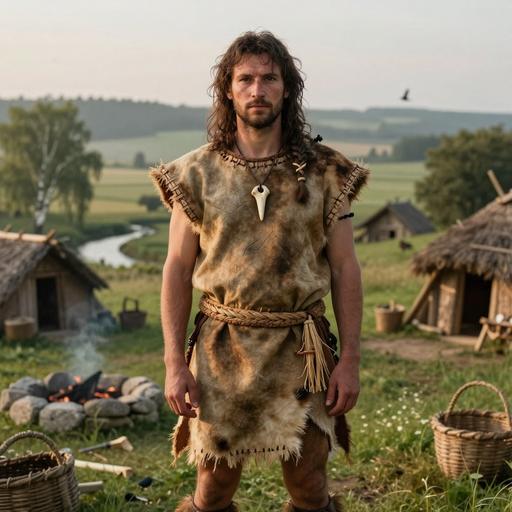
From a cultural perspective, Mesolithic lifeways influenced resource use, seasonal mobility, and landscape management across the Holocene. Elements of this legacy — technological innovations like microlithic tool production, riverine exploitation strategies, and symbolic practices — can be traced in later traditions, though they were transformed by contact with incoming populations.

Given the single‑sample context, any direct ties to modern populations are speculative. Nevertheless, integrating archaeological evidence from Wöllersdorf with ancient DNA helps reconstruct the mosaic of ancestries that form Europe’s deep past and underscores the need for more targeted sampling in Austria to reveal patterns of continuity and change.

  • Contributes to the deep hunter‑gatherer ancestry visible in modern Europeans
  • Highlights the need for more regional sampling to resolve paternal lineage histories
Chapter VII

Sample Catalog

1 ancient DNA samples associated with the Wöllersdorf Mesolithic Individual culture

Ancient DNA samples from this era, providing genetic insights into the people who lived during this period.

1 / 1 samples
Portrait Sample Country Era Date Culture Sex Y-DNA mtDNA
Portrait of ancient individual WOL001 from Austria, dated 7034 BCE
WOL001
Austria Austria_Mesolithic 7034 BCE Pre-Alpine M P37.2 U5a2
AI Powered

AI Assistant

Ask questions about the Wöllersdorf Mesolithic Individual culture

AI Assistant by DNAGENICS

Unlock this feature
Ask questions about the Wöllersdorf Mesolithic Individual culture. Our AI assistant can explain genetic findings, historical context, archaeological evidence, and modern connections.
Sample AI Analysis

The Wöllersdorf Mesolithic Individual culture represents a fascinating chapter in human history...

Genetic analysis reveals connections to earlier populations while showing evidence of unique adaptations and cultural innovations. The ancient DNA samples provide insights into migration patterns, social structures, and the biological relationships between ancient populations.

This is a preview of the AI analysis. Unlock the full AI Assistant to explore detailed insights about:

  • Genetic composition and ancestry
  • Migration patterns and origins
  • Daily life and cultural practices
  • Modern genetic legacy
Use code for 35% off Expires May 20