Menu
Store
Blog
Abaco Islands, Bahamas

Whispers from Abaco Caves

Fragmentary voices of Ceramic-period Bahamians revealed by archaeology and ancient DNA

772 CE - 1398 CE
Scroll to begin
Chapter I

The Story

Understanding the Whispers from Abaco Caves culture

Archaeological remains from Abaco Island caves (772–1398 CE) and four ancient DNA samples hint at Ceramic-period Lucayan lifeways. Limited samples point to Indigenous Y-haplogroup Q and mtDNA B lineages, suggesting connections to wider Arawakan maritime networks—preliminary but evocative.

Time Period

772–1398 CE (sampled range)

Region

Abaco Islands, Bahamas

Common Y-DNA

Q (observed 2/4)

Common mtDNA

B2e (2), B (1), B2 (1)

Chapter II

Timeline

Key moments in the history of this culture

772 CE

Earliest dated Abaco sample

Oldest direct radiocarbon date associated with the sampled Abaco cave remains (sampled range begins).

Chapter III

Origins & Emergence

The Abaco Ceramic assemblage occupies a narrow but luminous corner of Caribbean prehistory. Within the sampled window (772–1398 CE) archaeological contexts from Hopetown, Prophet's Cave (Moore's Island), Bill Johnson's Cave, and Lubber's Quarters preserve ceramics, shell tools, and cave-associated deposits that speak to long-distance seafaring and island-focused lifeways. Archaeological data indicates these peoples participated in the broader Ceramic Period expansion that brought Arawakan-speaking communities across the Greater Antilles and into the Bahamian archipelago.

Material culture — thin, stamped ceramics, ground stone and shell adzes, and coastal midden layers — suggests a maritime adaptation with strong cultural ties to the Greater Antilles. Caves on Abaco appear to have been used for multiple purposes: shelter, storage, and sometimes funerary deposition; stratigraphic sequences in some caves contain charcoal and ceramic fragments that anchor radiocarbon dates within the sampled range.

Genetic results, while extremely limited in number, provide tantalizing complements to the material record by indicating paternal and maternal lineages consistent with Indigenous American origins. However, with only four ancient genomes available, any model of migration or local emergence remains provisional. Future excavations and responsibly-sourced ancient DNA will be required to transform these tentative connections into a robust narrative of arrival and adaptation in the northern Bahamas.

  • Sites: Hopetown; Prophet's Cave (Moore's Island); Bill Johnson's Cave; Lubber's Quarters
  • Material culture aligns with Caribbean Ceramic traditions and maritime lifeways
  • Interpretations remain provisional due to small sample sizes
Chapter IV

Daily Life & Society

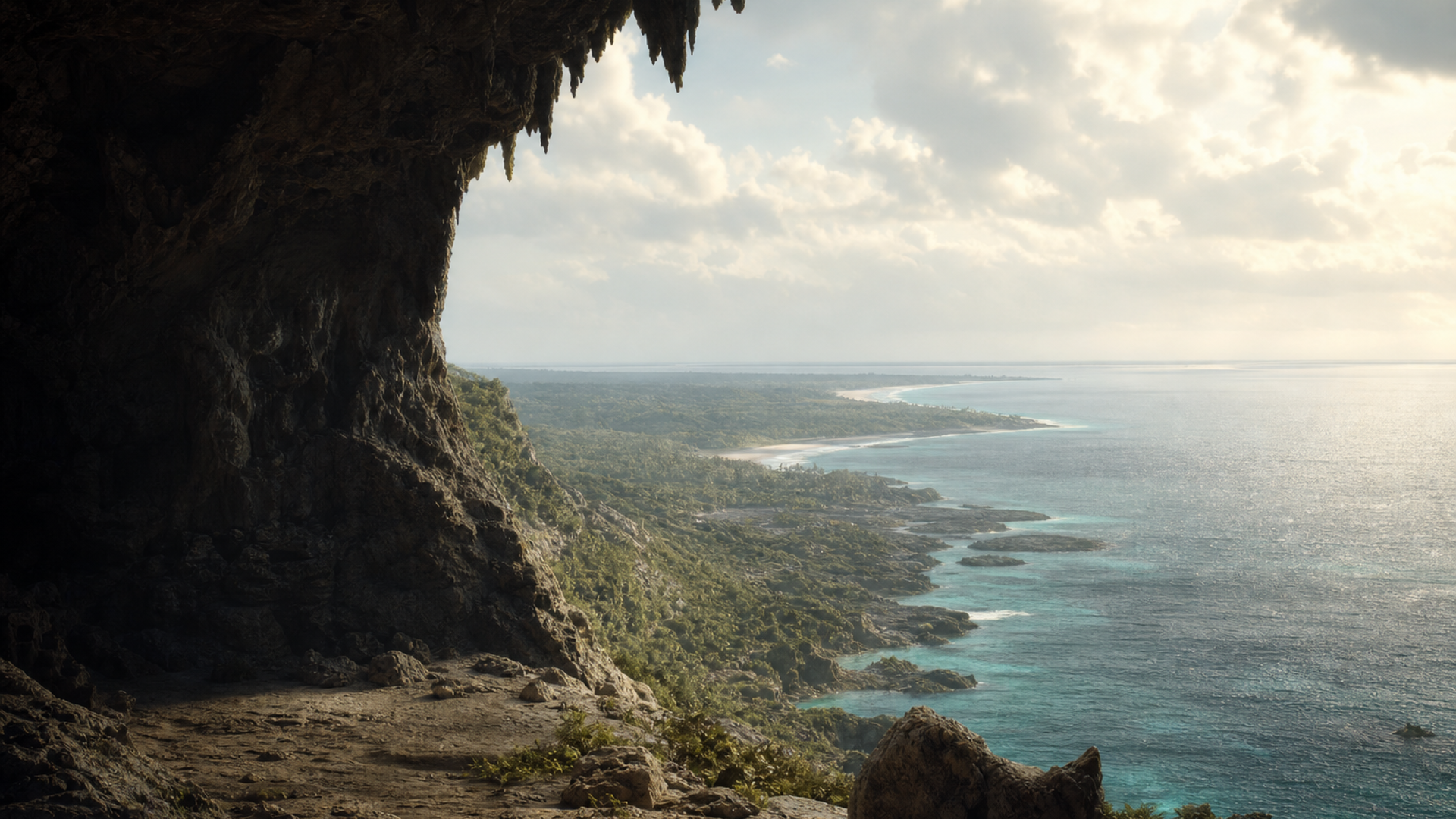
Life on Abaco during the Ceramic Period can be glimpsed as a cinematic coastal rhythm: dawn light on shallow reefs, canoes cutting across turquoise channels, and the steady shaping of clay into shallow bowls and cooking dishes. Archaeological deposits recover fish bone, conch, turtle remains, and shellfish middens that indicate marine resources formed the backbone of subsistence. Occasional terrestrial remains imply small-scale horticulture or gathered roots and fruits supplemented diets, though direct botanical preservation in these island caves is limited.

The presence of decorated ceramics and standardized shell tools suggests craft specialization and exchange. Caves and rock shelters contain discrete assemblages that archaeologists interpret as storage, ritual space, or burial loci; human remains recovered in some cave contexts (where ethically and legally studied) indicate varied mortuary treatments. Social life likely centered on kin groups with mobility along island chains—seasonal movements and canoe-borne trade connecting Abaco with neighboring islands.

Yet caution is essential: the archaeological picture is patchy, and preservation biases (erosion, sea-level change, and site disturbance) preferentially hide or destroy evidence of plant use, housing, and ephemeral structures. The surviving traces give us a compelling, if incomplete, portrait of resilient island communities who navigated both sea and social networks across the pre-Columbian Caribbean.

  • Marine resources dominate zooarchaeological assemblages (fish, conch, turtle)
  • Caves served varied roles: storage, ritual, and possible funerary contexts
Chapter V

Genetic Profile

Four ancient DNA samples from Abaco caves (dated between 772 and 1398 CE) yield a concise but important set of uniparental markers. On the paternal side, haplogroup Q appears in two samples. Q is broadly associated with Indigenous peoples of the Americas and its presence in Abaco aligns with an American-origin paternal ancestry. Maternal lineages are dominated by haplogroup B variants: two samples carry B2e, one carries B, and one carries B2. Haplogroup B and its subclades are widely distributed in northern South America and the Caribbean in ancient and modern datasets, consistent with archaeological links to Arawakan-speaking expansions.

These uniparental markers support an interpretation of Indigenous American ancestry for the sampled individuals, in agreement with the archaeological Ceramic-period context. However, important caveats apply: uniparental markers represent only single ancestral lines and cannot alone resolve population structure, admixture, or the dynamics of migration. Critically, the sample count is four—below the threshold for broad generalizations—so patterns observed should be regarded as preliminary signals rather than definitive population portraits.

Future work integrating autosomal genomes, additional samples across the Bahamas and Greater Antilles, and careful radiocarbon dating will be necessary to test models of continuity, demographic change, and the degree of connectivity between Abaco and neighboring islands.

  • Y-DNA: Q observed in 2 of 4 samples—consistent with Indigenous American paternal lineages
  • mtDNA: B2e (2), B (1), B2 (1) — maternal lineages common in northern South America and the Caribbean
Chapter VI

Legacy & Modern Connections

The Lucayan peoples who inhabited the Bahamas at European contact left complex legacies: material traces in caves and coastal middens, and genetic echoes that may persist in the region. Archaeogenetic data from Abaco provide a faint but meaningful bridge to those past lives, revealing Indigenous haplogroups that connect the islands to wider Caribbean and mainland American genealogies.

It is important to acknowledge the historical disruptions that followed contact—including displacement, disease, and demographic collapse—that complicate direct lines between ancient populations and living communities. Moreover, the limited ancient sample set from Abaco (n = 4) necessitates caution: these genomes are pieces of a larger puzzle, not its final image. Nonetheless, each responsibly-studied ancient genome expands our ability to reconstruct pre-contact diversity and to situate modern Bahamian ancestry within a deeper temporal framework. Collaborative research, community engagement, and more extensive sampling remain essential for turning these early insights into a fuller, ethically-grounded history.

  • Ancient haplogroups link Abaco to broader Caribbean and mainland American ancestries
  • Historical disruptions and low sample numbers mean conclusions are provisional
AI Powered

AI Assistant

Ask questions about the Whispers from Abaco Caves culture

AI Assistant by DNAGENICS

Unlock this feature
Ask questions about the Whispers from Abaco Caves culture. Our AI assistant can explain genetic findings, historical context, archaeological evidence, and modern connections.
Sample AI Analysis

The Whispers from Abaco Caves culture represents a fascinating chapter in human history...

Genetic analysis reveals connections to earlier populations while showing evidence of unique adaptations and cultural innovations. The ancient DNA samples provide insights into migration patterns, social structures, and the biological relationships between ancient populations.

This is a preview of the AI analysis. Unlock the full AI Assistant to explore detailed insights about:

  • Genetic composition and ancestry
  • Migration patterns and origins
  • Daily life and cultural practices
  • Modern genetic legacy
Use code for 30% off Expires May 12