A man buried in Portugal in the Late Neolithic to Copper Age era

Download PDF creates a visual, rasterized copy. Use Print for selectable text and better assistive-technology support.

Loading Report

Preparing your ancestry journey

Preparing the available report content...

Your report will open automatically.

Skip to main content
Reference library / Sample profile

A man buried in Portugal in the Late Neolithic to Copper Age era

Explore the recorded context, genetic comparisons and research behind this reference sample.

PortugalPortugal LN C

A reference profile describes this sample. It does not establish a personal or family relationship.

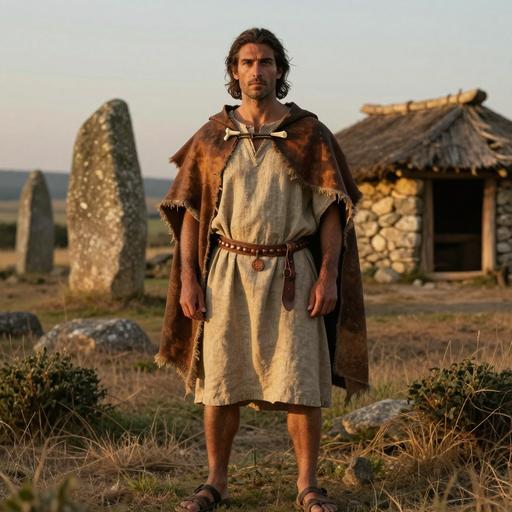
AI portrait reconstruction for A man buried in Portugal in the Late Neolithic to Copper Age era
AI-generated artistic reconstruction, not a photograph of the individual.
Record

Sample details

Recorded details and available lineage markers.

Individual

Western European Megalithic Culture individual, Portugal

Sample ID: CovaMoura364

Date Range

2500 BCE - 2000 BCE

Cultural Period

Portugal LN C

Biological Sex

Male

mtDNA Haplogroup

H

Y-DNA Haplogroup

I2a1b

Social Role

Farmer (AI estimate, era-typical)

Geography

Location

Where this individual was discovered

Country Portugal
Locality Cova da Moura
Coordinates 38.7450, -9.2152
Chronology

Date range

When this individual lived in the broader context of human history

Western European Megalithic Culture individual, Portugal 2500 BCE - 2000 BCE
Context

Historical context

Background information associated with the reference record.

Late Neolithic to Copper Age life in Portugal unfolded across Atlantic-facing coasts, river valleys, and uplands with rain-fed agriculture supporting both settlement and exchange.

Region & Environment

Portugal’s landscapes offered diverse resources: arable soils for cultivation, pasture for herding, and access to coastal and inland raw materials. Settlements could cluster near fertile valleys and workable uplands, while seafaring routes and river corridors helped link communities across regions.

Historical Context

Between roughly the mid–4th and early 3rd millennia BCE, southern and western Iberian societies experienced long-term Neolithic developments alongside gradual uptake of copper and related technologies. This period is often treated as a bridge between purely Neolithic lifeways and the later Bronze Age world, with metallurgy and specialized production becoming increasingly visible in the archaeological record.

Populations & Lifeways

Populations were largely community-based and agricultural, with mixed farming and animal husbandry. Daily life centered on producing and managing subsistence—growing crops, keeping herds, and processing food—while also participating in seasonal movements and local building projects. Funerary behavior and communal monuments indicate that social identities and networks mattered as much as subsistence needs.

Archaeology & Material Culture

Archaeologically, this era is marked by continuities in Neolithic settlement patterns and architecture, alongside changes that accompany Copper Age experimentation. Material culture typically includes:

  • durable pottery used in domestic contexts
  • lithic toolkits used for cutting, scraping, and woodworking
  • megalithic and other communal mortuary settings
  • early copper items and evidence for craft practice where copper was available The co-occurrence of long-established stone traditions with emerging metalworking helps explain the “Late Neolithic to Copper Age” character of this phase.

Culture & Society

Copper production and the circulation of metal objects would have required knowledge, access to raw materials, and mechanisms for exchange. Social organization likely combined households engaged in production with broader community structures expressed through monument building and shared burial practices. Links between regions are suggested by stylistic and technological parallels that appear across Iberia during this wider transition.

Legacy & Transition

This period helped set the conditions for later Bronze Age developments: intensification of farming, expansion of craft specialization, and growing importance of metal in status and exchange. As communities moved into the Bronze Age, the archaeological record increasingly reflects more systematic metallurgy and larger-scale networks tying Portugal into wider Atlantic Iberian interactions.

Analysis

Genetic comparisons

These comparisons show genetic similarity, not identity or origin. The populations listed are those whose genomes show statistical alignment to this ancient individual.

Similarity reflects shared history, not shared identity. These are analytical comparisons, not claims about who this person was.

Modern Genetic Admixture

This analysis compares the DNA profile with present-day reference populations, showing statistical similarity to modern reference populations from different regions. The excavation site records where this individual was found, not a fixed modern genetic identity.

Europe 97.3%
Southern European 92.8%
Iberian 53.8%
Sardinian 28.6%
Italian 10.4%
Northwestern European 4.5%
Africa 2.2%
North African 1.7%
North African 1.7%
Oceania 0.5%
Melanesian 0.5%
Papuan 0.5%

Closest Modern Populations

These are the modern populations showing the closest statistical alignment to A man buried in Portugal in the Late Neolithic to Copper Age era, ranked by genetic distance. Lower distance values indicate closer statistical similarity. Cross-region similarity can reflect shared ancestry, population movement, continuity, or later admixture.

1
Sardinian
3.4229
2
French Corsica
5.3813
3
Spanish La Rioja
5.3951
4
Spanish Castilla La Mancha
5.7083
5
Spanish Castello
5.7666
6
Spanish Pirineu
5.7840
7
Spanish Aragon
5.8173
8
Spanish Cantabria
5.8404
9
Spanish Navarra
5.8432
10
Spanish Menorca
5.8475
Context

Related Samples

This individual exists within a broader network of ancient samples. No ancient genome stands alone.

Individual Culture/Period Date Location Action
Western European Neolithic individual, Portugal Middle Neolithic Portugal 4500 BCE Lugar do Canto, Portugal View
Western European Megalithic Culture individual, Portugal Late Neolithic to Chalcolithic Portugal 2500 BCE Cova da Moura, Portugal View
Western European Neolithic individual, Portugal Middle Neolithic Portugal 4500 BCE Lugar do Canto, Portugal View
Western European Megalithic Culture individual, Portugal Late Neolithic to Chalcolithic Portugal 3700 BCE Dolmen de Ansião, Portugal View
Iberian Chalcolithic individual, Portugal Chalcolithic Portugal 3350 BCE Lisbon. Torres Vedras. Cabeço da Arruda I, Portugal View
Western European Neolithic individual, Portugal Middle Neolithic Portugal 4500 BCE Lugar do Canto, Portugal View
Atlantic Bronze Age individual, Portugal Middle Bronze Age Portugal 1728 BCE Monte do Gato de Cima 3, Portugal View
Atlantic Bronze Age individual, Portugal Middle Bronze Age Portugal 1800 BCE Torre Velha 3, Portugal View
Western European Megalithic Culture individual, Portugal Late Neolithic to Chalcolithic Portugal 2500 BCE Cova da Moura, Portugal View
Atlantic Bronze Age individual, Portugal Middle Bronze Age Portugal 1800 BCE Torre Velha 3, Portugal View
Iberian Chalcolithic individual, Portugal Chalcolithic Portugal 3350 BCE Lisbon. Torres Vedras. Cabeço da Arruda I, Portugal View
Atlantic Bronze Age individual, Portugal Middle Bronze Age Portugal 1800 BCE Monte do Vale do Ouro 2, Portugal View
Western European Neolithic individual, Portugal Middle Neolithic Portugal 4500 BCE Lugar do Canto, Portugal View
Western European Megalithic Culture individual, Portugal Late Neolithic to Chalcolithic Portugal 3011 BCE Monte Canelas 1, Portugal View
Iberia Ca individual, Portugal 3350 BCE Lisbon. Torres Vedras. Cabeço da Arruda I, Portugal View
Iberia Ca individual, Portugal 2500 BCE Cova da Moura, Portugal View
Iberia Mln individual, Portugal 3700 BCE Dolmen de Ansião, Portugal View
Iberia Mln individual, Portugal 4500 BCE Lugar do Canto, Portugal View
Iberia Ca individual, Portugal 3011 BCE Monte Canelas 1, Portugal View
Iberia Ba individual, Portugal 1728 BCE Monte do Gato de Cima 3, Portugal View
Iberia Ba individual, Portugal 1800 BCE Torre Velha 3, Portugal View
Iberia Ba individual, Portugal 1800 BCE Monte do Vale do Ouro 2, Portugal View
Page 1
Individual Culture/Period Date Location Action
Western European Megalithic Culture individual, Portugal Late Neolithic to Chalcolithic Portugal 2287 BCE Cova da Moura, Portugal View
Western European Megalithic Culture individual, Portugal Late Neolithic to Chalcolithic Portugal 2500 BCE Cova da Moura, Portugal View
Western European Megalithic Culture individual, Portugal Late Neolithic to Chalcolithic Portugal 3700 BCE Dolmen de Ansião, Portugal View
Western European Megalithic Culture individual, Portugal Late Neolithic to Chalcolithic Portugal 2500 BCE Cova da Moura, Portugal View
Western European Megalithic Culture individual, Portugal Late Neolithic to Chalcolithic Portugal 3011 BCE Monte Canelas 1, Portugal View
Page 1
Sources

References

Scientific publications and genetic data that inform this profile.

G25 Coordinates

These coordinates represent a position in genetic space, a tool for comparison, not a conclusion. You can use these to perform custom admixture analysis in G25 Studio.

CovaMoura364,0.12042878,0.1603443,0.03195156,-0.02986524,0.0573319,-0.01578102,-0.00189528,0.00617042,0.03700564,0.06348054,-0.00560114,0.0144965,-0.02562598,-0.01273676,-0.00478902,0.00379144,0.0048757,-0.00072456,-0.00093042,-0.00332408,0.00185172,0.00525118,-0.01209882,-0.0179082,0.00420839
Continue in G25 Studio
Use code for 30% off • Expires Nov 16