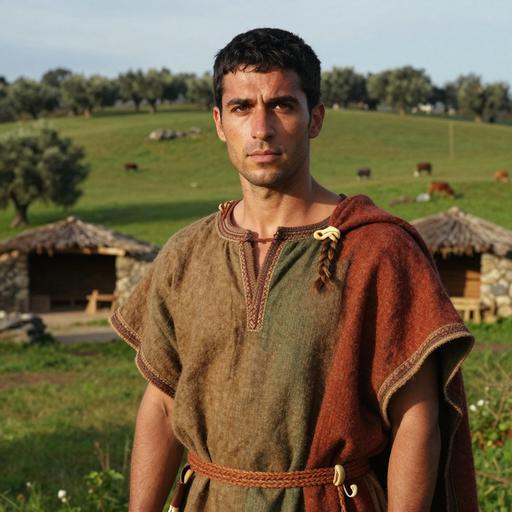
A man buried in Portugal in the Middle Bronze Age era

Download PDF creates a visual, rasterized copy. Use Print for selectable text and better assistive-technology support.

Loading Report

Preparing your ancestry journey

Preparing the available report content...

Your report will open automatically.

Skip to main content
Reference library / Sample profile

A man buried in Portugal in the Middle Bronze Age era

Explore the recorded context, genetic comparisons and research behind this reference sample.

PortugalPortugal MBA

A reference profile describes this sample. It does not establish a personal or family relationship.

AI portrait reconstruction for A man buried in Portugal in the Middle Bronze Age era
AI-generated artistic reconstruction, not a photograph of the individual.
Record

Sample details

Recorded details and available lineage markers.

Individual

Atlantic Bronze Age individual, Portugal

Sample ID: TV3831

Date Range

1800 BCE - 1400 BCE

Cultural Period

Portugal MBA

Biological Sex

Male

mtDNA Haplogroup

H1-d

Y-DNA Haplogroup

R-P312

Social Role

Pastoralist (AI estimate, era-typical)

Geography

Location

Where this individual was discovered

Country Portugal
Locality Torre Velha 3
Coordinates 37.1990, -8.5880
Chronology

Date range

When this individual lived in the broader context of human history

Atlantic Bronze Age individual, Portugal 1800 BCE - 1400 BCE
Context

Historical context

Background information associated with the reference record.

Middle Bronze Age Portugal developed within an Atlantic-focused Bronze Age landscape where metalworking and exchange linked communities across western Iberia.

Region & Environment

Portugal’s productive river valleys and coastal zones offered environments suited to mixed farming and herding. Access to water, pasture, and arable land supported stable communities, while proximity to routes—both coastal and overland—facilitated the movement of goods, including metal and crafted items.

Historical Context

From about the 2nd millennium BCE into the early 1st, western Iberian societies increasingly emphasized bronze artifacts and the networks needed to obtain copper and tin (or copper alloys). The Middle Bronze Age is commonly treated as a period of intensified metallurgy and social differentiation expressed through burial practices and the presence of metal goods.

Populations & Lifeways

Populations likely continued to live in settlements organized around agricultural production and herding. Craft and metal-related activities would have added specialized labor alongside household work. Social life was shaped by community participation in building and ritual activities, with burial contexts serving as key evidence for how identities were maintained and displayed.

Archaeology & Material Culture

Archaeological material for the Middle Bronze Age in Portugal typically includes:

  • pottery forms and domestic debris consistent with established farming settlements
  • lithic tools for daily production, alongside increasing reliance on metal items for some tasks
  • bronze artifacts (where recovered) that signal access to metallurgical expertise and supply chains
  • mortuary evidence that reflects changing norms compared with earlier Copper Age contexts These patterns together indicate that metallurgy and crafted goods became more integrated into social practice rather than remaining rare curiosities.

Culture & Society

Within the Atlantic Bronze Age framework, objects made of bronze and other portable materials could function as markers of status and membership in wider exchange networks. Social organization likely combined household-level production with cooperative frameworks for communal labor and for securing raw materials. Burial assemblages—when present—provide a conservative basis for interpreting differential access to valued goods.

Legacy & Transition

The Middle Bronze Age set the stage for later Late Bronze Age transformations by reinforcing metallurgy, enhancing craft specialization, and sustaining broader regional connections. Over time, these trends contributed to the more complex cultural landscapes of the first millennium BCE in Iberia.

Analysis

Genetic comparisons

These comparisons show genetic similarity, not identity or origin. The populations listed are those whose genomes show statistical alignment to this ancient individual.

Similarity reflects shared history, not shared identity. These are analytical comparisons, not claims about who this person was.

Modern Genetic Admixture

This analysis compares the DNA profile with present-day reference populations, showing statistical similarity to modern reference populations from different regions. The excavation site records where this individual was found, not a fixed modern genetic identity.

Europe 97.2%
Southern European 85.1%
Iberian 40.5%
Italian 24.4%
Sardinian 20.2%
Northwestern European 12.1%
English 7.0%
Northwestern European 4.0%
Scandinavian 1.1%
Oceania 1.7%
Melanesian 1.7%
Papuan 1.7%
Africa 0.9%
North African 0.9%
Egyptian 0.5%

Closest Modern Populations

These are the modern populations showing the closest statistical alignment to A man buried in Portugal in the Middle Bronze Age era, ranked by genetic distance. Lower distance values indicate closer statistical similarity. Cross-region similarity can reflect shared ancestry, population movement, continuity, or later admixture.

1
Spanish La Rioja
3.0281
2
Spanish Burgos
3.4149
3
Spanish Pirineu
3.4582
4
Spanish Castilla La Mancha
3.4656
5
Spanish Aragon
3.4732
6
Spanish Navarra
3.4890
7
Spanish Castello
3.5074
8
Spanish Cantabria
3.5077
9
Spanish Terres De L'ebre
3.5665
10
French Bigorre
3.5757
Context

Related Samples

This individual exists within a broader network of ancient samples. No ancient genome stands alone.

Individual Culture/Period Date Location Action
Western European Neolithic individual, Portugal Middle Neolithic Portugal 4500 BCE Lugar do Canto, Portugal View
Western European Megalithic Culture individual, Portugal Late Neolithic to Chalcolithic Portugal 2500 BCE Cova da Moura, Portugal View
Western European Neolithic individual, Portugal Middle Neolithic Portugal 4500 BCE Lugar do Canto, Portugal View
Western European Megalithic Culture individual, Portugal Late Neolithic to Chalcolithic Portugal 3700 BCE Dolmen de Ansião, Portugal View
Iberian Chalcolithic individual, Portugal Chalcolithic Portugal 3350 BCE Lisbon. Torres Vedras. Cabeço da Arruda I, Portugal View
Western European Neolithic individual, Portugal Middle Neolithic Portugal 4500 BCE Lugar do Canto, Portugal View
Atlantic Bronze Age individual, Portugal Middle Bronze Age Portugal 1728 BCE Monte do Gato de Cima 3, Portugal View
Atlantic Bronze Age individual, Portugal Middle Bronze Age Portugal 1800 BCE Torre Velha 3, Portugal View
Western European Megalithic Culture individual, Portugal Late Neolithic to Chalcolithic Portugal 2500 BCE Cova da Moura, Portugal View
Atlantic Bronze Age individual, Portugal Middle Bronze Age Portugal 1800 BCE Torre Velha 3, Portugal View
Iberian Chalcolithic individual, Portugal Chalcolithic Portugal 3350 BCE Lisbon. Torres Vedras. Cabeço da Arruda I, Portugal View
Atlantic Bronze Age individual, Portugal Middle Bronze Age Portugal 1800 BCE Monte do Vale do Ouro 2, Portugal View
Western European Neolithic individual, Portugal Middle Neolithic Portugal 4500 BCE Lugar do Canto, Portugal View
Western European Megalithic Culture individual, Portugal Late Neolithic to Chalcolithic Portugal 3011 BCE Monte Canelas 1, Portugal View
Iberia Ca individual, Portugal 3350 BCE Lisbon. Torres Vedras. Cabeço da Arruda I, Portugal View
Iberia Ca individual, Portugal 2500 BCE Cova da Moura, Portugal View
Iberia Mln individual, Portugal 3700 BCE Dolmen de Ansião, Portugal View
Iberia Mln individual, Portugal 4500 BCE Lugar do Canto, Portugal View
Iberia Ca individual, Portugal 3011 BCE Monte Canelas 1, Portugal View
Iberia Ba individual, Portugal 1728 BCE Monte do Gato de Cima 3, Portugal View
Iberia Ba individual, Portugal 1800 BCE Torre Velha 3, Portugal View
Iberia Ba individual, Portugal 1800 BCE Monte do Vale do Ouro 2, Portugal View
Page 1
Individual Culture/Period Date Location Action
MBA individual, Portugal Middle Bronze Age Portugal 1700 BCE Setúbal. Melides. Casas Velhas, Portugal View
Atlantic Bronze Age individual, Portugal Middle Bronze Age Portugal 1728 BCE Monte do Gato de Cima 3, Portugal View
Atlantic Bronze Age individual, Portugal Middle Bronze Age Portugal 1800 BCE Torre Velha 3, Portugal View
Atlantic Bronze Age individual, Portugal Middle Bronze Age Portugal 1800 BCE Monte do Vale do Ouro 2, Portugal View
Page 1
Sources

References

Scientific publications and genetic data that inform this profile.

G25 Coordinates

These coordinates represent a position in genetic space, a tool for comparison, not a conclusion. You can use these to perform custom admixture analysis in G25 Studio.

TV3831,0.12107868,0.15579748,0.038988,-0.01438908,0.05471758,-0.00891636,-0.00125776,0.00499274,0.03151262,0.05151366,-0.006717,0.01365652,-0.02383352,-0.0116162,0.00154626,0.00082338,-0.00222286,-0.00100218,-0.00074312,-0.00283122,0.00357944,0.00494074,-0.01153154,-0.01285908,0.00272858
Continue in G25 Studio
Use code for 30% off • Expires Nov 16