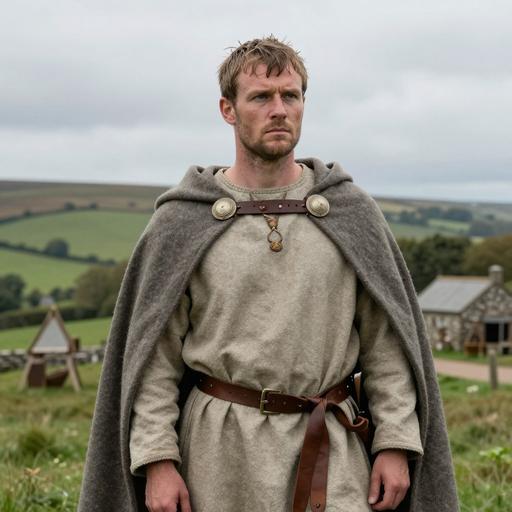
A man buried in United Kingdom in the era

Download PDF creates a visual, rasterized copy. Use Print for selectable text and better assistive-technology support.

Loading Report

Preparing your ancestry journey

Preparing the available report content...

Your report will open automatically.

Skip to main content
Reference library / Sample profile

A man buried in United Kingdom in the era

Explore the recorded context, genetic comparisons and research behind this reference sample.

United KingdomRoman Britain

A reference profile describes this sample. It does not establish a personal or family relationship.

AI portrait reconstruction for A man buried in United Kingdom in the  era
AI-generated artistic reconstruction, not a photograph of the individual.
Record

Sample details

Recorded details and available lineage markers.

Individual

Britain Roman individual, United Kingdom

Sample ID: 6DT23

Date Range

50 CE - 350 CE

Cultural Period

Roman Britain

Biological Sex

Male

mtDNA Haplogroup

H6a1b2

Y-DNA Haplogroup

R-S4268

Social Role

Farmer (AI estimate, era-typical)

Geography

Location

Where this individual was discovered

Country United Kingdom
Locality England. Yorkshire. Driffield Terrace

A location map is not available for this record.

Chronology

Date range

When this individual lived in the broader context of human history

Britain Roman individual, United Kingdom 50 CE - 350 CE
Context

Historical context

Background information associated with the reference record.

Roman Britain refers to the time when Roman authority extended over much of the island and Roman institutions interacted with local societies. The period is understood primarily through archaeology (architecture, coins, and everyday goods) and through later historical sources, where available.

Region & Environment

Britain encompasses diverse environments: from temperate lowlands to uplands and extensive coastlines. Roman infrastructure had to accommodate rainfall variability, rivers and marshy zones, and different patterns of settlement density, with roads and towns shaping movement and provisioning.

Historical Context

Roman involvement began in the mid-1st century CE and continued into the early 5th century CE. Over time, Roman administration, military presence, and economic integration became more visible in many regions, though local practices persisted and varied by area.

Populations & Lifeways

Roman Britain included soldiers, administrators, urban residents, artisans, and rural communities. In cities, many lifeways reflected Roman routines—bathing, markets, and coordinated crafts—while in the countryside local agricultural traditions continued alongside Roman markets. Family and community identities were likely blended in places, but sources and material evidence show substantial regional variation.

Archaeology & Material Culture

Archaeological signatures include Roman-style building materials and construction methods, coin circulation, and imported or imitated goods such as ceramics, glass, and metalwork. Road networks, villas or agrarian estates where identified, and urban amenities (where preserved) provide evidence for changing land use and economic integration. Military installations and artifacts also mark the scale and logistics of Roman presence.

Culture & Society

Roman governance and cultural influence operated through institutions—law, taxation systems, and urban planning—while interactions with indigenous communities shaped local outcomes. Religious diversity is suggested by material traces (such as imported cult objects and variations in burial practices), though interpretations should remain cautious and region-specific.

Legacy & Transition

The Roman period ended in the early 5th century CE, followed by new political configurations across Britain. Roman-era roads, towns, and some building traditions left durable physical and organizational traces that informed later developments, even as administrative systems and imported material flows changed.

Analysis

Genetic comparisons

These comparisons show genetic similarity, not identity or origin. The populations listed are those whose genomes show statistical alignment to this ancient individual.

Similarity reflects shared history, not shared identity. These are analytical comparisons, not claims about who this person was.

Modern Genetic Admixture

This analysis compares the DNA profile with present-day reference populations, showing statistical similarity to modern reference populations from different regions. The excavation site records where this individual was found, not a fixed modern genetic identity.

Europe 96.3%
Northwestern European 68.5%
English 37.4%
Northwestern European 16.7%
Scandinavian 9.6%
Finnish 4.8%
Southern European 20.6%
Iberian 20.6%
Eastern European 7.1%
Asia 3.7%
Northern West Asian 3.7%
Caucasian 2.0%
Cypriot 1.7%

Closest Modern Populations

These are the modern populations showing the closest statistical alignment to A man buried in United Kingdom in the era, ranked by genetic distance. Lower distance values indicate closer statistical similarity. Cross-region similarity can reflect shared ancestry, population movement, continuity, or later admixture.

1
Irish
1.6825
2
Scottish
1.8529
3
Orcadian
1.8955
4
Shetlandic
1.9922
5
Norwegian
2.0995
6
Icelandic
2.1031
7
English
2.2150
8
Welsh
2.2738
9
Danish
2.3002
10
Dutch
2.3765
Context

Related Samples

This individual exists within a broader network of ancient samples. No ancient genome stands alone.

Individual Culture/Period Date Location Action
Celtic individual, United Kingdom Iron Age to Roman England 50 CE England. Yorkshire. Driffield Terrace, United Kingdom View
Anglo-Saxon/Germanic individual, United Kingdom Early Medieval Saxon England 600 CE England. North Yorkshire. Stockton-on-Tees. Norton. Norton Bishops Mill, United Kingdom View
Celtic individual, United Kingdom Iron Age to Roman England 50 CE England. Yorkshire. Driffield Terrace, United Kingdom View
Celtic individual, United Kingdom Iron Age England 210 BCE England. Yorkshire. East Riding. North Ferriby. Melton Quarry, United Kingdom View
England Early Medieval Saxon individual, United Kingdom Early Medieval Saxon England 600 CE Norton East Mill / Bishops Mill (England, North Yorkshire, Stockton-on-Tees, Norton), United Kingdom View
Anglo Saxon individual, United Kingdom 600 CE England. North Yorkshire. Stockton-on-Tees. Norton. Norton Bishops Mill, United Kingdom View
Britain Roman individual, United Kingdom 50 CE England. Yorkshire. Driffield Terrace, United Kingdom View
Britain Ia individual, United Kingdom 210 BCE England. Yorkshire. East Riding. North Ferriby. Melton Quarry, United Kingdom View
Page 1
Individual Culture/Period Date Location Action
Britain Roman individual, United Kingdom 50 CE England. Yorkshire. Driffield Terrace, United Kingdom View
Page 1
Sources

References

Scientific publications and genetic data that inform this profile.

G25 Coordinates

These coordinates represent a position in genetic space, a tool for comparison, not a conclusion. You can use these to perform custom admixture analysis in G25 Studio.

6DT23,0.1297952,0.12905826,0.06055378,0.0495727,0.03439924,0.025474,0.00453188,0.00409836,0.00605926,0.00055574,-0.00148206,0.0062453,-0.01102502,-0.01132102,0.02829334,0.00309414,-0.01459282,0.00859506,0.00048982,0.00386356,0.00290742,-0.00204942,0.0053415,0.01279296,0.00493058
Continue in G25 Studio
Use code for 30% off • Expires Nov 16