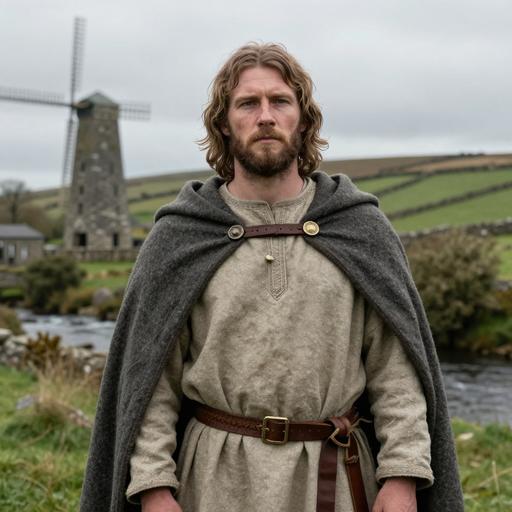
A man buried in United Kingdom in the era

Download PDF creates a visual, rasterized copy. Use Print for selectable text and better assistive-technology support.

Loading Report

Preparing your ancestry journey

Preparing the available report content...

Your report will open automatically.

Skip to main content
Reference library / Sample profile

A man buried in United Kingdom in the era

Explore the recorded context, genetic comparisons and research behind this reference sample.

United KingdomAnglo-Saxon England

A reference profile describes this sample. It does not establish a personal or family relationship.

AI portrait reconstruction for A man buried in United Kingdom in the  era
AI-generated artistic reconstruction, not a photograph of the individual.
Record

Sample details

Recorded details and available lineage markers.

Individual

Anglo Saxon individual, United Kingdom

Sample ID: I17268

Date Range

600 CE - 900 CE

Cultural Period

Anglo-Saxon England

Biological Sex

Male

mtDNA Haplogroup

H1a

Y-DNA Haplogroup

I-DF29

Social Role

Farmer (AI estimate, era-typical)

Geography

Location

Where this individual was discovered

Country United Kingdom
Locality England. North Yorkshire. Stockton-on-Tees. Norton. Norton Bishops Mill

A location map is not available for this record.

Chronology

Date range

When this individual lived in the broader context of human history

Anglo Saxon individual, United Kingdom 600 CE - 900 CE
Context

Historical context

Background information associated with the reference record.

Overview

Anglo-Saxon England covers the period from the formation of early post-Roman kingdoms through their consolidation and transformation, culminating in the events of 1066. It is a historical era best understood through the combination of archaeology and later written sources.

Region & Environment

The focus is England and adjacent areas, characterized by varied landscapes including river valleys, chalk and limestone uplands, and extensive woodland. Environmental conditions supported mixed economies of arable farming and animal husbandry, with many communities positioned to access navigable waterways and fertile soils.

Historical Context

After Roman administration declined, power in Britain increasingly fragmented. Germanic-speaking groups and other incoming communities contributed to the formation of multiple polities, often described in terms of kingdoms. Over time, larger political units emerged, and ecclesiastical institutions expanded, reshaping literacy, record-keeping, and material culture in ways visible in archaeological assemblages.

Populations & Lifeways

Populations were organized into local communities ranging from farming households to larger settlements with specialized craft or administrative functions. Lifeways commonly included cereal cultivation, livestock rearing, and household-based production of everyday goods. Burial practices—such as furnished graves in earlier phases—suggest differences in status and identity, while later changes reflect broader transformations in religion and social organization.

Archaeology & Material Culture

Material culture includes metalwork, weaponry and personal adornment, domestic refuse patterns, and building traditions that vary by region and date. Cemeteries with grave goods, along with cemeteries showing changing burial rites, provide key evidence for shifting practices. Portable finds—especially brooches, buckles, coins, and decorated objects—help track regional connections and chronology. Settlement evidence, including sunken-featured buildings and later forms of domestic and craft activity, supports a picture of changing economic organization.

Culture & Society

Anglo-Saxon societies were layered and dynamic, with local elites displaying status through objects and burial practices. Over time, Christianity spread more broadly, influencing funerary customs, church-related landholding, and the production of art and manuscript culture. Trade and exchange linked communities to wider networks across the North Sea and beyond, visible in distinctive imported or imitation goods.

Legacy & Transition

The era’s legacy lies in the durable cultural and linguistic foundations that shaped medieval England. Archaeologically, the transition to the later medieval period can be tracked through changes in settlement organization, burial practice, and craft production. The political upheaval associated with 1066 marks a clear historical turning point, while earlier centuries had already set many of the patterns visible in subsequent developments.

Analysis

Genetic comparisons

These comparisons show genetic similarity, not identity or origin. The populations listed are those whose genomes show statistical alignment to this ancient individual.

Similarity reflects shared history, not shared identity. These are analytical comparisons, not claims about who this person was.

Modern Genetic Admixture

This analysis compares the DNA profile with present-day reference populations, showing statistical similarity to modern reference populations from different regions. The excavation site records where this individual was found, not a fixed modern genetic identity.

Europe 97.3%
Northwestern European 94.2%
English 41.5%
Scandinavian 30.0%
Northwestern European 13.8%
Finnish 9.0%
Eastern European 3.0%
Asia 1.8%
Northern West Asian 1.4%
Anatolian 1.4%
Oceania 0.6%
Melanesian 0.6%
Papuan 0.6%

Closest Modern Populations

These are the modern populations showing the closest statistical alignment to A man buried in United Kingdom in the era, ranked by genetic distance. Lower distance values indicate closer statistical similarity. Cross-region similarity can reflect shared ancestry, population movement, continuity, or later admixture.

1
Orcadian
1.7261
2
Scottish
1.8933
3
Shetlandic
2.1474
4
Icelandic
2.1524
5
Irish
2.1612
6
Norwegian
2.1626
7
Danish
2.2964
8
English
2.3058
9
Dutch
2.3766
10
English Cornwall
2.4254
Context

Related Samples

This individual exists within a broader network of ancient samples. No ancient genome stands alone.

Individual Culture/Period Date Location Action
Celtic individual, United Kingdom Iron Age to Roman England 50 CE England. Yorkshire. Driffield Terrace, United Kingdom View
Anglo-Saxon/Germanic individual, United Kingdom Early Medieval Saxon England 600 CE England. North Yorkshire. Stockton-on-Tees. Norton. Norton Bishops Mill, United Kingdom View
Celtic individual, United Kingdom Iron Age to Roman England 50 CE England. Yorkshire. Driffield Terrace, United Kingdom View
Celtic individual, United Kingdom Iron Age England 210 BCE England. Yorkshire. East Riding. North Ferriby. Melton Quarry, United Kingdom View
England Early Medieval Saxon individual, United Kingdom Early Medieval Saxon England 600 CE Norton East Mill / Bishops Mill (England, North Yorkshire, Stockton-on-Tees, Norton), United Kingdom View
Anglo Saxon individual, United Kingdom 600 CE England. North Yorkshire. Stockton-on-Tees. Norton. Norton Bishops Mill, United Kingdom View
Britain Roman individual, United Kingdom 50 CE England. Yorkshire. Driffield Terrace, United Kingdom View
Britain Ia individual, United Kingdom 210 BCE England. Yorkshire. East Riding. North Ferriby. Melton Quarry, United Kingdom View
Page 1
Individual Culture/Period Date Location Action
Anglo Saxon individual, United Kingdom 600 CE England. North Yorkshire. Stockton-on-Tees. Norton. Norton Bishops Mill, United Kingdom View
Page 1
Sources

References

Scientific publications and genetic data that inform this profile.

G25 Coordinates

These coordinates represent a position in genetic space, a tool for comparison, not a conclusion. You can use these to perform custom admixture analysis in G25 Studio.

I17268,0.12926198,0.12665836,0.06344064,0.05041856,0.0404481,0.02081178,-4.7E-05,0.00410608,0.00558076,-0.00307794,-0.00564558,0.0029075,-0.010328,-0.00647696,0.02066456,-0.00386786,-0.02048716,0.00288988,1.7E-05,-0.00338248,0.00312856,0.00332688,-0.00282172,0.01476758,0.00089115
Continue in G25 Studio
Use code for 30% off • Expires Nov 16