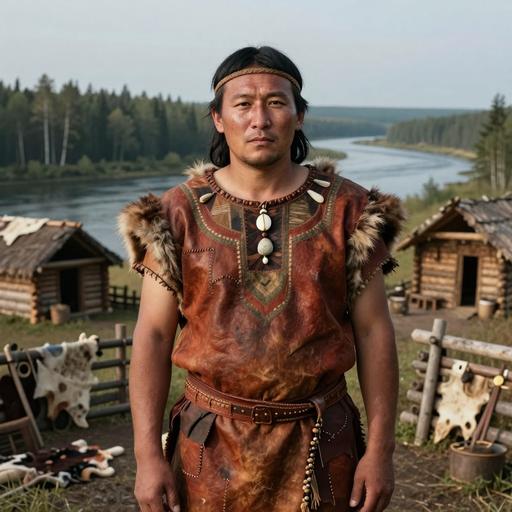
A man buried in Russia in the Early Bronze Age era

Download PDF creates a visual, rasterized copy. Use Print for selectable text and better assistive-technology support.

Loading Report

Preparing your ancestry journey

Preparing the available report content...

Your report will open automatically.

Skip to main content
Reference library / Sample profile

A man buried in Russia in the Early Bronze Age era

Explore the recorded context, genetic comparisons and research behind this reference sample.

RussiaEarly Bronze Age Irkutsk, Siberia, Russia

A reference profile describes this sample. It does not establish a personal or family relationship.

AI portrait reconstruction for A man buried in Russia in the Early Bronze Age era
AI-generated artistic reconstruction, not a photograph of the individual.
Record

Sample details

Recorded details and available lineage markers.

Individual

Irkutsk EBA Irkutsk individual, Russia

Sample ID: GLZ001

Date Range

2838 BCE - 2495 BCE

Cultural Period

Early Bronze Age Irkutsk, Siberia, Russia

Biological Sex

Male

mtDNA Haplogroup

C4j

Y-DNA Haplogroup

C2b1

Social Role

Hunter (AI estimate, era-typical)

Geography

Location

Where this individual was discovered

Country Russia
Locality Siberia. Irkutsk city. Glazkovskoe predmestie
Chronology

Date range

When this individual lived in the broader context of human history

Irkutsk EBA Irkutsk individual, Russia 2838 BCE - 2495 BCE
Context

Historical context

Background information associated with the reference record.

Region & Environment

Eastern Siberia’s Baikal-related environments offered varied habitats—lake and river fisheries, forested zones, and seasonal landscapes. These features supported subsistence strategies centered on hunting and fishing, with movement patterns likely tuned to seasonal availability.

Historical Context

In the Early Bronze Age, technological change in Siberia does not necessarily correspond to urbanism, but it does reflect changing material practices. The Irkutsk phase belongs to broader Siberian Bronze Age developments where metal-related knowledge and evolving craft traditions appear within continuing forager economies.

Populations & Lifeways

Populations likely lived by hunting and fishing, complemented by gathered foods. Settlement was probably semi-mobile, with groups exploiting different ecological niches across the year.

Archaeology & Material Culture

Archaeological evidence for the Irkutsk phase is characterized by ceramics and stone-tool assemblages associated with the Glazkovo complex. Where metal objects occur in regional contexts, they indicate familiarity with bronze or related materials, but the overall material record remains dominated by durable craft equipment and ceramic traditions.

Culture & Society

The Irkutsk cultural label reflects recurring stylistic and technological traits that help define regional horizons. Such consistency implies communication and shared learning among communities operating across the Baikal and adjacent areas.

Legacy & Transition

Chronological changes following the Irkutsk phase involve shifting material styles and adjustments in the regional emphasis of certain technologies. This makes the Irkutsk horizon useful for tracing how local Neolithic traditions developed into later Bronze Age patterns in Eastern Siberia.

Analysis

Genetic comparisons

These comparisons show genetic similarity, not identity or origin. The populations listed are those whose genomes show statistical alignment to this ancient individual.

Similarity reflects shared history, not shared identity. These are analytical comparisons, not claims about who this person was.

Modern Genetic Admixture

This analysis compares the DNA profile with present-day reference populations, showing statistical similarity to modern reference populations from different regions. The excavation site records where this individual was found, not a fixed modern genetic identity.

Asia 95.8%
Northern Asian 63.1%
Siberian 43.3%
Mongolian 19.8%
Chinese & Southeast Asian 16.6%
Tibetan 8.7%
Chinese 7.9%
Japanese & Korean 16.2%
Japanese 16.2%
America 3.6%
America 3.6%
Native American 3.6%
Africa 0.7%
West African 0.7%
Ghanaian, Liberian, Sierra Leonean 0.7%

Closest Modern Populations

These are the modern populations showing the closest statistical alignment to A man buried in Russia in the Early Bronze Age era, ranked by genetic distance. Lower distance values indicate closer statistical similarity. Cross-region similarity can reflect shared ancestry, population movement, continuity, or later admixture.

1
Negidal
5.3819
2
Ulchi
5.5274
3
Nanai
5.7194
4
Khamnegan
6.2751
5
Oroqen
6.3818
6
Nivkh
7.4867
7
Evenk O
8.5258
8
Buryat
8.6686
9
Yukagir Tundra
9.5289
10
Todzin
9.6857
Context

Related Samples

This individual exists within a broader network of ancient samples. No ancient genome stands alone.

Individual Culture/Period Date Location Action
EN Angara individual, Russia Early Neolithic Angara, Siberia, Russia 5373 BCE Siberia. Angara river. Angara, Russia View
Krasnoyarsk Krai EBA individual, Russia Early Bronze Age Tenisei, Siberia, Russia 2879 BCE Siberia. Yenisei river. Bazaikha, Russia View
Irkutsk EBA Irkutsk individual, Russia Early Bronze Age Irkutsk, Siberia, Russia 2838 BCE Siberia. Irkutsk city. Glazkovskoe predmestie, Russia View
EBA Irkutsk individual, Russia Early Bronze Age Irkutsk, Siberia, Russia 2568 BCE Siberia. Irkutsk city. Glazkovskoe predmestie, Russia View
EBA Irkutsk individual, Russia Early Bronze Age Irkutsk, Siberia, Russia 2569 BCE Siberia. Irkutsk city. Glazkovskoe predmestie, Russia View
Irkutsk EN individual, Russia Early Neolithic Lena River, Siberia, Russia 5021 BCE Siberia. Lena river. Iushino, Russia View
Paleo-Siberian individual, Russia Early Neolithic Lena River, Siberia, Russia 4980 BCE Siberia. Lena river. Kachug, Russia View
Irkutsk EBA individual, Russia Early Bronze Age Lena River, Siberia, Russia 1878 BCE Siberia. Lena river. Kachug, Russia View
Irkutsk EBA individual, Russia Early Bronze Age Lena River, Siberia, Russia 1880 BCE Siberia. Upper Lena river. Khaptsagai, Russia View
Siberian individual, Russia Early Bronze Age Lena River, Siberia, Russia 2191 BCE Siberia. Upper Lena river. Khaptsagai, Russia View
Irkutsk EBA individual, Russia Early Bronze Age Lena River, Siberia, Russia 2115 BCE Siberia. Upper Lena river. Khaptsagai, Russia View
Irkutsk EBA individual, Russia Early Bronze Age Lena River, Siberia, Russia 1891 BCE Siberia. Upper Lena river. Khaptsagai, Russia View
Irkutsk EBA-o individual, Russia Early Bronze Age Lena River, Siberia, Russia 2192 BCE Siberia. Upper Lena river. Khaptsagai, Russia View
Irkutsk EBA individual, Russia Early Bronze Age Lena River, Siberia, Russia 1735 BCE Siberia. Upper Lena river. Khaptsagai, Russia View
Paleolithic individual, Russia Upper Paleolithic Siberia, Russia 12100 BCE Siberia. Eastern Siberia. Ust'Kyakhta, Russia View
Irkutsk EBA individual, Russia Early Bronze Age Lena River, Siberia, Russia 2854 BCE Siberia. Lower Lena river. Zhigalovo, Russia View
Irkutsk EBA individual, Russia Early Bronze Age Lena River, Siberia, Russia 4700 BCE Siberia. Lower Lena river. Stepno-Baltaiskii ulus, Russia View
Irkutsk EBA individual, Russia Early Bronze Age Lena River, Siberia, Russia 2200 BCE Siberia. Upper Lena river. Zapleskino, Russia View
Irkutsk EBA individual, Russia Early Bronze Age Lena River, Siberia, Russia 2289 BCE Siberia. Upper Lena river. Zapleskino, Russia View
Siberia Cis Baikal Eba individual, Russia 2191 BCE Siberia. Upper Lena river. Khaptsagai, Russia View
Page 1
Individual Culture/Period Date Location Action
Irkutsk EBA Irkutsk individual, Russia Early Bronze Age Irkutsk, Siberia, Russia 2838 BCE Siberia. Irkutsk city. Glazkovskoe predmestie, Russia View
EBA Irkutsk individual, Russia Early Bronze Age Irkutsk, Siberia, Russia 2568 BCE Siberia. Irkutsk city. Glazkovskoe predmestie, Russia View
EBA Irkutsk individual, Russia Early Bronze Age Irkutsk, Siberia, Russia 2569 BCE Siberia. Irkutsk city. Glazkovskoe predmestie, Russia View
Page 1
Sources

References

Scientific publications and genetic data that inform this profile.

G25 Coordinates

These coordinates represent a position in genetic space, a tool for comparison, not a conclusion. You can use these to perform custom admixture analysis in G25 Studio.

GLZ001,0.03020244,-0.4120986,0.09483378,-0.02519556,-0.07607118,-0.04660184,0.01361466,0.0180586,0.0096193,0.01242184,0.00518998,0.00191898,-0.00060246,-0.00249694,-0.01336604,-0.0153633,-0.00759784,0.01056246,0.01925048,0.0104444,0.02151916,-0.02532898,0.002023,0.00498338,0.01262276
Continue in G25 Studio
Use code for 30% off • Expires Nov 16