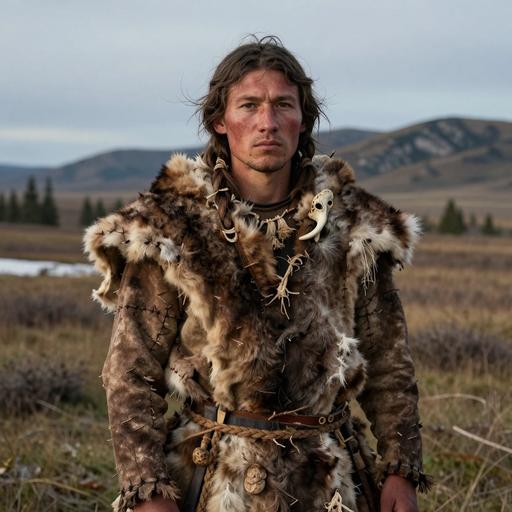
A man buried in Russia in the Pleistocene era

Download PDF creates a visual, rasterized copy. Use Print for selectable text and better assistive-technology support.

Loading Report

Preparing your ancestry journey

Preparing the available report content...

Your report will open automatically.

Skip to main content
Reference library / Sample profile

A man buried in Russia in the Pleistocene era

Explore the recorded context, genetic comparisons and research behind this reference sample.

RussiaUpper Paleolithic Siberia, Russia

A reference profile describes this sample. It does not establish a personal or family relationship.

AI portrait reconstruction for A man buried in Russia in the Pleistocene era
AI-generated artistic reconstruction, not a photograph of the individual.
Record

Sample details

Recorded details and available lineage markers.

Individual

Paleolithic individual, Russia

Sample ID: UKY001

Date Range

12100 BCE - 11858 BCE

Cultural Period

Upper Paleolithic Siberia, Russia

Biological Sex

Male

mtDNA Haplogroup

C4*

Y-DNA Haplogroup

C2b

Social Role

Hunter (AI estimate, era-typical)

Geography

Location

Where this individual was discovered

Country Russia
Locality Siberia. Eastern Siberia. Ust'Kyakhta
Chronology

Date range

When this individual lived in the broader context of human history

Paleolithic individual, Russia 12100 BCE - 11858 BCE
Context

Historical context

Background information associated with the reference record.

Region & Environment

Upper Paleolithic Siberia spans diverse cold environments, with large river systems and extensive forest-tundra mosaics. During the late Pleistocene, temperature swings and shifting habitats affected where animals fed and where people could reliably hunt and travel.

Historical Context

This era belongs to the late stages of Paleolithic development in northern Eurasia. In Siberia, the Upper Paleolithic is characterized by intensive lithic production and broadly flexible subsistence strategies, with regional traditions reflecting local environments rather than a single, uniform way of life.

Populations & Lifeways

Hunter-gatherer groups relied on seasonal movement to track game and to gather plant foods when available. Portable toolkits, prepared stone cores, and retouched implements supported butchery, hide working, and tasks needed for living in cold conditions. Social life is not directly measurable, but repeated use of landscapes and recurring technological patterns imply shared knowledge and learned practices passed through generations.

Archaeology & Material Culture

Archaeological signatures include stone tool assemblages typical of Siberian Upper Paleolithic traditions. Features such as standardized flaking techniques, hunting-related tool forms, and abundant debitage indicate sustained craft and repeated site use. Organic materials are often less visible in the record, but tool categories and site patterns suggest the importance of bone/antler and perishable technologies that usually survive only in favorable conditions.

Culture & Society

Cultural identity in this time is expressed primarily through technology—how stone was quarried, shaped, and maintained. Differences among regional assemblages can reflect varying mobility routes, hunting targets, and local histories, while shared technological understandings point to communication or parallel adaptation across Siberia.

Legacy & Transition

As the Upper Paleolithic ends around the start of the Holocene, environments and resources change, and Siberia transitions into Mesolithic lifeways. The legacy of this period lies in enduring mobility strategies, established lithic traditions, and the deep chronological framework for later regional cultures.

Analysis

Genetic comparisons

These comparisons show genetic similarity, not identity or origin. The populations listed are those whose genomes show statistical alignment to this ancient individual.

Similarity reflects shared history, not shared identity. These are analytical comparisons, not claims about who this person was.

Modern Genetic Admixture

This analysis compares the DNA profile with present-day reference populations, showing statistical similarity to modern reference populations from different regions. The excavation site records where this individual was found, not a fixed modern genetic identity.

Asia 75.8%
Northern Asian 33.3%
Siberian 29.7%
Mongolian 3.6%
Central Asian, Northern Indian & Pakistani 19.8%
Central Asian 16.5%
Indian 3.3%
Japanese & Korean 14.0%
Japanese 14.0%
Chinese & Southeast Asian 8.8%
Tibetan 4.5%
Chinese 4.3%
America 19.0%
America 19.0%
Native American 19.0%
Africa 3.7%
West African 3.7%
Ghanaian, Liberian, Sierra Leonean 3.1%
Oceania 0.8%
Melanesian 0.8%
Papuan 0.8%
Europe 0.8%
Northwestern European 0.8%
Scandinavian 0.8%

Closest Modern Populations

These are the modern populations showing the closest statistical alignment to A man buried in Russia in the Pleistocene era, ranked by genetic distance. Lower distance values indicate closer statistical similarity. Cross-region similarity can reflect shared ancestry, population movement, continuity, or later admixture.

1
Itelmen
11.7493
2
Chukchi
11.8748
3
Altaian
12.0669
4
Altaian Kizhi
12.0799
5
Khakass Kachins
12.0823
6
Mogush
12.1418
7
Greenlander East
12.1478
8
Teleut O
12.3395
9
Eskimo Sireniki
12.5244
10
Mongol Xinjiang
12.7846
Context

Related Samples

This individual exists within a broader network of ancient samples. No ancient genome stands alone.

Individual Culture/Period Date Location Action
EN Angara individual, Russia Early Neolithic Angara, Siberia, Russia 5373 BCE Siberia. Angara river. Angara, Russia View
Krasnoyarsk Krai EBA individual, Russia Early Bronze Age Tenisei, Siberia, Russia 2879 BCE Siberia. Yenisei river. Bazaikha, Russia View
Irkutsk EBA Irkutsk individual, Russia Early Bronze Age Irkutsk, Siberia, Russia 2838 BCE Siberia. Irkutsk city. Glazkovskoe predmestie, Russia View
EBA Irkutsk individual, Russia Early Bronze Age Irkutsk, Siberia, Russia 2568 BCE Siberia. Irkutsk city. Glazkovskoe predmestie, Russia View
EBA Irkutsk individual, Russia Early Bronze Age Irkutsk, Siberia, Russia 2569 BCE Siberia. Irkutsk city. Glazkovskoe predmestie, Russia View
Irkutsk EN individual, Russia Early Neolithic Lena River, Siberia, Russia 5021 BCE Siberia. Lena river. Iushino, Russia View
Paleo-Siberian individual, Russia Early Neolithic Lena River, Siberia, Russia 4980 BCE Siberia. Lena river. Kachug, Russia View
Irkutsk EBA individual, Russia Early Bronze Age Lena River, Siberia, Russia 1878 BCE Siberia. Lena river. Kachug, Russia View
Irkutsk EBA individual, Russia Early Bronze Age Lena River, Siberia, Russia 1880 BCE Siberia. Upper Lena river. Khaptsagai, Russia View
Siberian individual, Russia Early Bronze Age Lena River, Siberia, Russia 2191 BCE Siberia. Upper Lena river. Khaptsagai, Russia View
Irkutsk EBA individual, Russia Early Bronze Age Lena River, Siberia, Russia 2115 BCE Siberia. Upper Lena river. Khaptsagai, Russia View
Irkutsk EBA individual, Russia Early Bronze Age Lena River, Siberia, Russia 1891 BCE Siberia. Upper Lena river. Khaptsagai, Russia View
Irkutsk EBA-o individual, Russia Early Bronze Age Lena River, Siberia, Russia 2192 BCE Siberia. Upper Lena river. Khaptsagai, Russia View
Irkutsk EBA individual, Russia Early Bronze Age Lena River, Siberia, Russia 1735 BCE Siberia. Upper Lena river. Khaptsagai, Russia View
Paleolithic individual, Russia Upper Paleolithic Siberia, Russia 12100 BCE Siberia. Eastern Siberia. Ust'Kyakhta, Russia View
Irkutsk EBA individual, Russia Early Bronze Age Lena River, Siberia, Russia 2854 BCE Siberia. Lower Lena river. Zhigalovo, Russia View
Irkutsk EBA individual, Russia Early Bronze Age Lena River, Siberia, Russia 4700 BCE Siberia. Lower Lena river. Stepno-Baltaiskii ulus, Russia View
Irkutsk EBA individual, Russia Early Bronze Age Lena River, Siberia, Russia 2200 BCE Siberia. Upper Lena river. Zapleskino, Russia View
Irkutsk EBA individual, Russia Early Bronze Age Lena River, Siberia, Russia 2289 BCE Siberia. Upper Lena river. Zapleskino, Russia View
Siberia Cis Baikal Eba individual, Russia 2191 BCE Siberia. Upper Lena river. Khaptsagai, Russia View
Page 1
Individual Culture/Period Date Location Action
Paleolithic individual, Russia Upper Paleolithic Siberia, Russia 12100 BCE Siberia. Eastern Siberia. Ust'Kyakhta, Russia View
Page 1
Sources

References

Scientific publications and genetic data that inform this profile.

G25 Coordinates

These coordinates represent a position in genetic space, a tool for comparison, not a conclusion. You can use these to perform custom admixture analysis in G25 Studio.

UKY001,0.03472928,-0.31501348,0.07705184,0.02551018,-0.07357032,-0.0251761,-0.05028314,-0.05372616,0.00343288,-0.00742866,0.00084526,-0.00503414,0.00830516,-0.01914292,-0.01607778,-0.00791304,-0.0034437,0.007289,0.0200473,0.01362848,0.00540148,-0.01968728,0.00621684,0.01477344,0.02303518
Continue in G25 Studio
Use code for 30% off • Expires Nov 16