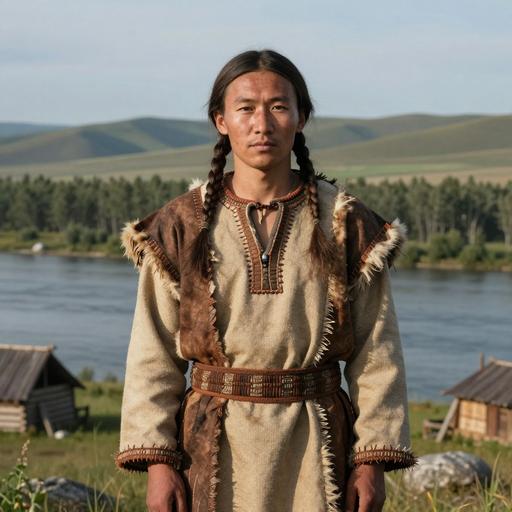
A man buried in Russia in the Early Bronze Age era

Download PDF creates a visual, rasterized copy. Use Print for selectable text and better assistive-technology support.

Loading Report

Preparing your ancestry journey

Preparing the available report content...

Your report will open automatically.

Skip to main content
Reference library / Sample profile

A man buried in Russia in the Early Bronze Age era

Explore the recorded context, genetic comparisons and research behind this reference sample.

RussiaEarly Bronze Age Tenisei, Siberia, Russia

A reference profile describes this sample. It does not establish a personal or family relationship.

AI portrait reconstruction for A man buried in Russia in the Early Bronze Age era
AI-generated artistic reconstruction, not a photograph of the individual.
Record

Sample details

Recorded details and available lineage markers.

Individual

Krasnoyarsk Krai EBA individual, Russia

Sample ID: BZK002

Date Range

2879 BCE - 2633 BCE

Cultural Period

Early Bronze Age Tenisei, Siberia, Russia

Biological Sex

Male

mtDNA Haplogroup

A-a1*

Y-DNA Haplogroup

Q1a2a1c

Social Role

Hunter (AI estimate, era-typical)

Geography

Location

Where this individual was discovered

Country Russia
Locality Siberia. Yenisei river. Bazaikha
Coordinates 55.9903, 92.8510
Chronology

Date range

When this individual lived in the broader context of human history

Krasnoyarsk Krai EBA individual, Russia 2879 BCE - 2633 BCE
Context

Historical context

Background information associated with the reference record.

Region & Environment

In Early Bronze Age Siberia, the Tenisei (Yenisei) landscape combines expansive river valleys, forests, and major waterways that structure travel, hunting, and exchange. Seasonal climates encouraged cyclical movement between resources in the taiga and along river corridors.

Historical Context

Between roughly the third and early second millennia BCE, Siberia participated in broader interregional shifts that include expanding knowledge and availability of copper and tin-bearing materials and the diffusion of bronze technologies. The Tenisei EBA is best understood as a regional expression of these wider metal-using transformations rather than as a single, uniform “state” culture.

Populations & Lifeways

Communities likely included groups practicing hunting and fishing alongside varying degrees of herding and/or farming depending on local conditions and access to resources. Settlement evidence is often patchy at this scale, but the recurring presence of durable toolkits suggests regular maintenance of daily equipment for food procurement, hide processing, and transport.

Archaeology & Material Culture

Archaeological signatures in the Tenisei EBA emphasize metal use and craft. Assemblages commonly include bronze artifacts (where preserved) alongside stone tools, ceramics or ceramic fragments where documented, and bone/antler implements. Cemetery and burial evidence in related steppe-and-forest settings often features how metals and prestige items were curated and displayed, though specifics can vary by site and region.

Culture & Society

The production and movement of metal items implies skilled specialists or at least sustained learning within households or craft networks. Objects made of bronze and other durable materials suggest social differentiation in consumption and the signaling of roles such as craft, ritual leadership, or long-distance linkage.

Legacy & Transition

As the Bronze Age progressed, regional traditions in the Yenisei/Tenisei sphere increasingly intersected with later Siberian developments in metallurgy, burial practice, and long-distance contact. The Tenisei EBA thus forms a bridge between earlier regional lifeways and subsequent periods in which metal culture became more deeply embedded in local social systems.

Analysis

Genetic comparisons

These comparisons show genetic similarity, not identity or origin. The populations listed are those whose genomes show statistical alignment to this ancient individual.

Similarity reflects shared history, not shared identity. These are analytical comparisons, not claims about who this person was.

Modern Genetic Admixture

This analysis compares the DNA profile with present-day reference populations, showing statistical similarity to modern reference populations from different regions. The excavation site records where this individual was found, not a fixed modern genetic identity.

Asia 67.4%
Northern Asian 41.0%
Siberian 36.9%
Mongolian 4.2%
Central Asian, Northern Indian & Pakistani 22.7%
Central Asian 15.7%
Pakistan 4.7%
Indian 2.3%
Japanese & Korean 2.7%
Japanese 2.7%
Chinese & Southeast Asian 1.0%
Chinese 1.0%
America 19.0%
America 19.0%
Native American 19.0%
Europe 13.4%
Eastern European 12.8%
Northwestern European 0.6%
Finnish 0.6%

Closest Modern Populations

These are the modern populations showing the closest statistical alignment to A man buried in Russia in the Early Bronze Age era, ranked by genetic distance. Lower distance values indicate closer statistical similarity. Cross-region similarity can reflect shared ancestry, population movement, continuity, or later admixture.

1
Tlingit
6.8033
2
Ket O1
10.1129
3
Tatar Siberian Zabolotniye
10.1490
4
Tatar Siberian
10.4204
5
Bashkir
10.7108
6
Khanty O1
10.9834
7
Komi B
10.9978
8
Greenlander West
11.2069
9
Mansi
11.6668
10
Yukagir Forest
12.8687
Context

Related Samples

This individual exists within a broader network of ancient samples. No ancient genome stands alone.

Individual Culture/Period Date Location Action
EN Angara individual, Russia Early Neolithic Angara, Siberia, Russia 5373 BCE Siberia. Angara river. Angara, Russia View
Krasnoyarsk Krai EBA individual, Russia Early Bronze Age Tenisei, Siberia, Russia 2879 BCE Siberia. Yenisei river. Bazaikha, Russia View
Irkutsk EBA Irkutsk individual, Russia Early Bronze Age Irkutsk, Siberia, Russia 2838 BCE Siberia. Irkutsk city. Glazkovskoe predmestie, Russia View
EBA Irkutsk individual, Russia Early Bronze Age Irkutsk, Siberia, Russia 2568 BCE Siberia. Irkutsk city. Glazkovskoe predmestie, Russia View
EBA Irkutsk individual, Russia Early Bronze Age Irkutsk, Siberia, Russia 2569 BCE Siberia. Irkutsk city. Glazkovskoe predmestie, Russia View
Irkutsk EN individual, Russia Early Neolithic Lena River, Siberia, Russia 5021 BCE Siberia. Lena river. Iushino, Russia View
Paleo-Siberian individual, Russia Early Neolithic Lena River, Siberia, Russia 4980 BCE Siberia. Lena river. Kachug, Russia View
Irkutsk EBA individual, Russia Early Bronze Age Lena River, Siberia, Russia 1878 BCE Siberia. Lena river. Kachug, Russia View
Irkutsk EBA individual, Russia Early Bronze Age Lena River, Siberia, Russia 1880 BCE Siberia. Upper Lena river. Khaptsagai, Russia View
Siberian individual, Russia Early Bronze Age Lena River, Siberia, Russia 2191 BCE Siberia. Upper Lena river. Khaptsagai, Russia View
Irkutsk EBA individual, Russia Early Bronze Age Lena River, Siberia, Russia 2115 BCE Siberia. Upper Lena river. Khaptsagai, Russia View
Irkutsk EBA individual, Russia Early Bronze Age Lena River, Siberia, Russia 1891 BCE Siberia. Upper Lena river. Khaptsagai, Russia View
Irkutsk EBA-o individual, Russia Early Bronze Age Lena River, Siberia, Russia 2192 BCE Siberia. Upper Lena river. Khaptsagai, Russia View
Irkutsk EBA individual, Russia Early Bronze Age Lena River, Siberia, Russia 1735 BCE Siberia. Upper Lena river. Khaptsagai, Russia View
Paleolithic individual, Russia Upper Paleolithic Siberia, Russia 12100 BCE Siberia. Eastern Siberia. Ust'Kyakhta, Russia View
Irkutsk EBA individual, Russia Early Bronze Age Lena River, Siberia, Russia 2854 BCE Siberia. Lower Lena river. Zhigalovo, Russia View
Irkutsk EBA individual, Russia Early Bronze Age Lena River, Siberia, Russia 4700 BCE Siberia. Lower Lena river. Stepno-Baltaiskii ulus, Russia View
Irkutsk EBA individual, Russia Early Bronze Age Lena River, Siberia, Russia 2200 BCE Siberia. Upper Lena river. Zapleskino, Russia View
Irkutsk EBA individual, Russia Early Bronze Age Lena River, Siberia, Russia 2289 BCE Siberia. Upper Lena river. Zapleskino, Russia View
Siberia Cis Baikal Eba individual, Russia 2191 BCE Siberia. Upper Lena river. Khaptsagai, Russia View
Page 1
Individual Culture/Period Date Location Action
Krasnoyarsk Krai EBA individual, Russia Early Bronze Age Tenisei, Siberia, Russia 2879 BCE Siberia. Yenisei river. Bazaikha, Russia View
Page 1
Sources

References

Scientific publications and genetic data that inform this profile.

G25 Coordinates

These coordinates represent a position in genetic space, a tool for comparison, not a conclusion. You can use these to perform custom admixture analysis in G25 Studio.

BZK002,0.08853624,-0.12767216,0.08277768,0.07313758,-0.04949042,-0.00509904,-0.04836166,-0.04931838,0.00105604,-0.01828068,0.02910944,-0.0099845,0.01642122,-0.03092348,-0.015045,-0.00970392,-0.00422548,0.00105178,-0.00257302,-0.00607604,-0.00589778,0.01794454,0.00983892,-0.00443038,-0.0095921
Continue in G25 Studio
Use code for 30% off • Expires Nov 16