A woman buried in Israel in the Neolithic era

Download PDF creates a visual, rasterized copy. Use Print for selectable text and better assistive-technology support.

Loading Report

Preparing your ancestry journey

Preparing the available report content...

Your report will open automatically.

Skip to main content
Reference library / Sample profile

A woman buried in Israel in the Neolithic era

Explore the recorded context, genetic comparisons and research behind this reference sample.

IsraelPre-Pottery Neolithic B Israel

A reference profile describes this sample. It does not establish a personal or family relationship.

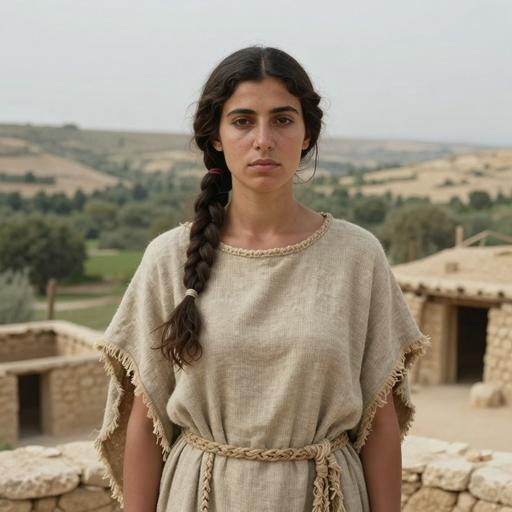
AI portrait reconstruction for A woman buried in Israel in the Neolithic era
AI-generated artistic reconstruction, not a photograph of the individual.
Record

Sample details

Recorded details and available lineage markers.

Individual

PPNB LN individual, Israel

Sample ID: KFH2

Date Range

7728 BCE - 7588 BCE

Cultural Period

Pre-Pottery Neolithic B Israel

Biological Sex

Female

mtDNA Haplogroup

N1a1b

Y-DNA Haplogroup

Not available

Social Role

Laborer (AI estimate, era-typical)

Geography

Location

Where this individual was discovered

Country Israel
Locality Kfar HaHoresh
Coordinates 32.7037, 36.4683
Chronology

Date range

When this individual lived in the broader context of human history

PPNB LN individual, Israel 7728 BCE - 7588 BCE
Context

Historical context

Background information associated with the reference record.

Overview

Pre-Pottery Neolithic B (PPNB) communities in Israel represent settled farming societies that preceded pottery production. Their villages, agricultural routines, and distinctive stone and chipped-stone technologies provide a clear archaeological contrast with earlier Neolithic lifeways.

Region & Environment

In Israel and the broader southern Levant, PPNB communities lived across ecologically varied zones—coastal areas, spring-fed landscapes, and inland valleys where cultivation was feasible. Seasonal rainfall and the availability of arable plots encouraged strategies centered on cereal cultivation, orchard and garden resources where suitable, and ongoing management of water and grazing areas.

Historical Context

PPNB belongs to the regional Neolithic sequence in southwest Asia, when early village life and intensified food production were well established. The time span (roughly 8500–6200 BCE) captures long-term village occupation and gradual regional shifts in settlement organization and material practices, as communities adapted to local environmental opportunities.

Populations & Lifeways

Populations were organized around households living in villages with substantial building traditions. Lifeways likely combined crop cultivation with herding, alongside hunting and gathering activities that complemented farming. Household routines would have included food processing, tool production and maintenance, and daily use of storage spaces—activities reflected indirectly in architecture and tool assemblages.

Archaeology & Material Culture

Archaeologically, PPNB is commonly recognized through features such as substantial building remains, associated chipped-stone tool industries, and domestic activity areas. Lithic assemblages often include pressure-flaked or carefully made stone tools, with emphasis on flint and related stoneworking traditions. While pottery is not a defining feature of the period, other containers and technologies for storage and processing are reflected in the archaeological record.

Culture & Society

PPNB societies were village-based and relatively sedentary, supporting long-term community learning and shared craft practices. Social and cultural expression is visible mainly through consistent building traditions and repeated technological choices in lithic production rather than through pottery styles. Community organization would have been reinforced by cooperation in construction, food production, and maintenance of everyday infrastructure.

Legacy & Transition

As the PPNB sequence progressed toward later Neolithic phases, regional trajectories show changing settlement patterns and technological emphases. The transition to subsequent periods involved broader shifts in material culture and subsistence organization across the Levant, while the underlying reliance on farming and village life remained a strong legacy of earlier Neolithic development.

Analysis

Genetic comparisons

These comparisons show genetic similarity, not identity or origin. The populations listed are those whose genomes show statistical alignment to this ancient individual.
Similarity reflects shared history, not shared identity. These are analytical comparisons, not claims about who this person was.

Modern Genetic Admixture

This analysis compares the DNA profile with present-day reference populations, showing statistical similarity to modern reference populations from different regions. The excavation site records where this individual was found, not a fixed modern genetic identity.

Europe 38.7%
Southern European 38.6%
Sardinian 24.2%
Iberian 14.4%
Asia 38.5%
Arab, Egyptian & Levantine 32.7%
Arabian 31.4%
Levantine 1.3%
Northern West Asian 5.7%
Cypriot 5.7%
Africa 22.8%
North African 22.8%
North African 16.4%
Egyptian 6.4%

Closest Modern Populations

These are the modern populations showing the closest statistical alignment to A woman buried in Israel in the Neolithic era, ranked by genetic distance. Lower distance values indicate closer statistical similarity. Cross-region similarity can reflect shared ancestry, population movement, continuity, or later admixture.

1
Yemenite Amran
6.6123
2
Saudia
6.6260
3
Egyptian Copt
6.6546
4
Samaritan
6.8267
5
Libyan Jew
6.8856
6
Tunisian Jew
6.8980
7
Yemenite Ma'rib
6.8992
8
Yemenite Jew
6.9609
9
Yemenite Dhamar
7.0148
10
Yemenite Al Bayda
7.1054
Context

Related Samples

This individual exists within a broader network of ancient samples. No ancient genome stands alone.

Individual Culture/Period Date Location Action
PPNB LN individual, Jordan Pre-Pottery Neolithic B Jordan 7100 BCE Ba’ja, Jordan View
PPNB LN individual, Israel Pre-Pottery Neolithic B Israel 7728 BCE Kfar HaHoresh, Israel View
Epipaleolithic individual, Turkey Epipaleolithic Turkey 13629 BCE Pınarbaşı, Turkey View
PPN individual, Turkey Neolithic Turkey 8300 BCE Boncuklu, Turkey View
PPN individual, Turkey Neolithic Turkey 8269 BCE Boncuklu, Turkey View
PPN individual, Turkey Neolithic Turkey 8300 BCE Boncuklu, Turkey View
Page 1
Individual Culture/Period Date Location Action
PPNB LN individual, Israel Pre-Pottery Neolithic B Israel 7728 BCE Kfar HaHoresh, Israel View
Page 1
Sources

References

Scientific publications and genetic data that inform this profile.

G25 Coordinates

These coordinates represent a position in genetic space, a tool for comparison, not a conclusion. You can use these to perform custom admixture analysis in G25 Studio.

KFH2,0.06900272,0.1494713,-0.03047994,-0.0952567,0.01375638,-0.04536814,-0.00662072,-0.0014511,0.05345684,0.02129704,0.0084068,-0.01117192,0.0274647,-0.00210146,-0.00480592,0.01430648,-0.01718858,0.00347288,0.007034,0.01143614,0.01556028,0.01621632,-0.01277156,-0.0087777,-0.00326583
Continue in G25 Studio
Use code for 30% off • Expires Nov 16