A man buried in Turkey in the Pleistocene era

Download PDF creates a visual, rasterized copy. Use Print for selectable text and better assistive-technology support.

Loading Report

Preparing your ancestry journey

Preparing the available report content...

Your report will open automatically.

Skip to main content
Reference library / Sample profile

A man buried in Turkey in the Pleistocene era

Explore the recorded context, genetic comparisons and research behind this reference sample.

TurkeyTurkey Epipaleolithic

A reference profile describes this sample. It does not establish a personal or family relationship.

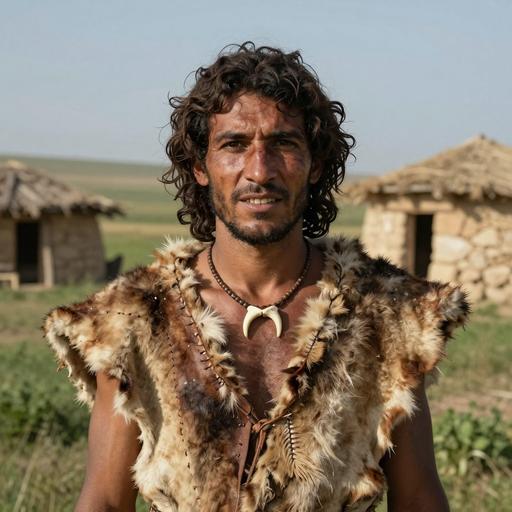
AI portrait reconstruction for A man buried in Turkey in the Pleistocene era
AI-generated artistic reconstruction, not a photograph of the individual.
Record

Sample details

Recorded details and available lineage markers.

Individual

Epipaleolithic individual, Turkey

Sample ID: ZBC

Date Range

13629 BCE - 13308 BCE

Cultural Period

Turkey Epipaleolithic

Biological Sex

Male

mtDNA Haplogroup

K2b

Y-DNA Haplogroup

C-V20

Social Role

Gatherer (AI estimate, era-typical)

Geography

Location

Where this individual was discovered

Country Turkey
Locality Pınarbaşı
Coordinates 37.4833, 33.0333
Chronology

Date range

When this individual lived in the broader context of human history

Epipaleolithic individual, Turkey 13629 BCE - 13308 BCE
Context

Historical context

Background information associated with the reference record.

Region & Environment

In this period, Anatolia experienced changing climatic conditions across the late Pleistocene. Landscapes included forested and open habitats, with resources distributed patchily across coasts, valleys, and upland areas. As conditions fluctuated, hunter-gatherers adjusted movement and subsistence strategies accordingly.

Historical Context

The Epipaleolithic is a broad term for late Pleistocene foraging societies in transition toward later prehistoric developments. In Anatolia, stone tool traditions and settlement evidence indicate continued regional variability rather than a uniform “one culture” across the entire peninsula. This time span precedes the widespread establishment of agricultural villages.

Populations & Lifeways

Populations were primarily hunter-gatherers using diversified diets that would have varied by season and local ecology. Mobility patterns likely ranged from short seasonal movements to longer-range contacts, depending on resource availability and local knowledge. Social learning and shared technological conventions would have supported cooperation within groups.

Archaeology & Material Culture

Archaeological remains for the Epipaleolithic typically focus on stone tools and knapping debris, which document how people procured raw materials and shaped implements. Toolkits often show emphasis on microlithic or small cutting elements in many Epipaleolithic contexts, reflecting functional needs for hunting and processing activities. Preservation varies widely, so reconstructions rely on patterned lithic assemblages and site context.

Culture & Society

Because Epipaleolithic societies lacked writing, culture is best approached through recurring technological and behavioral patterns visible in archaeological assemblages. Regional traditions in stone tool making suggest both learning networks and local adaptations. Sites may represent repeated use of favorable locations, indicating an understanding of landscapes and seasonal resources.

Legacy & Transition

The Epipaleolithic forms part of the long sequence leading toward the Neolithic. Over time, changing climates and resource landscapes contributed to shifts in settlement and technology, creating conditions for later experimentation with new subsistence strategies. The transition to farming is not instantaneous, and evidence for that shift appears later in the Anatolian archaeological sequence.

Analysis

Genetic comparisons

These comparisons show genetic similarity, not identity or origin. The populations listed are those whose genomes show statistical alignment to this ancient individual.

Similarity reflects shared history, not shared identity. These are analytical comparisons, not claims about who this person was.

Modern Genetic Admixture

This analysis compares the DNA profile with present-day reference populations, showing statistical similarity to modern reference populations from different regions. The excavation site records where this individual was found, not a fixed modern genetic identity.

Europe 87.5%
Southern European 87.5%
Italian 41.7%
Sardinian 27.0%
Iberian 18.4%
Asia 9.3%
Northern West Asian 6.2%
Cypriot 6.2%
Arab, Egyptian & Levantine 3.1%
Arabian 3.1%
Africa 3.2%
North African 3.2%
North African 3.2%

Closest Modern Populations

These are the modern populations showing the closest statistical alignment to A man buried in Turkey in the Pleistocene era, ranked by genetic distance. Lower distance values indicate closer statistical similarity. Cross-region similarity can reflect shared ancestry, population movement, continuity, or later admixture.

1
Sardinian
3.6559
2
French Corsica
6.7306
3
Belmonte Jew
6.8343
4
Italian Lazio
7.6031
5
Italian Umbria
7.8820
6
Sicilian West
7.9170
7
Italian Campania
8.1715
8
Sicilian East
8.2064
9
Italian Lombardy
8.2474
10
Italian Calabria
8.2579
Context

Related Samples

This individual exists within a broader network of ancient samples. No ancient genome stands alone.
Individual Culture/Period Date Location Action
PPNB LN individual, Jordan Pre-Pottery Neolithic B Jordan 7100 BCE Ba’ja, Jordan View
PPNB LN individual, Israel Pre-Pottery Neolithic B Israel 7728 BCE Kfar HaHoresh, Israel View
Epipaleolithic individual, Turkey Epipaleolithic Turkey 13629 BCE Pınarbaşı, Turkey View
PPN individual, Turkey Neolithic Turkey 8300 BCE Boncuklu, Turkey View
PPN individual, Turkey Neolithic Turkey 8269 BCE Boncuklu, Turkey View
PPN individual, Turkey Neolithic Turkey 8300 BCE Boncuklu, Turkey View
Page 1
Individual Culture/Period Date Location Action
Epipaleolithic individual, Turkey Epipaleolithic Turkey 13629 BCE Pınarbaşı, Turkey View
Page 1
Sources

References

Scientific publications and genetic data that inform this profile.

G25 Coordinates

These coordinates represent a position in genetic space, a tool for comparison, not a conclusion. You can use these to perform custom admixture analysis in G25 Studio.

ZBC,0.11030028,0.15964142,0.00955932,-0.0589955,0.04975592,-0.02832632,-0.00357276,0.00380842,0.04162794,0.06598822,-0.00132102,0.01080082,-0.01792252,-0.01293416,-0.01316964,0.00680248,0.01292094,0.00073076,0.00102498,-0.00234646,0.00076202,0.00544316,-0.01191274,-0.01815636,0.00354531
Continue in G25 Studio
Use code for 30% off • Expires Nov 16