A woman buried in South Korea in the Late Antiquity era

Download PDF creates a visual, rasterized copy. Use Print for selectable text and better assistive-technology support.

Loading Report

Preparing your ancestry journey

Preparing the available report content...

Your report will open automatically.

Skip to main content
Reference library / Sample profile

A woman buried in South Korea in the Late Antiquity era

Explore the recorded context, genetic comparisons and research behind this reference sample.

South KoreaThree Kingdoms Period Yuha-ri, Gimhae, South Korea

A reference profile describes this sample. It does not establish a personal or family relationship.

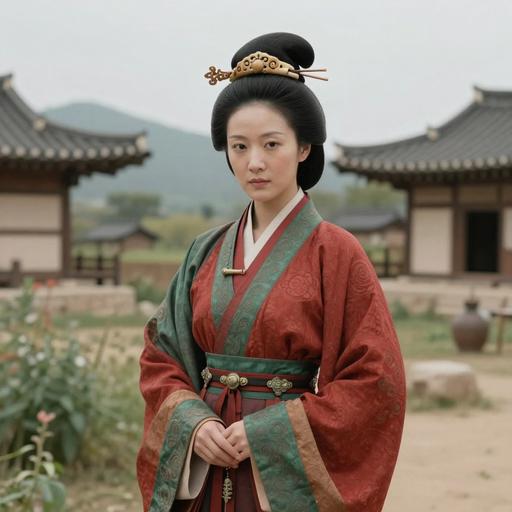
AI portrait reconstruction for A woman buried in South Korea in the Late Antiquity era
AI-generated artistic reconstruction, not a photograph of the individual.
Record

Sample details

Recorded details and available lineage markers.

Individual

Republicof Korea Three Kingdoms individual, South Korea

Sample ID: AKG_3420

Date Range

300 CE - 500 CE

Cultural Period

Three Kingdoms Period Yuha-ri, Gimhae, South Korea

Biological Sex

Female

mtDNA Haplogroup

D4a1

Y-DNA Haplogroup

Not available

Social Role

Farmer (AI estimate, era-typical)

Geography

Location

Where this individual was discovered

Country South Korea
Locality Gyeongsangnam-do. Yuha-ri
Chronology

Date range

When this individual lived in the broader context of human history

Republicof Korea Three Kingdoms individual, South Korea 300 CE - 500 CE
Context

Historical context

Background information associated with the reference record.

The Three Kingdoms Period in Korean history, lasting from 57 BCE to 668 CE, is a significant era marked by the rule of the three rival kingdoms of Goguryeo, Baekje, and Silla, along with the Gaya confederation. Within this context, the Yuha-ri region in Gimhae, South Korea, provides a compelling glimpse into the cultural and historical dynamics of the period, especially in relation to the Gaya confederation.

Historical Context

Gimhae, located in the southeastern part of the Korean Peninsula, was a prominent area associated with the Gaya Confederation. This confederation differed somewhat from the other kingdoms as it was not a centralized monarchy but rather a collective of small polities or states. Among these, Geumgwan Gaya was the most influential and is considered the central polity, forming the economic and political heart of Gaya.

The Culture of Gaya and Yuha-ri

Politics and Society

The Gaya Confederation, including regions like Yuha-ri, functioned with a distinct political structure characterized by a network-based organization rather than centralized monarchy. The political alliances were often secured through marriages and trade agreements, with power being distributed among various ruling clans. The chiefs of these polities wielded considerable authority and often collaborated to resist external pressures from larger state entities such as Silla and Baekje.

Economy and Trade

The Gaya states, and particularly the region of Yuha-ri in Gimhae, were renowned for their rich iron resources. Gaya iron works played a pivotal role in the economy, producing tools and weapons that were among the most advanced in East Asia at the time. The proficiency in metallurgy made Gaya an important trade hub, facilitating the exchange of goods and culture throughout the Korean Peninsula, Japan, and even parts of China.

Art and Material Culture

The artistic expression of the Three Kingdoms Period, including that of Yuha-ri, was heavily influenced by both indigenous traditions and external contacts through trade. Iron and pottery works are particularly significant, with Gaya known for its distinctive style of pottery characterized by grayish-black or gray-colored ware. Artifacts such as burial goods, decorative items, and weaponry provide insights into the aesthetics and technological sophistication of the period.

Religion and Beliefs

During the Three Kingdoms Period, shamanistic practices were prevalent across the Korean Peninsula, and Gaya was no exception. The people of Yuha-ri likely practiced indigenous spiritual traditions involving ancestral worship and shamanism, with a focus on nature and agricultural rites. As with other regions influenced by Chinese culture during this time, Buddhism began to make inroads into the region, though it was not as pronounced as in the neighboring kingdoms of Silla and Baekje.

Burial Practices

Archaeological findings from burial sites in Yuha-ri have shed light on the mortuary customs of the Gaya people. The tombs, typically constructed with stone chambers, were often filled with burial goods that reflected the individual's status and role within society. Such items included iron weapons, horse trappings, pottery, and various ornaments, highlighting both the practical and ceremonial aspects of their culture.

Conclusion

Yuha-ri in Gimhae during the Three Kingdoms Period provides a fascinating lens through which to explore the Gaya Confederation’s contributions to the cultural tapestry of early Korean history. Its role as an iron production center and a nexus of trade underscored its regional importance, while its distinct social structures and cultural achievements contributed to the broader narrative of the Three Kingdoms Period. This era remains a crucial part of understanding the development of Korean identity and cultural heritage.

Analysis

Genetic comparisons

These comparisons show genetic similarity, not identity or origin. The populations listed are those whose genomes show statistical alignment to this ancient individual.

Similarity reflects shared history, not shared identity. These are analytical comparisons, not claims about who this person was.

Modern Genetic Admixture

This analysis compares the DNA profile with present-day reference populations, showing statistical similarity to modern reference populations from different regions. The excavation site records where this individual was found, not a fixed modern genetic identity.

Asia 99.2%
Chinese & Southeast Asian 45.0%
Chinese 45.0%
Japanese & Korean 39.7%
Japanese 39.7%
Northern Asian 11.8%
Mongolian 11.3%
Siberian 0.5%
Central Asian, Northern Indian & Pakistani 2.1%
Indian 2.1%
Arab, Egyptian & Levantine 0.6%
Africa 0.8%
West African 0.8%
Nigerian 0.8%

Closest Modern Populations

These are the modern populations showing the closest statistical alignment to A woman buried in South Korea in the Late Antiquity era, ranked by genetic distance. Lower distance values indicate closer statistical similarity. Cross-region similarity can reflect shared ancestry, population movement, continuity, or later admixture.
1
Manchu
2.4116
2
Manchu Jinzhou
2.4560
3
Han Shandong
2.6648
4
Korean Antu
2.7654
5
Korean
2.8044
6
Manchu Liaoning
2.8713
7
Han Shanxi
2.9054
8
Han Henan
2.9350
9
Yugur
3.7828
10
Han Jiangsu
3.7830
Context

Related Samples

This individual exists within a broader network of ancient samples. No ancient genome stands alone.

Individual Culture/Period Date Location Action
Republicof Korea Three Kingdoms individual, South Korea The Three Kingdoms of Korea 300-500 CE Gyeongsangnam-do. Daeseong-dong, South Korea View
Republicof Korea Three Kingdoms individual, South Korea Three Kingdoms Period Yuha-ri, Gimhae, South Korea 300-500 CE Gyeongsangnam-do. Yuha-ri, South Korea View
Republicof Korea Three Kingdoms individual, South Korea The Three Kingdoms of Korea 300-500 CE Gyeongsangnam-do. Daeseong-dong, South Korea View
Page 1
Individual Culture/Period Date Location Action
Republicof Korea Three Kingdoms individual, South Korea Three Kingdoms Period Yuha-ri, Gimhae, South Korea 300-500 CE Gyeongsangnam-do. Yuha-ri, South Korea View
Page 1
Sources

References

Scientific publications and genetic data that inform this profile.

G25 Coordinates

These coordinates represent a position in genetic space, a tool for comparison, not a conclusion. You can use these to perform custom admixture analysis in G25 Studio.

AKG_3420,0.01727048,-0.44027618,0.00741548,-0.05818022,0.04327078,0.01498646,0.00465656,0.003927,-0.00659324,0.00534328,-0.05915304,-0.00663972,0.0083617,-0.00938444,-0.00763478,-0.00262188,0.00105588,0.00109322,0.0015419,-0.00609034,0.01553744,-0.00354688,0.00936094,0.00226702,-0.01057401
Continue in G25 Studio

Our analyses use reference samples for comparison. A sample’s place, period and source help explain how to interpret a match.

Use code for 35% off • Expires Nov 30