
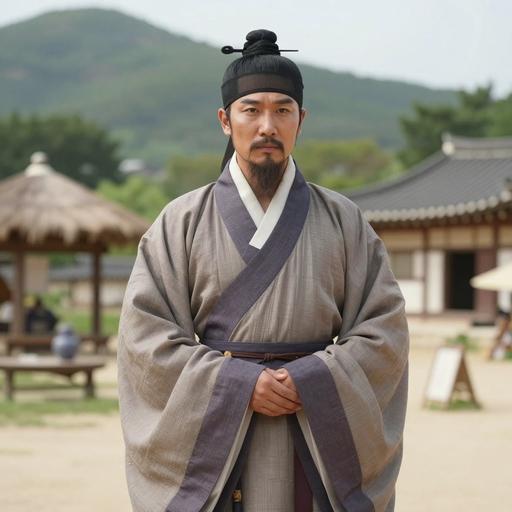
A man buried in South Korea in the Late Antiquity era

Download PDF creates a visual, rasterized copy. Use Print for selectable text and better assistive-technology support.

Loading Report

Preparing your ancestry journey

Preparing the available report content...

Your report will open automatically.

Skip to main content
Reference library / Sample profile

A man buried in South Korea in the Late Antiquity era

Explore the recorded context, genetic comparisons and research behind this reference sample.

South KoreaThe Three Kingdoms of Korea

A reference profile describes this sample. It does not establish a personal or family relationship.

AI portrait reconstruction for A man buried in South Korea in the Late Antiquity era
AI-generated artistic reconstruction, not a photograph of the individual.
Record

Sample details

Recorded details and available lineage markers.

Individual

Republicof Korea Three Kingdoms individual, South Korea

Sample ID: AKG_10218

Date Range

300 CE - 500 CE

Cultural Period

The Three Kingdoms of Korea

Biological Sex

Male

mtDNA Haplogroup

D4a1

Y-DNA Haplogroup

O-FGC50558

Social Role

Farmer (AI estimate, era-typical)

Geography

Location

Where this individual was discovered

Country South Korea
Locality Gyeongsangnam-do. Daeseong-dong
Chronology

Date range

When this individual lived in the broader context of human history

Republicof Korea Three Kingdoms individual, South Korea 300 CE - 500 CE
Context

Historical context

Background information associated with the reference record.

Region & Environment

The Three Kingdoms of Korea developed in the peninsula of Korea and its surrounding waters. Coastal areas supported farming, fishing, and transport, while inland valleys and river basins provided arable land and routes for movement of people and goods.

Historical Context

Between the late first millennium BCE and the early centuries CE, power shifted through the growth and consolidation of competing polities. Over time, three major kingdoms—commonly identified as Goguryeo, Baekje, and Silla—rose to prominence through warfare, diplomacy, and control of strategic routes. Their rivalry encouraged fortification, intensified production, and increasing political centralization.

Populations & Lifeways

Communities relied primarily on agriculture, with rice cultivation in suitable lowlands and complementary exploitation of upland resources. Households also participated in fishing and collection of forest products in appropriate regions. Lifeways were shaped by increasing social stratification, visible in differences in burial treatment, access to prestige goods, and settlement size.

Archaeology & Material Culture

Archaeological remains include fortified settlement sites, tombs, craft-related features, and domestic structures. Metalwork—particularly iron implements and fittings—was important for agriculture, construction, and weaponry. Pottery traditions varied by region and period, reflecting local identities and changing tastes; ceramic styles can help track regional interactions and broader cultural trends. Evidence of specialized production (for example, for metal and ceramics) indicates the growth of organized craft and supply.

Culture & Society

Elite society is most clearly seen through mortuary practices and the placement of grave goods. Differential access to valued objects suggests ranked communities and patronage networks. Monumental construction and standardized material forms in some contexts point to collective practices organized at larger-than-household scales.

Legacy & Transition

By the end of the Three Kingdoms period, these competing states were drawn into a sequence of conflicts that ultimately reshaped political control over the peninsula. The archaeological record preserves the long-term development of institutions, technologies, and regional connections that provided the foundation for later unification and subsequent historical eras.

Analysis

Genetic comparisons

These comparisons show genetic similarity, not identity or origin. The populations listed are those whose genomes show statistical alignment to this ancient individual.

Similarity reflects shared history, not shared identity. These are analytical comparisons, not claims about who this person was.

Modern Genetic Admixture

This analysis compares the DNA profile with present-day reference populations, showing statistical similarity to modern reference populations from different regions. The excavation site records where this individual was found, not a fixed modern genetic identity.

Asia 95.4%
Chinese & Southeast Asian 52.5%
Chinese 52.5%
Japanese & Korean 27.1%
Japanese 27.1%
Northern Asian 15.2%
Mongolian 11.6%
Siberian 3.6%
Arab, Egyptian & Levantine 0.6%
Arabian 0.6%
Africa 3.0%
West African 3.0%
Senegambian & Guinean 2.7%
Europe 1.7%
Southern European 1.7%
Sardinian 1.6%

Closest Modern Populations

These are the modern populations showing the closest statistical alignment to A man buried in South Korea in the Late Antiquity era, ranked by genetic distance. Lower distance values indicate closer statistical similarity. Cross-region similarity can reflect shared ancestry, population movement, continuity, or later admixture.

1
Korean
3.4282
2
Korean Antu
3.4349
3
Manchu
3.4544
4
Manchu Jinzhou
3.5523
5
Han Shanxi
3.8179
6
Japanese
3.8763
7
Han Shandong
3.8830
8
Han Henan
3.8985
9
Yugur
3.9790
10
Manchu Liaoning
4.0214
Context

Related Samples

This individual exists within a broader network of ancient samples. No ancient genome stands alone.

Individual Culture/Period Date Location Action
Republicof Korea Three Kingdoms individual, South Korea The Three Kingdoms of Korea 300-500 CE Gyeongsangnam-do. Daeseong-dong, South Korea View
Republicof Korea Three Kingdoms individual, South Korea Three Kingdoms Period Yuha-ri, Gimhae, South Korea 300-500 CE Gyeongsangnam-do. Yuha-ri, South Korea View
Republicof Korea Three Kingdoms individual, South Korea The Three Kingdoms of Korea 300-500 CE Gyeongsangnam-do. Daeseong-dong, South Korea View
Page 1
Individual Culture/Period Date Location Action
Republicof Korea Three Kingdoms individual, South Korea The Three Kingdoms of Korea 300-500 CE Gyeongsangnam-do. Daeseong-dong, South Korea View
Page 1
Sources

References

Scientific publications and genetic data that inform this profile.

G25 Coordinates

These coordinates represent a position in genetic space, a tool for comparison, not a conclusion. You can use these to perform custom admixture analysis in G25 Studio.

AKG_10218,0.02114188,-0.43112786,0.0110092,-0.05922562,0.0432988,0.01202286,0.00498418,0.00349852,-0.00551268,0.0079713,-0.05532202,-0.00555154,0.00769396,-0.01060022,-0.00868378,-0.00218118,0.00064236,1.036E-05,0.00289408,-0.00497498,0.0158566,-0.00832078,0.00664268,0.0030327,-0.01766156
Continue in G25 Studio

Our analyses use reference samples for comparison. A sample’s place, period and source help explain how to interpret a match.

Use code for 35% off • Expires Nov 30