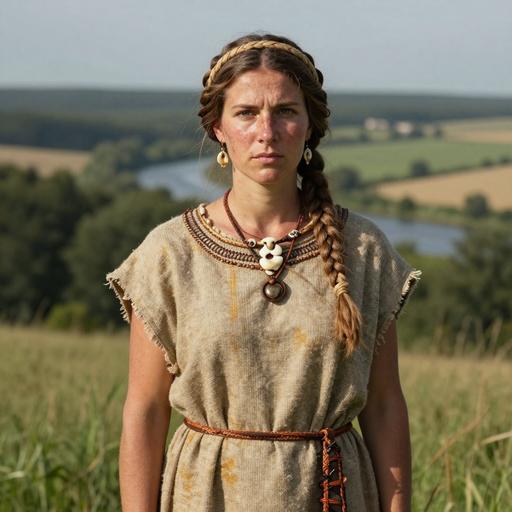
A woman buried in Poland in the Late Neolithic to Early Bronze Age era

Download PDF creates a visual, rasterized copy. Use Print for selectable text and better assistive-technology support.

Loading Report

Preparing your ancestry journey

Preparing the available report content...

Your report will open automatically.

Skip to main content
Reference library / Sample profile

A woman buried in Poland in the Late Neolithic to Early Bronze Age era

Explore the recorded context, genetic comparisons and research behind this reference sample.

PolandGlobular Amphora Culture Koszyce, Poland

A reference profile describes this sample. It does not establish a personal or family relationship.

AI portrait reconstruction for A woman buried in Poland in the Late Neolithic to Early Bronze Age era
AI-generated artistic reconstruction, not a photograph of the individual.
Record

Sample details

Recorded details and available lineage markers.

Individual

Indo-European individual, Poland

Sample ID: RISE1170

Date Range

2900 BCE - 2696 BCE

Cultural Period

Globular Amphora Culture Koszyce, Poland

Biological Sex

Female

mtDNA Haplogroup

K1a1b1e

Y-DNA Haplogroup

Not available

Social Role

Farmer (AI estimate, era-typical)

Geography

Location

Where this individual was discovered

Country Poland
Locality Koszyce. site 3
Coordinates 50.1701, 20.5790
Chronology

Date range

When this individual lived in the broader context of human history

Indo-European individual, Poland 2900 BCE - 2696 BCE
Context

Historical context

Background information associated with the reference record.

The Globular Amphora Culture (GAC) was a Neolithic culture that flourished in Central and Eastern Europe between approximately 3400 and 2800 BCE. This culture is noted for its distinctive pottery, characterized by its spherical or globular-shaped vessels. The Globular Amphora Culture is considered part of the larger tradition of Neolithic cultures in Europe and is often studied in the context of prehistoric developments preceding the Indo-European migrations.

Geography and Distribution

The Globular Amphora Culture stretched across a considerable swath of Europe, with sites found in present-day Poland, Germany, the Czech Republic, Ukraine, and other parts of Eastern and Central Europe. In Poland, some of the most prominent archaeological findings attributed to this culture have been unearthed, including the site at Koszyce.

Koszyce Site

Koszyce, located in southern Poland, has become a focal point of study due to a unique and significant archaeological discovery. The site revealed a mass grave that provides a snapshot into the cultural practices and societal structure of the Globular Amphora Culture. This burial site is noted for the communal and family structures inferred from the remains, as well as the grave goods associated with them, offering insight into their social hierarchy and cultural values.

Pottery and Material Culture

The hallmark of the Globular Amphora Culture is its pottery. The vessels often feature cord-impressed designs and are typically large, round, and robust, with handles and sometimes adorned with zoomorphic motifs. These ceramics were possibly used for storing and fermenting substances, indicating a level of sophistication in food preparation and storage.

Apart from pottery, the Globular Amphora Culture is also recognized for its tools and weapons made from flint and other stones. Axes and chisels made from stone or copper suggest a society proficient in crafting tools essential for agriculture and woodworking.

Economy and Subsistence

The Globular Amphora Culture was primarily agrarian, with evidence suggesting that they practiced mixed farming. They grew crops such as wheat, barley, and legumes and raised domesticated animals, including cattle, pigs, and sheep. The use of draft animals is suggested by remains that show wear indicative of harnessing, pointing to advanced agrarian techniques.

Cultural and Social Structure

The discovery at Koszyce provides critical insights into the culture's social and familial structures. It suggests a communal society with familial ties being significant in their societal organization. The presence of grave goods, including pottery and tools within burial contexts, suggests a belief in an afterlife or the significance of status and identity in the afterlife.

Religion and Rituals

Religious and ritualistic behaviors are difficult to fully reconstruct, but burial practices provide clues. The careful positioning of bodies, often accompanied by grave goods, indicates ritual significance linked to burial and death. It suggests an early form of ancestor veneration or a belief system concerning the afterlife.

Linguistic and Genetic Considerations

The Globular Amphora Culture existed during a time of significant demographic and cultural shifts in Europe, a prelude to the later Indo-European migrations. Genetic studies of remains from the Koszyce site and others have revealed insights into population dynamics, showing that these groups were part of a larger tapestry of prehistoric cultures that would eventually contribute to the genetic and cultural makeup of European populations.

Interaction with Surrounding Cultures

The Globular Amphora Culture coexisted and interacted with other contemporary cultures, such as the Funnelbeaker Culture. This interaction was likely through trade, warfare, and cultural exchange, contributing to the diffusion of ideas and technologies across regions.

In summary, the Globular Amphora Culture, exemplified by the findings at Koszyce in Poland, serves as a significant chapter in the prehistoric narrative of Europe. It provides valuable insights into the social structures, economic practices, and cultural expressions of Neolithic societies in Central and Eastern Europe during a period that set the stage for subsequent cultural and linguistic developments in the region.

Analysis

Genetic comparisons

These comparisons show genetic similarity, not identity or origin. The populations listed are those whose genomes show statistical alignment to this ancient individual.

Similarity reflects shared history, not shared identity. These are analytical comparisons, not claims about who this person was.

Modern Genetic Admixture

This analysis compares the DNA profile with present-day reference populations, showing statistical similarity to modern reference populations from different regions. The excavation site records where this individual was found, not a fixed modern genetic identity.

Europe 100.0%
Southern European 87.8%
Iberian 43.8%
Italian 26.3%
Sardinian 17.7%
Northwestern European 12.2%
Northwestern European 7.3%
Scandinavian 5.0%

Closest Modern Populations

These are the modern populations showing the closest statistical alignment to A woman buried in Poland in the Late Neolithic to Early Bronze Age era, ranked by genetic distance. Lower distance values indicate closer statistical similarity. Cross-region similarity can reflect shared ancestry, population movement, continuity, or later admixture.

1
Sardinian
4.2808
2
Spanish La Rioja
4.4670
3
Spanish Castilla La Mancha
4.8177
4
Spanish Pirineu
4.8702
5
Spanish Castello
4.8716
6
Spanish Aragon
4.8975
7
French Corsica
4.9124
8
Spanish Burgos
4.9167
9
Spanish Navarra
4.9211
10
Spanish Cantabria
4.9269
Context

Related Samples

This individual exists within a broader network of ancient samples. No ancient genome stands alone.

Individual Culture/Period Date Location Action
Indo-European individual, Poland Globular Amphora Culture Koszyce, Poland 2891 BCE Koszyce. site 3, Poland View
Indo-European individual, Poland Globular Amphora Culture Koszyce, Poland 2900 BCE Koszyce. site 3, Poland View
Indo-European individual, Poland Globular Amphora Culture Koszyce, Poland 2912 BCE Koszyce. site 3, Poland View
Indo-European individual, Poland Globular Amphora Culture Koszyce, Poland 3072 BCE Koszyce. site 3, Poland View
Indo-European individual, Poland Globular Amphora Culture Koszyce, Poland 2872 BCE Koszyce. site 3, Poland View
Indo-European individual, Poland Globular Amphora Culture Koszyce, Poland 2875 BCE Koszyce. site 3, Poland View
Indo-European individual, Poland Globular Amphora Culture Koszyce, Poland 2884 BCE Koszyce. site 3, Poland View
Indo-European individual, Poland Globular Amphora Culture Koszyce, Poland 3004 BCE Koszyce. site 3, Poland View
Indo-European individual, Poland Globular Amphora Culture Koszyce, Poland 2872 BCE Koszyce. site 3, Poland View
Indo-European individual, Poland Globular Amphora Culture Koszyce, Poland 2886 BCE Koszyce. site 3, Poland View
Indo-European individual, Poland Globular Amphora Culture Koszyce, Poland 2906 BCE Koszyce. site 3, Poland View
Indo-European individual, Poland Globular Amphora Culture Koszyce, Poland 2892 BCE Koszyce. site 3, Poland View
Indo-European individual, Poland Globular Amphora Culture Koszyce, Poland 2915 BCE Koszyce. site 3, Poland View
Indo-European individual, Poland Globular Amphora Culture Koszyce, Poland 2580 BCE Koszyce. site 3, Poland View
Indo-European individual, Poland Globular Amphora Culture Koszyce, Poland 2905 BCE Koszyce. site 3, Poland View
Indo-European individual, Poland Globular Amphora Culture Ksiaznice, Poland 2905 BCE Ksiaznice. site 2, Poland View
Indo-European individual, Poland Globular Amphora Culture Sandomierz, Poland 2901 BCE Sandomierz. site 78, Poland View
Indo-European individual, Poland Globular Amphora Culture Ksiaznice, Poland 2950 BCE Ksiaznice. site 2, Poland View
Indo-European individual, Poland Globular Amphora Culture Sandomierz, Poland 2950 BCE Sandomierz. site 78, Poland View
Indo-European individual, Poland Globular Amphora Culture Ksiaznice, Poland 2895 BCE Ksiaznice. site 2, Poland View
Indo-European individual, Poland Globular Amphora Culture Wilczyce, Poland 3100 BCE Wilczyce. site 90, Poland View
Indo-European individual, Poland Globular Amphora Culture Mierzanowice, Poland 3100 BCE Mierzanowice. site 1. grave 3, Poland View
Indo-European individual, Poland Globular Amphora Culture Ksiaznice, Poland 2950 BCE Ksiaznice. site 2, Poland View
Globular Amphora individual, Poland 2884 BCE Koszyce. site 3, Poland View
Globular Amphora individual, Poland 2892 BCE Koszyce. site 3, Poland View
Globular Amphora individual, Poland 2915 BCE Koszyce. site 3, Poland View
Globular Amphora individual, Poland 2912 BCE Koszyce. site 3, Poland View
Globular Amphora individual, Poland 2891 BCE Koszyce. site 3, Poland View
Globular Amphora individual, Poland 2580 BCE Koszyce. site 3, Poland View
Globular Amphora individual, Poland 2906 BCE Koszyce. site 3, Poland View
Globular Amphora individual, Poland 3072 BCE Koszyce. site 3, Poland View
Globular Amphora individual, Poland 2886 BCE Koszyce. site 3, Poland View
Globular Amphora individual, Poland 2872 BCE Koszyce. site 3, Poland View
Globular Amphora individual, Poland 2905 BCE Koszyce. site 3, Poland View
Globular Amphora individual, Poland 2900 BCE Koszyce. site 3, Poland View
Globular Amphora individual, Poland 3004 BCE Koszyce. site 3, Poland View
Globular Amphora individual, Poland 2872 BCE Koszyce. site 3, Poland View
Globular Amphora individual, Poland 2875 BCE Koszyce. site 3, Poland View
Globular Amphora individual, Poland 2901 BCE Sandomierz. site 78, Poland View
Globular Amphora Zlota individual, Poland 2950 BCE Ksiaznice. site 2, Poland View
Globular Amphora Zlota individual, Poland 2895 BCE Ksiaznice. site 2, Poland View
Globular Amphora Zlota individual, Poland 2950 BCE Ksiaznice. site 2, Poland View
Globular Amphora Zlota individual, Poland 2905 BCE Ksiaznice. site 2, Poland View
Globular Amphora individual, Poland 2950 BCE Sandomierz. site 78, Poland View
Globular Amphora individual, Poland 3100 BCE Mierzanowice. site 1. grave 3, Poland View
Globular Amphora Zlota individual, Poland 3100 BCE Wilczyce. site 90, Poland View
Page 1
Individual Culture/Period Date Location Action
Indo-European individual, Poland Globular Amphora Culture Koszyce, Poland 2891 BCE Koszyce. site 3, Poland View
Indo-European individual, Poland Globular Amphora Culture Koszyce, Poland 2900 BCE Koszyce. site 3, Poland View
Indo-European individual, Poland Globular Amphora Culture Koszyce, Poland 2912 BCE Koszyce. site 3, Poland View
Indo-European individual, Poland Globular Amphora Culture Koszyce, Poland 3072 BCE Koszyce. site 3, Poland View
Indo-European individual, Poland Globular Amphora Culture Koszyce, Poland 2872 BCE Koszyce. site 3, Poland View
Indo-European individual, Poland Globular Amphora Culture Koszyce, Poland 2875 BCE Koszyce. site 3, Poland View
Indo-European individual, Poland Globular Amphora Culture Koszyce, Poland 2884 BCE Koszyce. site 3, Poland View
Indo-European individual, Poland Globular Amphora Culture Koszyce, Poland 3004 BCE Koszyce. site 3, Poland View
Indo-European individual, Poland Globular Amphora Culture Koszyce, Poland 2872 BCE Koszyce. site 3, Poland View
Indo-European individual, Poland Globular Amphora Culture Koszyce, Poland 2886 BCE Koszyce. site 3, Poland View
Indo-European individual, Poland Globular Amphora Culture Koszyce, Poland 2906 BCE Koszyce. site 3, Poland View
Indo-European individual, Poland Globular Amphora Culture Koszyce, Poland 2892 BCE Koszyce. site 3, Poland View
Indo-European individual, Poland Globular Amphora Culture Koszyce, Poland 2915 BCE Koszyce. site 3, Poland View
Indo-European individual, Poland Globular Amphora Culture Koszyce, Poland 2580 BCE Koszyce. site 3, Poland View
Indo-European individual, Poland Globular Amphora Culture Koszyce, Poland 2905 BCE Koszyce. site 3, Poland View
Page 1
Sources

References

Scientific publications and genetic data that inform this profile.

G25 Coordinates

These coordinates represent a position in genetic space, a tool for comparison, not a conclusion. You can use these to perform custom admixture analysis in G25 Studio.

RISE1170,0.12071378,0.15871288,0.03464984,-0.02389922,0.05640978,-0.01310382,-0.00160832,0.00579846,0.03495646,0.05899936,-0.006011,0.01418906,-0.02496964,-0.01217686,-0.00235574,0.00274292,0.00209544,-0.00088124,-0.00080084,-0.0030287,0.0025184,0.00521692,-0.01189674,-0.01597986,0.00367002
Continue in G25 Studio
Use code for 30% off • Expires Nov 16