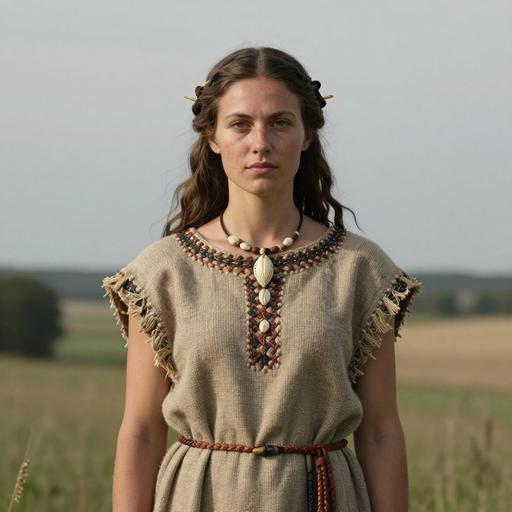
A woman buried in Poland in the Late Neolithic to Early Bronze Age era

Download PDF creates a visual, rasterized copy. Use Print for selectable text and better assistive-technology support.

Loading Report

Preparing your ancestry journey

Preparing the available report content...

Your report will open automatically.

Skip to main content
Reference library / Sample profile

A woman buried in Poland in the Late Neolithic to Early Bronze Age era

Explore the recorded context, genetic comparisons and research behind this reference sample.

PolandGlobular Amphora Culture Ksiaznice, Poland

A reference profile describes this sample. It does not establish a personal or family relationship.

AI portrait reconstruction for A woman buried in Poland in the Late Neolithic to Early Bronze Age era
AI-generated artistic reconstruction, not a photograph of the individual.
Record

Sample details

Recorded details and available lineage markers.

Individual

Indo-European individual, Poland

Sample ID: RISE1243

Date Range

2950 BCE - 2600 BCE

Cultural Period

Globular Amphora Culture Ksiaznice, Poland

Biological Sex

Female

mtDNA Haplogroup

J1c3f

Y-DNA Haplogroup

Not available

Social Role

Potter (AI estimate, era-typical)

Geography

Location

Where this individual was discovered

Country Poland
Locality Ksiaznice. site 2
Coordinates 50.2000, 21.4000
Chronology

Date range

When this individual lived in the broader context of human history

Indo-European individual, Poland 2950 BCE - 2600 BCE
Context

Historical context

Background information associated with the reference record.

The Globular Amphora Culture (GAC) is a Chalcolithic archaeological culture of Central Europe, prominently distinguished by its characteristic pottery, which dates back to around 3400–2800 BCE. It is primarily found in parts of modern-day Poland, Germany, and Ukraine. In Poland, the site of Książnice is particularly important for understanding this culture.

Geographical Context

Książnice is located in the Świętokrzyskie Voivodeship of south-central Poland, a region with a rich tapestry of prehistoric occupation. This site, like many other GAC sites, was strategically chosen for its proximity to rivers and fertile land, which facilitated agriculture and animal husbandry. The area’s topography includes rolling hills, forested areas, and open plains, providing diverse resources for the inhabitants.

Cultural Characteristics

Pottery

The most distinctive feature of the Globular Amphora Culture is its pottery. Vessels are typically bulbous or ‘globular’ in shape, characterized by smooth surfaces and sometimes adorned with cord impressions or incised decorations. These amphorae often had rounded bottoms and were used for storage, cooking, and ceremonial purposes. The sophistication and uniformity of the pottery are indicative of a socially coordinated production process.

Burial Practices

Burial practices in the GAC are notably rich and varied. People were often buried in flat graves, sometimes in a crouched position, with offerings such as pottery vessels, stone tools, and animal bones, suggesting rituals related to the afterlife and ancestor worship. Additionally, there are instances of collective burials, which might indicate a complex societal structure with familial or clan affiliations.

Economy and Subsistence

The economy of the GAC was predominantly agrarian, but it also included hunting, fishing, and gathering. The inhabitants raised livestock such as cattle, pigs, sheep, and goats. Agriculture was primarily based on cereal cultivation. The rich and varied diet is evidenced by archaeobotanical and zooarchaeological finds in the region.

Social Structure

The social organization of the Globular Amphora Culture is inferred from burial practices and settlement patterns. The presence of rich grave goods in some burials suggests a social hierarchy or differential status among individuals or groups. Settlements might have been organized as extended family groups or clans, each managing its agricultural and pastoral activities.

Technology and Craftsmanship

GAC communities exhibited advanced craftsmanship for their time. Aside from their pottery, they produced tools and ornaments from materials like flint, bone, wood, and antler. Flint mining and processing were important activities, and the people of this culture are known for their skills in creating finely worked flint tools, which were used for hunting, farming, and other daily activities.

Indo-European Links

The GAC is placed in a crucial period concerning the discussions on the spread of Indo-European languages in Europe. Some scholars have argued that the GAC may represent an early wave of Indo-European speakers, given its geographic span and time frame coinciding with linguistic dissemination theories. However, the exact nature of the Indo-European connection remains speculative without definitive linguistic or genetic evidence directly linking the GAC communities to the Indo-European language family.

Conclusion

The Globular Amphora Culture represents a fascinating snapshot of prehistoric life in Central Europe. The site at Książnice, Poland, contributes valuable insights into this culture’s daily life, spiritual practices, and social organization. Continued archaeological investigations and advances in technology such as DNA analysis may provide further understanding of their place in the broader tapestry of European prehistory, potentially shedding light on the enigmatic movements and influences of early Indo-European peoples.

Analysis

Genetic comparisons

These comparisons show genetic similarity, not identity or origin. The populations listed are those whose genomes show statistical alignment to this ancient individual.

Similarity reflects shared history, not shared identity. These are analytical comparisons, not claims about who this person was.

Modern Genetic Admixture

This analysis compares the DNA profile with present-day reference populations, showing statistical similarity to modern reference populations from different regions. The excavation site records where this individual was found, not a fixed modern genetic identity.

Europe 91.0%
Southern European 82.1%
Iberian 45.1%
Sardinian 19.9%
Italian 17.0%
Northwestern European 8.9%
Asia 9.0%
Northern West Asian 9.0%
Cypriot 9.0%

Closest Modern Populations

These are the modern populations showing the closest statistical alignment to A woman buried in Poland in the Late Neolithic to Early Bronze Age era, ranked by genetic distance. Lower distance values indicate closer statistical similarity. Cross-region similarity can reflect shared ancestry, population movement, continuity, or later admixture.

1
Spanish La Rioja
3.7293
2
Spanish Castello
4.0425
3
Spanish Castilla La Mancha
4.0638
4
Spanish Pirineu
4.0876
5
Spanish Aragon
4.1366
6
French Corsica
4.1426
7
Spanish Cantabria
4.1474
8
Spanish Terres De L'ebre
4.1804
9
Spanish Menorca
4.2110
10
Spanish Valencia
4.2132
Context

Related Samples

This individual exists within a broader network of ancient samples. No ancient genome stands alone.

Individual Culture/Period Date Location Action
Indo-European individual, Poland Globular Amphora Culture Koszyce, Poland 2891 BCE Koszyce. site 3, Poland View
Indo-European individual, Poland Globular Amphora Culture Koszyce, Poland 2900 BCE Koszyce. site 3, Poland View
Indo-European individual, Poland Globular Amphora Culture Koszyce, Poland 2912 BCE Koszyce. site 3, Poland View
Indo-European individual, Poland Globular Amphora Culture Koszyce, Poland 3072 BCE Koszyce. site 3, Poland View
Indo-European individual, Poland Globular Amphora Culture Koszyce, Poland 2872 BCE Koszyce. site 3, Poland View
Indo-European individual, Poland Globular Amphora Culture Koszyce, Poland 2875 BCE Koszyce. site 3, Poland View
Indo-European individual, Poland Globular Amphora Culture Koszyce, Poland 2884 BCE Koszyce. site 3, Poland View
Indo-European individual, Poland Globular Amphora Culture Koszyce, Poland 3004 BCE Koszyce. site 3, Poland View
Indo-European individual, Poland Globular Amphora Culture Koszyce, Poland 2872 BCE Koszyce. site 3, Poland View
Indo-European individual, Poland Globular Amphora Culture Koszyce, Poland 2886 BCE Koszyce. site 3, Poland View
Indo-European individual, Poland Globular Amphora Culture Koszyce, Poland 2906 BCE Koszyce. site 3, Poland View
Indo-European individual, Poland Globular Amphora Culture Koszyce, Poland 2892 BCE Koszyce. site 3, Poland View
Indo-European individual, Poland Globular Amphora Culture Koszyce, Poland 2915 BCE Koszyce. site 3, Poland View
Indo-European individual, Poland Globular Amphora Culture Koszyce, Poland 2580 BCE Koszyce. site 3, Poland View
Indo-European individual, Poland Globular Amphora Culture Koszyce, Poland 2905 BCE Koszyce. site 3, Poland View
Indo-European individual, Poland Globular Amphora Culture Ksiaznice, Poland 2905 BCE Ksiaznice. site 2, Poland View
Indo-European individual, Poland Globular Amphora Culture Sandomierz, Poland 2901 BCE Sandomierz. site 78, Poland View
Indo-European individual, Poland Globular Amphora Culture Ksiaznice, Poland 2950 BCE Ksiaznice. site 2, Poland View
Indo-European individual, Poland Globular Amphora Culture Sandomierz, Poland 2950 BCE Sandomierz. site 78, Poland View
Indo-European individual, Poland Globular Amphora Culture Ksiaznice, Poland 2895 BCE Ksiaznice. site 2, Poland View
Indo-European individual, Poland Globular Amphora Culture Wilczyce, Poland 3100 BCE Wilczyce. site 90, Poland View
Indo-European individual, Poland Globular Amphora Culture Mierzanowice, Poland 3100 BCE Mierzanowice. site 1. grave 3, Poland View
Indo-European individual, Poland Globular Amphora Culture Ksiaznice, Poland 2950 BCE Ksiaznice. site 2, Poland View
Globular Amphora individual, Poland 2884 BCE Koszyce. site 3, Poland View
Globular Amphora individual, Poland 2892 BCE Koszyce. site 3, Poland View
Globular Amphora individual, Poland 2915 BCE Koszyce. site 3, Poland View
Globular Amphora individual, Poland 2912 BCE Koszyce. site 3, Poland View
Globular Amphora individual, Poland 2891 BCE Koszyce. site 3, Poland View
Globular Amphora individual, Poland 2580 BCE Koszyce. site 3, Poland View
Globular Amphora individual, Poland 2906 BCE Koszyce. site 3, Poland View
Globular Amphora individual, Poland 3072 BCE Koszyce. site 3, Poland View
Globular Amphora individual, Poland 2886 BCE Koszyce. site 3, Poland View
Globular Amphora individual, Poland 2872 BCE Koszyce. site 3, Poland View
Globular Amphora individual, Poland 2905 BCE Koszyce. site 3, Poland View
Globular Amphora individual, Poland 2900 BCE Koszyce. site 3, Poland View
Globular Amphora individual, Poland 3004 BCE Koszyce. site 3, Poland View
Globular Amphora individual, Poland 2872 BCE Koszyce. site 3, Poland View
Globular Amphora individual, Poland 2875 BCE Koszyce. site 3, Poland View
Globular Amphora individual, Poland 2901 BCE Sandomierz. site 78, Poland View
Globular Amphora Zlota individual, Poland 2950 BCE Ksiaznice. site 2, Poland View
Globular Amphora Zlota individual, Poland 2895 BCE Ksiaznice. site 2, Poland View
Globular Amphora Zlota individual, Poland 2950 BCE Ksiaznice. site 2, Poland View
Globular Amphora Zlota individual, Poland 2905 BCE Ksiaznice. site 2, Poland View
Globular Amphora individual, Poland 2950 BCE Sandomierz. site 78, Poland View
Globular Amphora individual, Poland 3100 BCE Mierzanowice. site 1. grave 3, Poland View
Globular Amphora Zlota individual, Poland 3100 BCE Wilczyce. site 90, Poland View
Page 1
Individual Culture/Period Date Location Action
Indo-European individual, Poland Globular Amphora Culture Ksiaznice, Poland 2905 BCE Ksiaznice. site 2, Poland View
Indo-European individual, Poland Globular Amphora Culture Ksiaznice, Poland 2950 BCE Ksiaznice. site 2, Poland View
Indo-European individual, Poland Globular Amphora Culture Ksiaznice, Poland 2895 BCE Ksiaznice. site 2, Poland View
Indo-European individual, Poland Globular Amphora Culture Ksiaznice, Poland 2950 BCE Ksiaznice. site 2, Poland View
Page 1
Sources

References

Scientific publications and genetic data that inform this profile.

G25 Coordinates

These coordinates represent a position in genetic space, a tool for comparison, not a conclusion. You can use these to perform custom admixture analysis in G25 Studio.

RISE1243,0.12149038,0.15458728,0.03437998,-0.02075484,0.05432164,-0.01170564,-0.0014705,0.00462138,0.03165978,0.05403174,-0.00507232,0.01286574,-0.02352722,-0.01283994,-0.00230858,0.00190446,0.00413426,2.874E-05,-8.794E-05,-0.00331378,0.00136938,0.00406584,-0.01081144,-0.0119133,0.00295087
Continue in G25 Studio
Use code for 30% off • Expires Nov 16