A woman buried in Sweden in the era

Download PDF creates a visual, rasterized copy. Use Print for selectable text and better assistive-technology support.

Loading Report

Preparing your ancestry journey

Preparing the available report content...

Your report will open automatically.

Skip to main content
Reference library / Sample profile

A woman buried in Sweden in the era

Explore the recorded context, genetic comparisons and research behind this reference sample.

SwedenAncient Hunter-Gatherers of the Nordic Countries

A reference profile describes this sample. It does not establish a personal or family relationship.

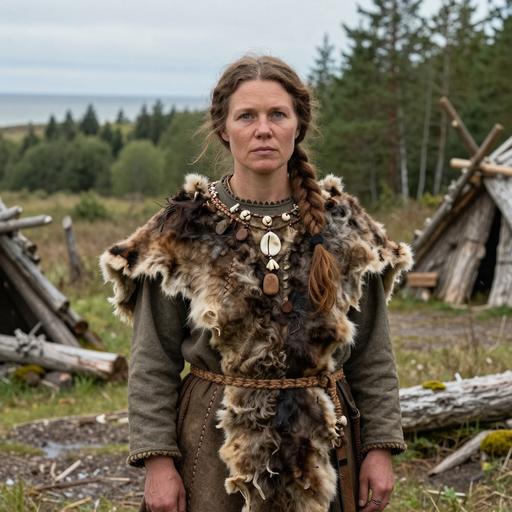
AI portrait reconstruction for A woman buried in Sweden in the  era
AI-generated artistic reconstruction, not a photograph of the individual.
Record

Sample details

Recorded details and available lineage markers.

Individual

Nordic Hg individual, Sweden

Sample ID: SF9

Date Range

7350 BCE - 7038 BCE

Cultural Period

Ancient Hunter-Gatherers of the Nordic Countries

Biological Sex

Female

mtDNA Haplogroup

U4a2

Y-DNA Haplogroup

Not available

Social Role

Gatherer (AI estimate, era-typical)

Geography

Location

Where this individual was discovered

Country Sweden
Locality Stora Förvar

A location map is not available for this record.

Chronology

Date range

When this individual lived in the broader context of human history

Nordic Hg individual, Sweden 7350 BCE - 7038 BCE
Context

Historical context

Background information associated with the reference record.

Ancient hunter-gatherer lifeways in the Nordic countries provide evidence for how people survived and organized daily activities in a northern environment before Neolithic farming became widespread.

Region & Environment

The Nordic environment includes cold-temperate and subarctic influences depending on latitude and proximity to coastlines. People exploited diverse ecologies—coastal and inland—matching hunting and foraging strategies to seasonality and local resources. Waterways likely mattered for travel, fishing, and access to habitats.

Historical Context

The Mesolithic period follows major climatic and landscape changes at the end of the Pleistocene. In this context, hunter-gatherer communities adjusted subsistence to shifting animal distributions, vegetation, and seasonal availability, forming regional patterns of toolmaking and site use.

Populations & Lifeways

Hunter-gatherer groups were typically mobile or semi-mobile, organizing camps around seasonal opportunities. Lifeways centered on hunting, fishing, and gathering, with cooperation among households and social learning reflected in shared techniques for producing tools and processing resources.

Archaeology & Material Culture

Mesolithic material culture is often dominated by stone tools, reflecting both raw material choice and technological traditions. Archaeological sites may include traces of hearths, tool production, and occupation layers, with variability indicating different site functions such as short-term foraging stops or longer seasonal camps.

Culture & Society

Shared technological traditions in stone tool industries can point to cultural learning networks between communities. Mortuary evidence, when present, is usually limited for this period; otherwise, social organization is inferred indirectly from settlement patterning and repeated site use.

Legacy & Transition

The Mesolithic record establishes a baseline of local adaptation to northern ecologies. Later Neolithic changes—especially farming and more permanent settlement—build on earlier knowledge of landscapes, while transforming patterns of material culture and mobility.

Analysis

Genetic comparisons

These comparisons show genetic similarity, not identity or origin. The populations listed are those whose genomes show statistical alignment to this ancient individual.

Similarity reflects shared history, not shared identity. These are analytical comparisons, not claims about who this person was.

Modern Genetic Admixture

This analysis compares the DNA profile with present-day reference populations, showing statistical similarity to modern reference populations from different regions. The excavation site records where this individual was found, not a fixed modern genetic identity.

Europe 100.0%
Northwestern European 75.0%
Finnish 42.0%
Scandinavian 18.3%
English 14.7%
Eastern European 25.0%

Closest Modern Populations

These are the modern populations showing the closest statistical alignment to A woman buried in Sweden in the era, ranked by genetic distance. Lower distance values indicate closer statistical similarity. Cross-region similarity can reflect shared ancestry, population movement, continuity, or later admixture.

1
Finnish Southeast
5.8987
2
Finnish Central
5.9007
3
Cossack Kuban
5.9154
4
Russian Kostroma
5.9625
5
Russian Yaroslavl
5.9911
6
Erzya
6.0310
7
Ingrian
6.0634
8
Karelian
6.1141
9
Mordovian
6.1193
10
Moksha
6.1528
Context

Related Samples

This individual exists within a broader network of ancient samples. No ancient genome stands alone.

Individual Culture/Period Date Location Action
Mesolithic individual, Sweden Mesolithic Sweden 7083 BCE Stora Förvar, Sweden View
European Hunter-Gatherers individual, Sweden Mesolithic Sweden 7350 BCE Stora Förvar, Sweden View
European Hunter-Gatherers individual, Sweden Mesolithic Sweden 7013 BCE Stora Bjers, Sweden View
European Hunter-Gatherers individual, Sweden Mesolithic Sweden 7073 BCE Stora Förvar, Sweden View
Scandinavian Hunter-Gatherers individual, Norway Mesolithic Norway 7502 BCE Hummervikholmen, Norway View
Norse individual, Norway Neolithic Hunter-Gatherer Norway 4000 BCE Steigen, Norway View
Scandinavian Hunter-Gatherers individual, Norway Mesolithic Norway 7502 BCE Hummervikholmen, Norway View
Nordic Hg individual, Norway 7502 BCE Hummervikholmen, Norway View
Nordic Hg individual, Sweden 7013 BCE Stora Bjers, Sweden View
Nordic Hg individual, Sweden 7073 BCE Stora Förvar, Sweden View
Nordic Hg individual, Sweden 7350 BCE Stora Förvar, Sweden View
Nordic Hg N individual, Norway 4000 BCE Steigen, Norway View
Page 1
Individual Culture/Period Date Location Action
Nordic Hg individual, Sweden 5722 BCE Motala. Kanaljorden, Sweden View
Nordic Hg individual, Norway 7502 BCE Hummervikholmen, Norway View
Nordic Hg individual, Sweden 7013 BCE Stora Bjers, Sweden View
Nordic Hg individual, Sweden 7073 BCE Stora Förvar, Sweden View
Nordic Hg individual, Sweden 7350 BCE Stora Förvar, Sweden View
Page 1
Sources

References

Scientific publications and genetic data that inform this profile.

G25 Coordinates

These coordinates represent a position in genetic space, a tool for comparison, not a conclusion. You can use these to perform custom admixture analysis in G25 Studio.

SF9,0.11693372,0.08920702,0.0607422,0.09588486,0.05352096,-0.0113543,0.00746662,0.0161136,-0.00401592,-0.02947726,-0.00074354,-0.00615972,0.01186688,0.01212916,0.00140124,0.00090868,0.00100854,-0.00251652,0.00471522,0.00097724,0.00369848,-0.00456068,-0.00440728,0.00844572,0.00228203
Continue in G25 Studio
Use code for 30% off • Expires Nov 16