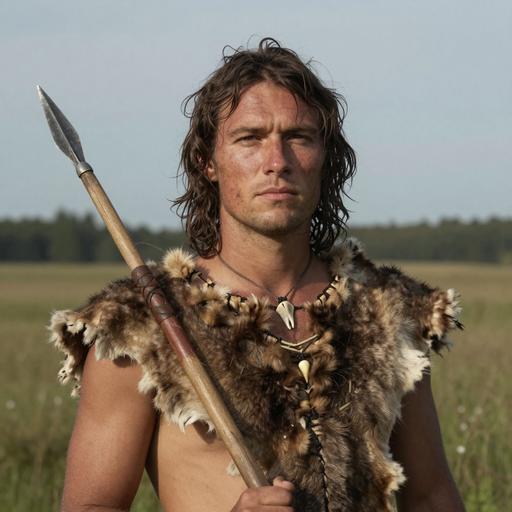
A man buried in Sweden in the Mesolithic era

Download PDF creates a visual, rasterized copy. Use Print for selectable text and better assistive-technology support.

Loading Report

Preparing your ancestry journey

Preparing the available report content...

Your report will open automatically.

Skip to main content
Reference library / Sample profile

A man buried in Sweden in the Mesolithic era

Explore the recorded context, genetic comparisons and research behind this reference sample.

SwedenSweden Mesolithic

A reference profile describes this sample. It does not establish a personal or family relationship.

AI portrait reconstruction for A man buried in Sweden in the Mesolithic era
AI-generated artistic reconstruction, not a photograph of the individual.
Record

Sample details

Recorded details and available lineage markers.

Individual

European Hunter-Gatherers individual, Sweden

Sample ID: SBj

Date Range

7013 BCE - 6629 BCE

Cultural Period

Sweden Mesolithic

Biological Sex

Male

mtDNA Haplogroup

U4a1

Y-DNA Haplogroup

I-FT344596

Social Role

Hunter (AI estimate, era-typical)

Geography

Location

Where this individual was discovered

Country Sweden
Locality Stora Bjers
Coordinates 57.7920, 18.5380
Chronology

Date range

When this individual lived in the broader context of human history

European Hunter-Gatherers individual, Sweden 7013 BCE - 6629 BCE
Context

Historical context

Background information associated with the reference record.

Overview

Sweden’s Mesolithic period is defined by hunter-gatherer lifeways in a landscape still reorganizing after the last Ice Age. From roughly 8000 to 4000 BCE, people relied on local resources while maintaining regional traditions in tools and settlement patterns.

Region & Environment

During this time, Sweden experienced long-term environmental change as temperatures rose and coastlines and inland waters shifted. Forest expansion, extensive wetlands, and abundant lakes and rivers supported diverse plant and animal resources. Coastal and inland zones were both important, with waterways serving as routes for travel and for accessing fish and other aquatic foods.

Historical Context

The Mesolithic follows the region’s late Palaeolithic/early postglacial phases and precedes Neolithic farming in Scandinavia. Instead of agriculture, communities remained organized around hunting, fishing, and gathering, with seasonal adjustments as local conditions changed. Long-distance contacts are difficult to demonstrate in detail, but recurring regional tool and technology patterns suggest shared knowledge networks at different scales.

Populations & Lifeways

Mesolithic populations in Sweden were mobile and seasonally scheduled, moving between resource-rich areas. Livelihoods typically combined:

  • fishing in lakes, rivers, and coastal waters
  • hunting terrestrial animals
  • gathering wild plants and other seasonal foods Settlements appear as temporary or repeatedly used locations, with evidence of craft activities such as tool production and maintenance.

Archaeology & Material Culture

Archaeological signatures commonly include:

  • stone tools (frequently microlithic or otherwise finely worked depending on local traditions)
  • knapping and manufacturing debris at activity areas
  • site features and depositional patterns consistent with short stays or repeated seasonal use Material culture is generally dominated by stone technologies, with organic materials rarely preserved except in special contexts such as waterlogged deposits.

Culture & Society

While precise social organization cannot be reconstructed from material remains alone, the archaeological record indicates established traditions in technology and site use. Shared craft practices and the recurrence of patterned tool forms suggest learning networks and cultural transmission between groups operating across a wider region than any single campsite.

Legacy & Transition

The Mesolithic in Sweden ends as Neolithic lifeways spread into the region. This transition involved significant changes in subsistence strategies, settlement longevity, and material culture, while earlier hunter-gatherer landscapes and resources continued to shape where and how new communities established themselves.

Analysis

Genetic comparisons

These comparisons show genetic similarity, not identity or origin. The populations listed are those whose genomes show statistical alignment to this ancient individual.

Similarity reflects shared history, not shared identity. These are analytical comparisons, not claims about who this person was.

Modern Genetic Admixture

This analysis compares the DNA profile with present-day reference populations, showing statistical similarity to modern reference populations from different regions. The excavation site records where this individual was found, not a fixed modern genetic identity.

Europe 100.0%
Northwestern European 80.9%
Scandinavian 46.2%
Finnish 34.7%
Eastern European 19.1%

Closest Modern Populations

These are the modern populations showing the closest statistical alignment to A man buried in Sweden in the Mesolithic era, ranked by genetic distance. Lower distance values indicate closer statistical similarity. Cross-region similarity can reflect shared ancestry, population movement, continuity, or later admixture.

1
Estonian
2.1193
2
Russian Pskov
3.0686
3
Russian Yaroslavl
3.2936
4
Russian Kaluga
3.3902
5
Ingrian
3.4131
6
Russian Tver
3.4482
7
Lithuanian VZ
3.5318
8
Lithuanian PA
3.5330
9
Lithuanian VA
3.5481
10
Finnish Central
3.5655
Context

Related Samples

This individual exists within a broader network of ancient samples. No ancient genome stands alone.

Individual Culture/Period Date Location Action
Mesolithic individual, Sweden Mesolithic Sweden 7083 BCE Stora Förvar, Sweden View
European Hunter-Gatherers individual, Sweden Mesolithic Sweden 7350 BCE Stora Förvar, Sweden View
European Hunter-Gatherers individual, Sweden Mesolithic Sweden 7013 BCE Stora Bjers, Sweden View
European Hunter-Gatherers individual, Sweden Mesolithic Sweden 7073 BCE Stora Förvar, Sweden View
Scandinavian Hunter-Gatherers individual, Norway Mesolithic Norway 7502 BCE Hummervikholmen, Norway View
Norse individual, Norway Neolithic Hunter-Gatherer Norway 4000 BCE Steigen, Norway View
Scandinavian Hunter-Gatherers individual, Norway Mesolithic Norway 7502 BCE Hummervikholmen, Norway View
Nordic Hg individual, Norway 7502 BCE Hummervikholmen, Norway View
Nordic Hg individual, Sweden 7013 BCE Stora Bjers, Sweden View
Nordic Hg individual, Sweden 7073 BCE Stora Förvar, Sweden View
Nordic Hg individual, Sweden 7350 BCE Stora Förvar, Sweden View
Nordic Hg N individual, Norway 4000 BCE Steigen, Norway View
Page 1
Individual Culture/Period Date Location Action
Mesolithic individual, Sweden Mesolithic Sweden 7083 BCE Stora Förvar, Sweden View
European Hunter-Gatherers individual, Sweden Mesolithic Sweden 7350 BCE Stora Förvar, Sweden View
European Hunter-Gatherers individual, Sweden Mesolithic Sweden 7013 BCE Stora Bjers, Sweden View
European Hunter-Gatherers individual, Sweden Mesolithic Sweden 7073 BCE Stora Förvar, Sweden View
Mesolithic individual, Sweden Mesolithic Sweden 8238 BCE Hanaskede (Västra Götalands län, Skara), Sweden View
Mesolithic individual, Sweden Mesolithic Sweden 7943 BCE Bredgården (Västra Götalands län, Ulricehamn), Sweden View
Page 1
Sources

References

Scientific publications and genetic data that inform this profile.

G25 Coordinates

These coordinates represent a position in genetic space, a tool for comparison, not a conclusion. You can use these to perform custom admixture analysis in G25 Studio.

SBj,0.13094264,0.11475974,0.08987466,0.07754618,0.03899342,0.03214982,0.00858258,0.0170948,-0.00113808,-0.03167022,0.00129314,-0.00746918,0.01369606,0.01340536,0.00072522,0.00025084,0.00068636,-0.0024975,0.00475682,0.00112246,0.00341078,-0.00464378,-0.00529554,0.00876166,0.00236729
Continue in G25 Studio
Use code for 30% off • Expires Nov 16