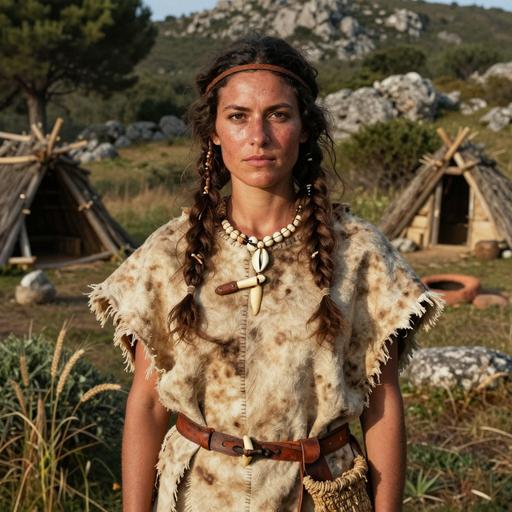
A woman buried in Spain in the era

Download PDF creates a visual, rasterized copy. Use Print for selectable text and better assistive-technology support.

Loading Report

Preparing your ancestry journey

Preparing the available report content...

Your report will open automatically.

Skip to main content
Reference library / Sample profile

A woman buried in Spain in the era

Explore the recorded context, genetic comparisons and research behind this reference sample.

SpainAncient Hunter-Gatherers of Iberia

A reference profile describes this sample. It does not establish a personal or family relationship.

AI portrait reconstruction for A woman buried in Spain in the  era
AI-generated artistic reconstruction, not a photograph of the individual.
Record

Sample details

Recorded details and available lineage markers.

Individual

Iberia Hg individual, Spain

Sample ID: Chan

Date Range

7320 BCE - 7054 BCE

Cultural Period

Ancient Hunter-Gatherers of Iberia

Biological Sex

Female

mtDNA Haplogroup

U5b

Y-DNA Haplogroup

Not available

Social Role

Gatherer (AI estimate, era-typical)

Geography

Location

Where this individual was discovered

Country Spain
Locality Chan do Lindeiro

A location map is not available for this record.

Chronology

Date range

When this individual lived in the broader context of human history

Iberia Hg individual, Spain 7320 BCE - 7054 BCE
Context

Historical context

Background information associated with the reference record.

Overview

Pleistocene hunter-gatherers across Iberia adapted to changing environments as climate and habitats shifted over long spans of time. Archaeological evidence primarily reflects stone tool industries and the exploitation of animals.

Region & Environment

Iberia spans diverse ecological zones, including river valleys, uplands, and coastal areas. During the Pleistocene, alternating cold and warmer phases reshaped vegetation cover and animal distributions, influencing where people could reliably hunt and forage.

Historical Context

This era predates widespread farming and complex urban life. Human presence in Iberia during the Pleistocene is associated with repeated occupations of suitable landscapes, with behavioral changes expressed in the sequence of tool traditions and patterns of faunal use.

Populations & Lifeways

Populations were mobile hunter-gatherers. Their lifeways centered on hunting and gathering wild resources, likely organized around seasonal availability of game and plant foods. Mobility strategies would have been responsive to shifting water sources, prey migration, and local habitat conditions.

Archaeology & Material Culture

Archaeological signatures are dominated by stone tools (including flake and core technologies, varying by sub-phase) and animal remains. Cut-marked or associated faunal deposits indicate processing of carcasses, while site types—such as caves, open-air concentrations near water, or ephemeral activity areas—reflect where conditions supported repeated use.

Culture & Society

Archaeological interpretations typically emphasize techno-economic choices: raw material procurement, tool production, and butchery practices. Social organization is not directly recoverable from material remains, but repeated occupation of favorable locales suggests knowledge of routes and seasonal landscapes.

Legacy & Transition

As the Pleistocene drew to a close, environmental instability and changing ecosystems set the stage for later epipalaeolithic and then Neolithic transformations. The long hunter-gatherer record provides the background for understanding how people later reorganized subsistence and settlement in response to new climates.

Analysis

Genetic comparisons

These comparisons show genetic similarity, not identity or origin. The populations listed are those whose genomes show statistical alignment to this ancient individual.

Similarity reflects shared history, not shared identity. These are analytical comparisons, not claims about who this person was.

Modern Genetic Admixture

This analysis compares the DNA profile with present-day reference populations, showing statistical similarity to modern reference populations from different regions. The excavation site records where this individual was found, not a fixed modern genetic identity.

Europe 89.7%
Northwestern European 71.1%
Finnish 24.9%
English 23.4%
Scandinavian 19.0%
Northwestern European 3.8%
Southern European 13.0%
Iberian 13.0%
Eastern European 5.6%
Asia 5.5%
Chinese & Southeast Asian 5.5%
Chinese 3.6%
Indonesian Khmer Thai Myanma 1.9%
Oceania 2.8%
Melanesian 2.8%
Papuan 2.8%
Africa 2.1%
West African 2.1%
Ghanaian, Liberian, Sierra Leonean 2.1%

Closest Modern Populations

These are the modern populations showing the closest statistical alignment to A woman buried in Spain in the era, ranked by genetic distance. Lower distance values indicate closer statistical similarity. Cross-region similarity can reflect shared ancestry, population movement, continuity, or later admixture.

1
Swedish
4.6623
2
Norwegian
4.8586
3
Afrikaner
4.8845
4
German Hamburg
5.1465
5
Dutch
5.2144
6
Danish
5.2178
7
Icelandic
5.2682
8
Shetlandic
5.2717
9
Orcadian
5.3389
10
Scottish
5.3710
Context

Related Samples

This individual exists within a broader network of ancient samples. No ancient genome stands alone.

Individual Culture/Period Date Location Action
Iberian individual, Spain Hunter-Gatherer Spain 7320 BCE Chan do Lindeiro, Spain View
Iberian individual, Spain Hunter-Gatherer Spain 5299 BCE Canes, Spain View
Old European individual, Romania Romanian Copper Age 3512 BCE Gura Baciului, Romania View
European Hunter-Gatherers individual, Romania Mesolithic Iron Gates, Romania 7250 BCE Iron Gates. Schela Cladovei, Romania View
European Hunter-Gatherers individual, Romania Mesolithic Iron Gates, Romania 7022 BCE Iron Gates. Ostrovul Corbului, Romania View
European Hunter-Gatherers individual, Romania Mesolithic Iron Gates, Romania 7125 BCE Iron Gates. Schela Cladovei, Romania View
European Hunter-Gatherers individual, Romania Mesolithic Iron Gates, Romania 7022 BCE Ostrovul-Corbului (Mehedinți County, Hinova), Romania View
Iron Gates Hg individual, Romania 7022 BCE Iron Gates. Ostrovul Corbului, Romania View
Iberia Hg individual, Spain 5299 BCE Canes, Spain View
Iberia Hg individual, Spain 7320 BCE Chan do Lindeiro, Spain View
Starcevo individual, Romania 3512 BCE Gura Baciului, Romania View
Iron Gates Hg individual, Romania 7125 BCE Iron Gates. Schela Cladovei, Romania View
Iron Gates Hg individual, Romania 7250 BCE Iron Gates. Schela Cladovei, Romania View
Page 1
Individual Culture/Period Date Location Action
Iberia Hg individual, Spain 5982 BCE León. La Braña-Arintero, Spain View
Iberia Hg individual, Spain 40000 BCE Andalusia. Piñar. Granada. Cueva de la Carigüela, Spain View
Iberia Hg individual, Spain 5982 BCE Leon. La Brana-Arintero, Spain View
Iberia Hg individual, Spain 5299 BCE Canes, Spain View
Iberia Hg individual, Spain 7320 BCE Chan do Lindeiro, Spain View
Iberia Hg individual, Spain 40000 BCE Andalusia. Piñar. Granada. Cueva de la Carigüela, Spain View
Page 1
Sources

References

Scientific publications and genetic data that inform this profile.

G25 Coordinates

These coordinates represent a position in genetic space, a tool for comparison, not a conclusion. You can use these to perform custom admixture analysis in G25 Studio.

Chan,0.11455108,0.09037146,0.05368498,0.05954702,0.04469256,0.01728754,0.00490564,0.00612454,0.0027398,-0.00655532,-0.00212648,0.00286156,-0.00260552,-0.00401744,0.02012404,0.00493692,-0.01007086,0.006753,0.00149052,0.0022147,0.00266714,-0.00232934,0.00757612,0.01109048,0.00382428
Continue in G25 Studio
Use code for 30% off • Expires Nov 16