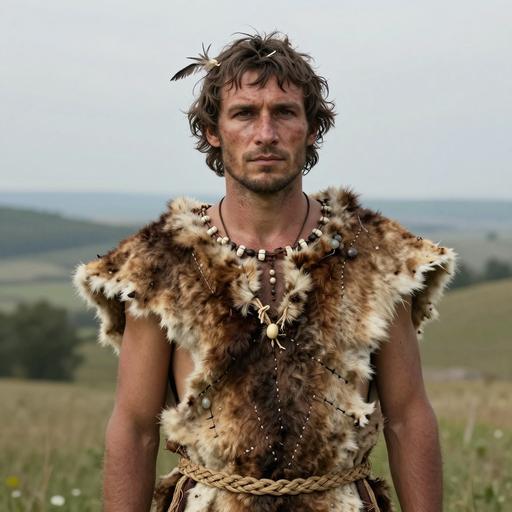
A man buried in Romania in the Mesolithic era

Download PDF creates a visual, rasterized copy. Use Print for selectable text and better assistive-technology support.

Loading Report

Preparing your ancestry journey

Preparing the available report content...

Your report will open automatically.

Skip to main content
Reference library / Sample profile

A man buried in Romania in the Mesolithic era

Explore the recorded context, genetic comparisons and research behind this reference sample.

RomaniaRomania IronGates Mesolithic

A reference profile describes this sample. It does not establish a personal or family relationship.

AI portrait reconstruction for A man buried in Romania in the Mesolithic era
AI-generated artistic reconstruction, not a photograph of the individual.
Record

Sample details

Recorded details and available lineage markers.

Individual

European Hunter-Gatherers individual, Romania

Sample ID: M96

Date Range

7250 BCE - 6500 BCE

Cultural Period

Romania IronGates Mesolithic

Biological Sex

Male

mtDNA Haplogroup

U5a1c3*

Y-DNA Haplogroup

R-FT360000

Social Role

Hunter (AI estimate, era-typical)

Geography

Location

Where this individual was discovered

Country Romania
Locality Iron Gates. Schela Cladovei
Coordinates 44.6261, 22.6058
Chronology

Date range

When this individual lived in the broader context of human history

European Hunter-Gatherers individual, Romania 7250 BCE - 6500 BCE
Context

Historical context

Background information associated with the reference record.

The term Iron Gates Mesolithic refers to Mesolithic lifeways in the Iron Gates area—where the Danube and its tributaries cut through the Carpathians—linking riverine resources with upland hunting grounds. Archaeological sequences in this landscape reflect a long post-glacial recovery period, with progressively stabilizing climates and ecosystems.

Region & Environment

The Iron Gates lies in a major river system between mountainous terrain and the river’s floodplain and terraces. In the Early Holocene, shifting temperatures and moisture would have altered the distribution of forests, open areas, and aquatic habitats, affecting the timing and targets of subsistence.

Historical Context

Between roughly 9500 and 7000 BCE, communities in this part of Europe belonged to a broad European hunter-gatherer world. Across the region, people adapted to post-glacial landscapes rather than relying on agriculture, and they appear to have organized life around seasonal availability of resources.

Populations & Lifeways

Populations were likely small groups using flexible, seasonally planned mobility. Lifeways emphasized foraging: hunting terrestrial animals, exploiting fish and water resources along the Danube and backwaters, and gathering edible plants and other seasonal foods when available. Social organization would have been maintained through repeated movement between favored locales.

Archaeology & Material Culture

Material culture is typically represented by stone tools and by the archaeological signatures of repeated use of landscapes. Mesolithic industries generally include microlithic and retouched stone implements suited to composite technologies, though details vary by site and phase. Preservation of organic materials can be uneven, but tool manufacture and maintenance would have been central to daily practice.

Culture & Society

The label Iron Gates Culture is an archaeological convention that groups material patterns associated with Mesolithic foragers in the area. Such groupings help archaeologists discuss shared technological traditions and common ways of using the landscape, even when specific social relationships are not directly recoverable from the record.

Legacy & Transition

As the Early Holocene progressed, environmental change continued and new regional economic strategies ultimately emerged in parts of Europe. The Mesolithic of the Iron Gates thus forms part of the longer transition toward later Holocene lifeways, when shifting subsistence and mobility patterns gradually reshaped settlement and material traditions.

Analysis

Genetic comparisons

These comparisons show genetic similarity, not identity or origin. The populations listed are those whose genomes show statistical alignment to this ancient individual.

Similarity reflects shared history, not shared identity. These are analytical comparisons, not claims about who this person was.

Modern Genetic Admixture

This analysis compares the DNA profile with present-day reference populations, showing statistical similarity to modern reference populations from different regions. The excavation site records where this individual was found, not a fixed modern genetic identity.

Europe 100.0%
Northwestern European 73.5%
Finnish 26.8%
English 21.4%
Scandinavian 20.6%
Northwestern European 4.8%
Eastern European 26.5%

Closest Modern Populations

These are the modern populations showing the closest statistical alignment to A man buried in Romania in the Mesolithic era, ranked by genetic distance. Lower distance values indicate closer statistical similarity. Cross-region similarity can reflect shared ancestry, population movement, continuity, or later admixture.

1
Estonian
2.1860
2
Russian Pskov
2.9050
3
Polish Kashubian
2.9489
4
Lithuanian PA
3.1392
5
Russian Kaluga
3.1808
6
Lithuanian VA
3.2251
7
Lithuanian VZ
3.2770
8
Belarusian
3.2896
9
Russian Kursk
3.3765
10
Russian Tver
3.4044
Context

Related Samples

This individual exists within a broader network of ancient samples. No ancient genome stands alone.

Individual Culture/Period Date Location Action
Iberian individual, Spain Hunter-Gatherer Spain 7320 BCE Chan do Lindeiro, Spain View
Iberian individual, Spain Hunter-Gatherer Spain 5299 BCE Canes, Spain View
Old European individual, Romania Romanian Copper Age 3512 BCE Gura Baciului, Romania View
European Hunter-Gatherers individual, Romania Mesolithic Iron Gates, Romania 7250 BCE Iron Gates. Schela Cladovei, Romania View
European Hunter-Gatherers individual, Romania Mesolithic Iron Gates, Romania 7022 BCE Iron Gates. Ostrovul Corbului, Romania View
European Hunter-Gatherers individual, Romania Mesolithic Iron Gates, Romania 7125 BCE Iron Gates. Schela Cladovei, Romania View
European Hunter-Gatherers individual, Romania Mesolithic Iron Gates, Romania 7022 BCE Ostrovul-Corbului (Mehedinți County, Hinova), Romania View
Iron Gates Hg individual, Romania 7022 BCE Iron Gates. Ostrovul Corbului, Romania View
Iberia Hg individual, Spain 5299 BCE Canes, Spain View
Iberia Hg individual, Spain 7320 BCE Chan do Lindeiro, Spain View
Starcevo individual, Romania 3512 BCE Gura Baciului, Romania View
Iron Gates Hg individual, Romania 7125 BCE Iron Gates. Schela Cladovei, Romania View
Iron Gates Hg individual, Romania 7250 BCE Iron Gates. Schela Cladovei, Romania View
Page 1
Individual Culture/Period Date Location Action
Mesolithic individual, Romania Mesolithic Iron Gates, Romania 5810 BCE Magura Buduiasca. Teleor 3, Romania View
Mesolithic individual, Romania Mesolithic Iron Gates, Romania 7000 BCE Iron Gates. Schela Cladovei, Romania View
European Hunter-Gatherers individual, Romania Mesolithic Iron Gates, Romania 7026 BCE Iron Gates. Ostrovul Corbului, Romania View
Iron Gates Mesolithic individual, Romania Mesolithic Iron Gates, Romania 7446 BCE Iron Gates. Schela Cladovei, Romania View
European Hunter-Gatherers individual, Romania Mesolithic Iron Gates, Romania 7451 BCE Iron Gates. Schela Cladovei, Romania View
European Hunter-Gatherers individual, Romania Mesolithic Iron Gates, Romania 7250 BCE Iron Gates. Schela Cladovei, Romania View
European Hunter-Gatherers individual, Romania Mesolithic Iron Gates, Romania 7022 BCE Iron Gates. Ostrovul Corbului, Romania View
European Hunter-Gatherers individual, Romania Mesolithic Iron Gates, Romania 7125 BCE Iron Gates. Schela Cladovei, Romania View
European Hunter-Gatherers individual, Romania Mesolithic Iron Gates, Romania 7581 BCE Iron Gates. Ostrovul Corbului, Romania View
European Hunter-Gatherers individual, Romania Mesolithic Iron Gates, Romania 7059 BCE Iron Gates. Schela Cladovei, Romania View
European Hunter-Gatherers individual, Romania Mesolithic Iron Gates, Romania 7584 BCE Ostrovul-Corbului (Mehedinți County, Hinova), Romania View
European Hunter-Gatherers individual, Romania Mesolithic Iron Gates, Romania 6641 BCE Ostrovul-Corbului (Mehedinți County, Hinova), Romania View
European Hunter-Gatherers individual, Romania Mesolithic Iron Gates, Romania 7022 BCE Ostrovul-Corbului (Mehedinți County, Hinova), Romania View
Iron Gates Mesolithic individual, Romania 7509 BCE Schela-Cladovei (Mehedinți County, Drobeta-Turnu Severin), Romania View
Page 1
Sources

References

Scientific publications and genetic data that inform this profile.

G25 Coordinates

These coordinates represent a position in genetic space, a tool for comparison, not a conclusion. You can use these to perform custom admixture analysis in G25 Studio.

M96,0.13232064,0.12052218,0.0863094,0.0751117,0.04102016,0.03278786,0.00815076,0.01605802,-0.00061698,-0.0293179,-0.00041628,-0.0059829,0.01272952,0.0137112,0.00131172,0.00143758,0.00067932,-0.00234656,0.0047138,0.0012493,0.0032457,-0.00425708,-0.00313318,0.00801774,0.00130222
Continue in G25 Studio
Use code for 30% off • Expires Nov 16