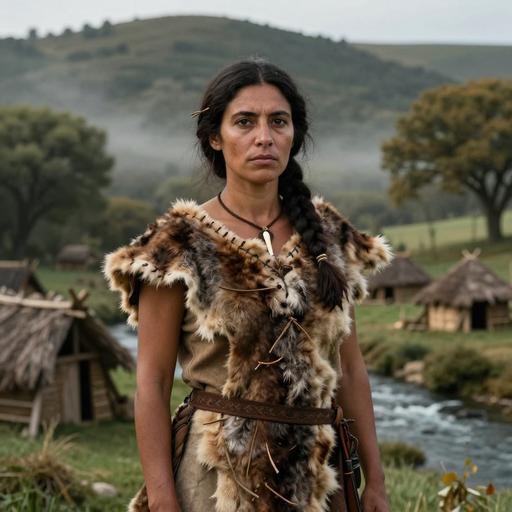
A woman buried in Spain in the Hunter-Gatherer era

Download PDF creates a visual, rasterized copy. Use Print for selectable text and better assistive-technology support.

Loading Report

Preparing your ancestry journey

Preparing the available report content...

Your report will open automatically.

Skip to main content
Reference library / Sample profile

A woman buried in Spain in the Hunter-Gatherer era

Explore the recorded context, genetic comparisons and research behind this reference sample.

SpainHunter-Gatherer Spain

A reference profile describes this sample. It does not establish a personal or family relationship.

AI portrait reconstruction for A woman buried in Spain in the Hunter-Gatherer era
AI-generated artistic reconstruction, not a photograph of the individual.
Record

Sample details

Recorded details and available lineage markers.

Individual

Iberian individual, Spain

Sample ID: Canes

Date Range

5299 BCE - 5011 BCE

Cultural Period

Hunter-Gatherer Spain

Biological Sex

Female

mtDNA Haplogroup

U5a2a

Y-DNA Haplogroup

Not available

Social Role

Gatherer (AI estimate, era-typical)

Geography

Location

Where this individual was discovered

Country Spain
Locality Canes
Coordinates 43.3550, -4.7167
Chronology

Date range

When this individual lived in the broader context of human history

Iberian individual, Spain 5299 BCE - 5011 BCE
Context

Historical context

Background information associated with the reference record.

Region & Environment

Iberia spans Atlantic-facing coasts and Mediterranean shores, along with varied interior landscapes of rivers, valleys, and uplands. During the early and middle Holocene, climates stabilized relative to the late Pleistocene, supporting shifts in available habitats and seasonal resource use across coasts and inland areas.

Historical Context

From about 10,000 to 5,600 BCE, Iberia experienced Mesolithic lifeways characterized by hunting, fishing, and gathering rather than full agricultural reliance. This era saw technological and settlement adaptations suited to changing ecosystems, with some regions later transitioning to Neolithic farming on different schedules.

Populations & Lifeways

Hunter-gatherer communities organized life around seasonal mobility and knowledge of local ecosystems. Coastal access supported fishing and shellfish gathering in appropriate areas, while inland hunting and plant collecting sustained diets across the year. Group size and mobility likely varied by resource abundance and local geography.

Archaeology & Material Culture

Mesolithic sites are often recognized through lithic technology, including microlaminar tool forms that helped maximize cutting edges and improve efficiency. Stoneworking sequences, backed artifacts, and worked flint components suggest flexible toolkits suited to diverse tasks such as hunting, processing plant foods, and working wood and hides.

Culture & Society

Mesolithic societies were likely structured through social networks of kin and exchange, though the archaeological record rarely preserves direct evidence for beliefs or institutions. Repeated technological traditions across regions can indicate shared learning and mobility connections, while site-to-site variation reflects local environmental choices.

Legacy & Transition

The Mesolithic period forms part of the long pathway toward Neolithic lifeways in Iberia. Where agriculture appears later, it does not simply replace the Mesolithic overnight; instead, transitions reflect changing interactions between people, resources, and technologies over centuries.

Analysis

Genetic comparisons

These comparisons show genetic similarity, not identity or origin. The populations listed are those whose genomes show statistical alignment to this ancient individual.

Similarity reflects shared history, not shared identity. These are analytical comparisons, not claims about who this person was.

Modern Genetic Admixture

This analysis compares the DNA profile with present-day reference populations, showing statistical similarity to modern reference populations from different regions. The excavation site records where this individual was found, not a fixed modern genetic identity.

Europe 95.2%
Northwestern European 71.2%
Finnish 36.5%
Northwestern European 17.7%
Scandinavian 9.1%
English 7.9%
Eastern European 24.1%
Asia 4.3%
Chinese & Southeast Asian 4.3%
Chinese 4.3%

Closest Modern Populations

These are the modern populations showing the closest statistical alignment to A woman buried in Spain in the Hunter-Gatherer era, ranked by genetic distance. Lower distance values indicate closer statistical similarity. Cross-region similarity can reflect shared ancestry, population movement, continuity, or later admixture.

1
Czech
2.0907
2
German East
2.3016
3
German Hamburg
2.3714
4
Polish
2.5497
5
Polish Kashubian
2.6230
6
Swedish
2.7018
7
Polish Silesian
2.9869
8
Slovakian
3.0983
9
Ukrainian Lviv
3.1966
10
Sorb Niederlausitz
3.3564
Context

Related Samples

This individual exists within a broader network of ancient samples. No ancient genome stands alone.

Individual Culture/Period Date Location Action
Iberian individual, Spain Hunter-Gatherer Spain 7320 BCE Chan do Lindeiro, Spain View
Iberian individual, Spain Hunter-Gatherer Spain 5299 BCE Canes, Spain View
Old European individual, Romania Romanian Copper Age 3512 BCE Gura Baciului, Romania View
European Hunter-Gatherers individual, Romania Mesolithic Iron Gates, Romania 7250 BCE Iron Gates. Schela Cladovei, Romania View
European Hunter-Gatherers individual, Romania Mesolithic Iron Gates, Romania 7022 BCE Iron Gates. Ostrovul Corbului, Romania View
European Hunter-Gatherers individual, Romania Mesolithic Iron Gates, Romania 7125 BCE Iron Gates. Schela Cladovei, Romania View
European Hunter-Gatherers individual, Romania Mesolithic Iron Gates, Romania 7022 BCE Ostrovul-Corbului (Mehedinți County, Hinova), Romania View
Iron Gates Hg individual, Romania 7022 BCE Iron Gates. Ostrovul Corbului, Romania View
Iberia Hg individual, Spain 5299 BCE Canes, Spain View
Iberia Hg individual, Spain 7320 BCE Chan do Lindeiro, Spain View
Starcevo individual, Romania 3512 BCE Gura Baciului, Romania View
Iron Gates Hg individual, Romania 7125 BCE Iron Gates. Schela Cladovei, Romania View
Iron Gates Hg individual, Romania 7250 BCE Iron Gates. Schela Cladovei, Romania View
Page 1
Individual Culture/Period Date Location Action
Mesolithic individual, Spain Hunter-Gatherer Spain 6015 BCE Castilla y León. León. La Brana-Arintero, Spain View
Mesolithic individual, Spain Hunter-Gatherer Spain 5978 BCE Valencian Community. Castelló/Castellón. Ares del Maestre. Cingle del Mas Nou, Spain View
Mesolithic individual, Spain Hunter-Gatherer Spain 6064 BCE Valencian Community. València/Valencia. Dos Aguas. Cueva de la Cocina, Spain View
Iberian individual, Spain Hunter-Gatherer Spain 5982 BCE León. La Braña-Arintero, Spain View
Iberian individual, Spain Hunter-Gatherer Spain 7320 BCE Chan do Lindeiro, Spain View
Iberian individual, Spain Hunter-Gatherer Spain 5299 BCE Canes, Spain View
Iberian individual, Spain Hunter-Gatherer Spain 40000 BCE Andalusia. Piñar. Granada. Cueva de la Carigüela, Spain View
Page 1
Sources

References

Scientific publications and genetic data that inform this profile.

G25 Coordinates

These coordinates represent a position in genetic space, a tool for comparison, not a conclusion. You can use these to perform custom admixture analysis in G25 Studio.

Canes,0.13377108,0.13235048,0.07066236,0.0576472,0.0429164,0.0255798,0.0071785,0.0105405,0.007379,-0.0076007,-0.00748066,-0.00041722,0.00522414,0.0121922,0.00403628,0.00561394,-0.00656708,0.00168626,0.0029646,0.002152,0.00233354,-0.0012269,0.0059912,5.61E-05,0.00061097
Continue in G25 Studio
Use code for 30% off • Expires Nov 16