
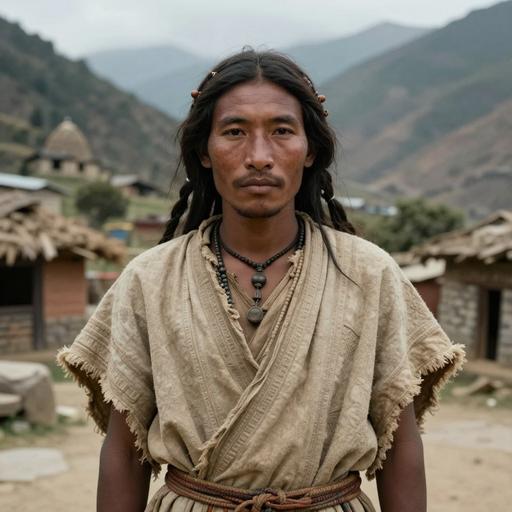
A man buried in Nepal in the Iron Age era

Download PDF creates a visual, rasterized copy. Use Print for selectable text and better assistive-technology support.

Loading Report

Preparing your ancestry journey

Preparing the available report content...

Your report will open automatically.

Skip to main content
Reference library / Sample profile

A man buried in Nepal in the Iron Age era

Explore the recorded context, genetic comparisons and research behind this reference sample.

NepalMebrak 2125BP

A reference profile describes this sample. It does not establish a personal or family relationship.

AI portrait reconstruction for A man buried in Nepal in the Iron Age era
AI-generated artistic reconstruction, not a photograph of the individual.
Record

Sample details

Recorded details and available lineage markers.

Individual

Neolithic Cultures of South Asia individual, Nepal

Sample ID: M344

Date Range

450 BCE - 100 CE

Cultural Period

Mebrak 2125BP

Biological Sex

Male

mtDNA Haplogroup

Z3a1a

Y-DNA Haplogroup

O-M134

Social Role

Laborer (AI estimate, era-typical)

Geography

Location

Where this individual was discovered

Country Nepal
Locality Mebrak Tomb. Nepal
Coordinates 28.7119, 83.8965
Chronology

Date range

When this individual lived in the broader context of human history

Neolithic Cultures of South Asia individual, Nepal 450 BCE - 100 CE
Context

Historical context

Background information associated with the reference record.

Overview

“Mebrak 2125BP” is presented here as a dated phase within the Iron Age of Nepal, associated with the named Mebrak culture and the Mustang Complex. Although the time marker is single-point, archaeological interpretation generally relies on material assemblages rather than written records.

Region & Environment

This phase is tied to Nepal’s mountainous environments, where steep terrain and variable access to arable land shape settlement choices. Upland and valley ecosystems would have supported mixed subsistence, including farming where conditions permit and grazing in nearby higher zones.

Historical Context

In the later first millennium BCE, Iron Age communities across Himalayan South Asia continued to develop local technological and stylistic traditions. The Mebrak phase, as labeled, should be understood as a regional expression within a longer sequence rather than an isolated “event.”

Populations & Lifeways

Populations likely lived in small, community-based settlements or clustered farmsteads, with daily life organized around food production and household craft activities. Regular work would have included crop cultivation and processing, tending herds, and producing or maintaining tools and everyday vessels.

Archaeology & Material Culture

Archaeology for a named cultural phase typically emphasizes consistent patterns in:

  • Pottery forms and manufacturing traits
  • Iron objects used in routine tasks
  • Domestic debris and features that indicate cooking, storage, and craft processes In mountainous regions, preservation can vary, so assemblage-based correlations with broader Mustang-linked sequences are often used to place such phases in time.

Culture & Society

Cultural identity is reflected through material choices—especially vessel styles and the organization of daily domestic production. The Mustang Complex framing suggests relationships among communities across nearby upland corridors, where similar needs and contacts could produce overlapping material traditions.

Legacy & Transition

As later centuries unfolded, cultural patterns would have continued to shift through changes in ceramic styles, tool distributions, and settlement arrangements. The Mebrak phase contributes to building block-like reconstructions of how local Iron Age traditions evolved in the Himalayan context leading beyond the date provided.

Analysis

Genetic comparisons

These comparisons show genetic similarity, not identity or origin. The populations listed are those whose genomes show statistical alignment to this ancient individual.

Similarity reflects shared history, not shared identity. These are analytical comparisons, not claims about who this person was.

Modern Genetic Admixture

This analysis compares the DNA profile with present-day reference populations, showing statistical similarity to modern reference populations from different regions. The excavation site records where this individual was found, not a fixed modern genetic identity.

Asia 87.6%
Chinese & Southeast Asian 72.6%
Chinese 62.7%
Tibetan 9.9%
Northern Asian 8.7%
Mongolian 4.5%
Siberian 4.1%
Central Asian, Northern Indian & Pakistani 6.4%
Central Asian 5.0%
Indian 1.4%
Oceania 5.3%
Melanesian 5.3%
Papuan 5.3%
Africa 3.7%
North African 2.2%
Egyptian 2.2%
West African 1.5%
Senegambian & Guinean 1.5%
America 3.5%
America 3.5%
Native American 3.5%

Closest Modern Populations

These are the modern populations showing the closest statistical alignment to A man buried in Nepal in the Iron Age era, ranked by genetic distance. Lower distance values indicate closer statistical similarity. Cross-region similarity can reflect shared ancestry, population movement, continuity, or later admixture.

1
Mongola
4.3684
2
Yugur
4.4276
3
Korean Antu
4.6626
4
Korean
4.7613
5
Tu
4.9323
6
Japanese
4.9520
7
Han Shanxi
4.9598
8
Manchu
5.1600
9
Manchu Jinzhou
5.1609
10
Xibo
5.3052
Context

Related Samples

This individual exists within a broader network of ancient samples. No ancient genome stands alone.

Individual Culture/Period Date Location Action
Indus Valley Civilization individual, Nepal Chokhopani 2800BP 1,200-450 BCE Chokhopani Tomb. Nepal, Nepal View
Neolithic Cultures of South Asia individual, Nepal Mebrak 2125BP 450 BCE-100 CE Mebrak Tomb. Nepal, Nepal View
Tibetan individual, Nepal Samdzong 1500BP 200-700 CE Samdzong Tomb. Nepal, Nepal View
Tibet Ia individual, Nepal 450 BCE-100 CE Mebrak Tomb. Nepal, Nepal View
Tibet Ia individual, Nepal 200-700 CE Samdzong Tomb. Nepal, Nepal View
Tibet Ba individual, Nepal 1,200-450 BCE Chokhopani Tomb. Nepal, Nepal View
Tibet Ia individual, Nepal 450 BCE-100 CE Mebrak Tomb. Nepal, Nepal View
Tibet Ia individual, Nepal 200-700 CE Samdzong Tomb. Nepal, Nepal View
Page 1
Individual Culture/Period Date Location Action
Neolithic Cultures of South Asia individual, Nepal Mebrak 2125BP 450 BCE-100 CE Mebrak Tomb. Nepal, Nepal View
Page 1
Sources

References

Scientific publications and genetic data that inform this profile.

G25 Coordinates

These coordinates represent a position in genetic space, a tool for comparison, not a conclusion. You can use these to perform custom admixture analysis in G25 Studio.

M344,0.02297388,-0.42979316,0.004938,-0.03807024,0.02960876,-0.00851864,0.0019054,0.00046432,-0.00201268,0.00810076,-0.06567588,-0.0067437,0.00990862,-0.00794948,-0.00965764,-0.00382952,0.0006554,-0.00035688,0.00180152,-0.00265796,0.01299116,-0.00544648,0.00370634,0.00410894,-0.01288306
Continue in G25 Studio

Our analyses use reference samples for comparison. A sample’s place, period and source help explain how to interpret a match.

Use code for 35% off • Expires Nov 30