
A man buried in Nepal in the era

Download PDF creates a visual, rasterized copy. Use Print for selectable text and better assistive-technology support.

Loading Report

Preparing your ancestry journey

Preparing the available report content...

Your report will open automatically.

Skip to main content
Reference library / Sample profile

A man buried in Nepal in the era

Explore the recorded context, genetic comparisons and research behind this reference sample.

NepalBronze Age Tibet

A reference profile describes this sample. It does not establish a personal or family relationship.

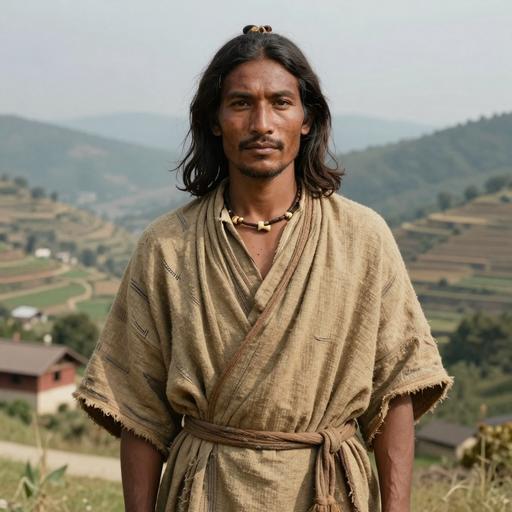
AI portrait reconstruction for A man buried in Nepal in the  era
AI-generated artistic reconstruction, not a photograph of the individual.
Record

Sample details

Recorded details and available lineage markers.

Individual

Tibet Ba individual, Nepal

Sample ID: C1

Date Range

1200 BCE - 450 BCE

Cultural Period

Bronze Age Tibet

Biological Sex

Male

mtDNA Haplogroup

D4j1b

Y-DNA Haplogroup

O-CTS5308

Social Role

Pastoralist (AI estimate, era-typical)

Geography

Location

Where this individual was discovered

Country Nepal
Locality Chokhopani Tomb. Nepal

A location map is not available for this record.

Chronology

Date range

When this individual lived in the broader context of human history

Tibet Ba individual, Nepal 1200 BCE - 450 BCE
Context

Historical context

Background information associated with the reference record.

Because the input record provides no Region, TimePeriod years, or named culture/civilization, this description remains intentionally general. It outlines the kinds of evidence historians and archaeologists use to approach Bronze Age phases in the Tibetan region, without asserting specific local chronologies beyond what is provided.

Region & Environment

The Tibetan highlands include high-elevation plateaus, valleys, and mountain passes with cold climates and strong topographic constraints on settlement. Archaeological interpretations generally emphasize the relationship between arable pockets, herding landscapes, and travel routes that connect basins. Without a specified region in the input, no single environmental regime can be safely prioritized.

Historical Context

“Bronze Age” in highland contexts is usually identified through the appearance of copper/bronze objects and related metallurgical practices, often interpreted alongside broader interaction across Inner Asian and Himalayan corridors. Such periods may represent changes in craft organization, exchange, and mortuary practice, though the timing and patterning vary substantially by local sequence.

Populations & Lifeways

Populations in highland Bronze Age phases are often understood in terms of mixed subsistence and mobility options, including herding and farming where conditions allow. Household production, seasonal movement, and the use of durable tools would have shaped daily routines. However, no securely specified population group is provided in the input.

Archaeology & Material Culture

Typical archaeological indicators for Bronze Age phases include bronze or copper-alloy implements, ornaments, and diagnostic vessel forms (when available), as well as burial assemblages that may preserve metal objects. Metalworking evidence, weapon or tool typologies, and stylistic connections to neighboring regions are used to correlate sequences.

Culture & Society

Inferences about social organization often rely on patterns in burial investment and the distribution of valuable objects, which may indicate differentiation in access to metal goods. Without named cultures or sites, this record can only describe Bronze Age social change in general terms.

Legacy & Transition

Bronze Age phases in the broader highland region often feed into later Iron Age or early historic developments, as metallurgical traditions and exchange networks continue to evolve. Determining the exact transition here requires additional chronological and archaeological context not present in the input.

Analysis

Genetic comparisons

These comparisons show genetic similarity, not identity or origin. The populations listed are those whose genomes show statistical alignment to this ancient individual.

Similarity reflects shared history, not shared identity. These are analytical comparisons, not claims about who this person was.

Modern Genetic Admixture

This analysis compares the DNA profile with present-day reference populations, showing statistical similarity to modern reference populations from different regions. The excavation site records where this individual was found, not a fixed modern genetic identity.

Asia 95.6%
Chinese & Southeast Asian 64.9%
Chinese 35.1%
Tibetan 27.6%
Indonesian Khmer Thai Myanma 2.2%
Northern Asian 18.4%
Mongolian 18.4%
Japanese & Korean 6.7%
Japanese 6.7%
Central Asian, Northern Indian & Pakistani 5.6%
Indian 5.6%
Oceania 1.8%
Melanesian 1.8%
Papuan 1.8%
Africa 1.6%
West African 1.3%
Nigerian 1.3%
America 0.9%
America 0.9%
Native American 0.9%

Closest Modern Populations

These are the modern populations showing the closest statistical alignment to A man buried in Nepal in the era, ranked by genetic distance. Lower distance values indicate closer statistical similarity. Cross-region similarity can reflect shared ancestry, population movement, continuity, or later admixture.

1
Tu
3.1997
2
Tibetan Xunhua
3.3352
3
Tibetan Gangcha
3.4018
4
Tibetan Shigatse
3.7911
5
Tibetan
4.0081
6
Tibetan Lhasa
4.0354
7
Tibetan Shannan
4.0496
8
Bonan
4.1562
9
Nepali Sherpa Rolwaling
4.2060
10
Tibetan Nagqu
4.2133
Context

Related Samples

This individual exists within a broader network of ancient samples. No ancient genome stands alone.

Individual Culture/Period Date Location Action
Indus Valley Civilization individual, Nepal Chokhopani 2800BP 1,200-450 BCE Chokhopani Tomb. Nepal, Nepal View
Neolithic Cultures of South Asia individual, Nepal Mebrak 2125BP 450 BCE-100 CE Mebrak Tomb. Nepal, Nepal View
Tibetan individual, Nepal Samdzong 1500BP 200-700 CE Samdzong Tomb. Nepal, Nepal View
Tibet Ia individual, Nepal 450 BCE-100 CE Mebrak Tomb. Nepal, Nepal View
Tibet Ia individual, Nepal 200-700 CE Samdzong Tomb. Nepal, Nepal View
Tibet Ba individual, Nepal 1,200-450 BCE Chokhopani Tomb. Nepal, Nepal View
Tibet Ia individual, Nepal 450 BCE-100 CE Mebrak Tomb. Nepal, Nepal View
Tibet Ia individual, Nepal 200-700 CE Samdzong Tomb. Nepal, Nepal View
Page 1
Individual Culture/Period Date Location Action
Tibet Ba individual, Nepal 1,200-450 BCE Chokhopani Tomb. Nepal, Nepal View
Page 1
Sources

References

Scientific publications and genetic data that inform this profile.

G25 Coordinates

These coordinates represent a position in genetic space, a tool for comparison, not a conclusion. You can use these to perform custom admixture analysis in G25 Studio.

C1,0.02075564,-0.41295702,0.00814342,-0.03773652,0.00991766,0.00752882,0.00715352,0.00875234,0.00366794,0.00993278,-0.05279718,-0.0056371,0.00723408,-0.00106372,-0.00661124,-0.00535238,0.0022323,0.0006043,-0.00270026,0.00189272,0.00887176,0.00931426,0.00532158,-0.00028954,0.02021012
Continue in G25 Studio

Our analyses use reference samples for comparison. A sample’s place, period and source help explain how to interpret a match.

Use code for 35% off • Expires Nov 30