A man buried in Nepal in the Bronze Age era

Download PDF creates a visual, rasterized copy. Use Print for selectable text and better assistive-technology support.

Loading Report

Preparing your ancestry journey

Preparing the available report content...

Your report will open automatically.

Skip to main content
Reference library / Sample profile

A man buried in Nepal in the Bronze Age era

Explore the recorded context, genetic comparisons and research behind this reference sample.

NepalChokhopani 2800BP

A reference profile describes this sample. It does not establish a personal or family relationship.

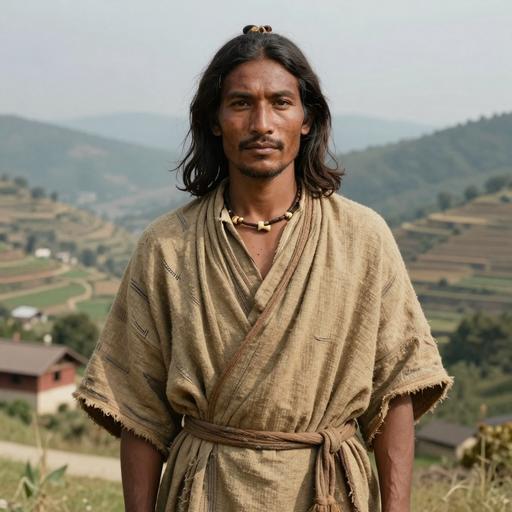
AI portrait reconstruction for A man buried in Nepal in the Bronze Age era
AI-generated artistic reconstruction, not a photograph of the individual.
Record

Sample details

Recorded details and available lineage markers.

Individual

Indus Valley Civilization individual, Nepal

Sample ID: C1

Date Range

1200 BCE - 450 BCE

Cultural Period

Chokhopani 2800BP

Biological Sex

Male

mtDNA Haplogroup

D4j1b

Y-DNA Haplogroup

O-M117

Social Role

Laborer (AI estimate, era-typical)

Geography

Location

Where this individual was discovered

Country Nepal
Locality Chokhopani Tomb. Nepal
Coordinates 28.7119, 83.6490
Chronology

Date range

When this individual lived in the broader context of human history

Indus Valley Civilization individual, Nepal 1200 BCE - 450 BCE
Context

Historical context

Background information associated with the reference record.

Chokhopani, approximately 2800 BP (Before Present), refers to a distinct cultural and historical era characterized by its unique advancements, socio-political structures, artistry, and interactions with the environment. This period can be traced back to a specific region, possibly in the vicinity of present-day South or Southeast Asia, where archaeological findings have shed light on the complexity and innovation of the Chokhopani people.

Geographical Context

The Chokhopani civilization thrived in a landscape rich with rivers, fertile plains, and dense forests. This environment supported a diverse ecosystem and provided the means for agricultural innovations. The river systems not only enabled irrigation and stable food production but also facilitated trade routes that connected Chokhopani to other contemporary cultures.

Socio-Political Structure

The Chokhopani society was structured around a hierarchical system with a prominent ruling class. This class, likely consisting of priests or warrior elites, held significant influence over religious and administrative matters. Local governance was conducted through a network of settlements that reported back to a central authority, indicating a complex system of political organization. Evidence suggests the existence of city-states, each governed by its own council but united under broader cultural traditions and religious beliefs.

Economy and Trade

Agriculture formed the backbone of the Chokhopani economy, with the cultivation of crops like barley, wheat, and rice. The region's favorable climate allowed for surplus production, supporting population growth and urbanization. Alongside agriculture, Chokhopani engaged in metallurgy, crafting tools and ornaments from copper, bronze, and iron.

Trade networks extended far beyond the Chokhopani heartland, as evidenced by the diversity of artifacts found in archaeological sites. It's believed that the civilization traded with the distant cultures of Mesopotamia, the Indus Valley, and beyond, exchanging goods such as textiles, spices, and crafted items, indicating a high degree of commercial sophistication.

Art and Culture

Chokhopani art reflects both the religious and social dynamics of the era. The discovery of intricately designed pottery, sculptures, and jewelry highlights a profound understanding of aesthetics and technical skill. Religious motifs dominated artistic expression, with figures often symbolizing gods, nature, or cosmological themes.

Music and dance were integral components of Chokhopani culture, celebrated during festivals and religious ceremonies. Songs and dances likely held both intergenerational significance and served as a means of preserving oral traditions.

Religion and Belief Systems

The Chokhopani civilization practiced a polytheistic religion, with a pantheon of gods associated with natural elements, agriculture, and societal values. Temples and shrines were common, serving as both places of worship and community gathering spaces. Rituals, possibly led by a dedicated priest class, would have played a central role in reinforcing the societal order and connecting the people to their deities.

Technological and Scientific Advancements

The Chokhopani are credited with advancements in various fields, including engineering, mathematics, and astronomy. Their understanding of agricultural cycles and celestial patterns improved farming techniques and informed their religious calendars. The remains of advanced irrigation systems and urban planning indicate a high level of technical expertise.

Legacy and Influence

The Chokhopani civilization left a lasting legacy through its contributions to art, trade, and cross-cultural interactions in the region. Subsequent cultures may have drawn from Chokhopani innovations in governance, agriculture, and religious practices. The study of Chokhopani provides valuable insights into the complexities and achievements of early human societies and their capacity for growth and adaptation.

In conclusion, the era and culture of Chokhopani 2800 BP represents a rich tapestry of human achievement, characterized by a blend of environmental harmony, sociopolitical sophistication, and cultural richness that continues to intrigue and inspire scholars in understanding the human past.

Analysis

Genetic comparisons

These comparisons show genetic similarity, not identity or origin. The populations listed are those whose genomes show statistical alignment to this ancient individual.
Similarity reflects shared history, not shared identity. These are analytical comparisons, not claims about who this person was.

Modern Genetic Admixture

This analysis compares the DNA profile with present-day reference populations, showing statistical similarity to modern reference populations from different regions. The excavation site records where this individual was found, not a fixed modern genetic identity.

Asia 95.6%
Chinese & Southeast Asian 64.9%
Chinese 35.1%
Tibetan 27.6%
Indonesian Khmer Thai Myanma 2.2%
Northern Asian 18.4%
Mongolian 18.4%
Japanese & Korean 6.7%
Japanese 6.7%
Central Asian, Northern Indian & Pakistani 5.6%
Indian 5.6%
Oceania 1.8%
Melanesian 1.8%
Papuan 1.8%
Africa 1.6%
West African 1.3%
Nigerian 1.3%
America 0.9%
America 0.9%
Native American 0.9%

Closest Modern Populations

These are the modern populations showing the closest statistical alignment to A man buried in Nepal in the Bronze Age era, ranked by genetic distance. Lower distance values indicate closer statistical similarity. Cross-region similarity can reflect shared ancestry, population movement, continuity, or later admixture.

1
Tu
3.1997
2
Tibetan Xunhua
3.3352
3
Tibetan Gangcha
3.4018
4
Tibetan Shigatse
3.7911
5
Tibetan
4.0081
6
Tibetan Lhasa
4.0354
7
Tibetan Shannan
4.0496
8
Bonan
4.1562
9
Nepali Sherpa Rolwaling
4.2060
10
Tibetan Nagqu
4.2133
Context

Related Samples

This individual exists within a broader network of ancient samples. No ancient genome stands alone.

Individual Culture/Period Date Location Action
Indus Valley Civilization individual, Nepal Chokhopani 2800BP 1,200-450 BCE Chokhopani Tomb. Nepal, Nepal View
Neolithic Cultures of South Asia individual, Nepal Mebrak 2125BP 450 BCE-100 CE Mebrak Tomb. Nepal, Nepal View
Tibetan individual, Nepal Samdzong 1500BP 200-700 CE Samdzong Tomb. Nepal, Nepal View
Tibet Ia individual, Nepal 450 BCE-100 CE Mebrak Tomb. Nepal, Nepal View
Tibet Ia individual, Nepal 200-700 CE Samdzong Tomb. Nepal, Nepal View
Tibet Ba individual, Nepal 1,200-450 BCE Chokhopani Tomb. Nepal, Nepal View
Tibet Ia individual, Nepal 450 BCE-100 CE Mebrak Tomb. Nepal, Nepal View
Tibet Ia individual, Nepal 200-700 CE Samdzong Tomb. Nepal, Nepal View
Page 1
Individual Culture/Period Date Location Action
Indus Valley Civilization individual, Nepal Chokhopani 2800BP 1,200-450 BCE Chokhopani Tomb. Nepal, Nepal View
Page 1
Sources

References

Scientific publications and genetic data that inform this profile.

G25 Coordinates

These coordinates represent a position in genetic space, a tool for comparison, not a conclusion. You can use these to perform custom admixture analysis in G25 Studio.

C1,0.02075564,-0.41295702,0.00814342,-0.03773652,0.00991766,0.00752882,0.00715352,0.00875234,0.00366794,0.00993278,-0.05279718,-0.0056371,0.00723408,-0.00106372,-0.00661124,-0.00535238,0.0022323,0.0006043,-0.00270026,0.00189272,0.00887176,0.00931426,0.00532158,-0.00028954,0.02021012
Continue in G25 Studio

Our analyses use reference samples for comparison. A sample’s place, period and source help explain how to interpret a match.

Use code for 35% off • Expires Nov 30