A woman buried in Spain in the Middle Neolithic era

Download PDF creates a visual, rasterized copy. Use Print for selectable text and better assistive-technology support.

Loading Report

Preparing your ancestry journey

Preparing the available report content...

Your report will open automatically.

Skip to main content
Reference library / Sample profile

A woman buried in Spain in the Middle Neolithic era

Explore the recorded context, genetic comparisons and research behind this reference sample.

SpainMiddle Neolithic Spain

A reference profile describes this sample. It does not establish a personal or family relationship.

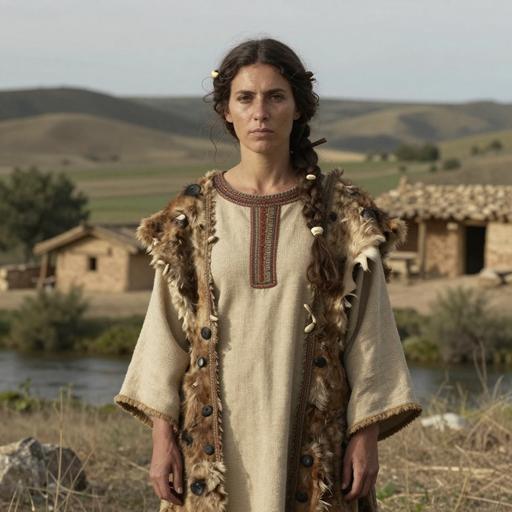
AI portrait reconstruction for A woman buried in Spain in the Middle Neolithic era
AI-generated artistic reconstruction, not a photograph of the individual.
Record

Sample details

Recorded details and available lineage markers.

Individual

Neolithic European individual, Spain

Sample ID: LD1174

Date Range

2578 BCE - 2459 BCE

Cultural Period

Middle Neolithic Spain

Biological Sex

Female

mtDNA Haplogroup

U5b2b5

Y-DNA Haplogroup

Not available

Social Role

Farmer (AI estimate, era-typical)

Geography

Location

Where this individual was discovered

Country Spain
Locality Lucena. Sima del Angel
Coordinates 37.4061, -4.4164
Chronology

Date range

When this individual lived in the broader context of human history

Neolithic European individual, Spain 2578 BCE - 2459 BCE
Context

Historical context

Background information associated with the reference record.

Middle Neolithic Spain (roughly 4500–3500 BCE) represents a substantial phase of village-based lifeways founded on crop cultivation and animal husbandry.

Region & Environment

Neolithic communities across Spain adapted to diverse ecologies, including fertile areas suitable for cultivation and more constrained settings where pastoral strategies were important. Availability of local stone and clay influenced tool and pottery production. Settlement placement reflects practical concerns such as water access, arable land proximity, and long-term habitability of local landscapes.

Historical Context

The Iberian Neolithic is part of broader European developments in which farming and herding became established more widely. In the Middle Neolithic, communities maintained and elaborated these ways of life while developing recognizable regional styles in pottery and artifacts. Chronological ordering relies heavily on ceramic typologies and associated material traits.

Populations & Lifeways

Populations were largely sedentary, organized around agricultural cycles and managed herds. Household labor supported food production, storage, and preparation, along with continuous tool maintenance. Over time, settlement choices and artifact patterns indicate how communities expanded, reorganized, or shifted emphasis within their local territories.

Archaeology & Material Culture

Material culture for this period commonly features ceramics used for storage and cooking, along with stone toolkits that reflect grinding, cutting, and woodworking activities. The distribution of ceramic styles and vessel forms can mark phases within the Middle Neolithic and help compare regions. Evidence from settlement contexts—floors, pits, and refuse—contributes to reconstructions of how domestic tasks were organized.

Culture & Society

Cultural identity in the Middle Neolithic is visible through patterned artifact traditions, especially in pottery and learned craft techniques. Social structures are best inferred indirectly: from the size and organization of settlements, from consistency of household production, and from differences in access to particular material resources. Long-distance interaction is suggested where regional artifact traits align with wider Mediterranean or European patterns.

Legacy & Transition

As the Neolithic progressed, many regions moved toward evolving material traditions associated with later Neolithic phases and ultimately toward the Chalcolithic. In Spain, transitions are visible in changing ceramic styles and shifts in technological emphasis. Understanding the Middle Neolithic is essential for tracing how Iberian farming communities reorganized over subsequent millennia.

Analysis

Genetic comparisons

These comparisons show genetic similarity, not identity or origin. The populations listed are those whose genomes show statistical alignment to this ancient individual.

Similarity reflects shared history, not shared identity. These are analytical comparisons, not claims about who this person was.

Modern Genetic Admixture

This analysis compares the DNA profile with present-day reference populations, showing statistical similarity to modern reference populations from different regions. The excavation site records where this individual was found, not a fixed modern genetic identity.

Europe 99.5%
Southern European 99.5%
Iberian 63.5%
Sardinian 30.0%
Italian 5.9%

Closest Modern Populations

These are the modern populations showing the closest statistical alignment to A woman buried in Spain in the Middle Neolithic era, ranked by genetic distance. Lower distance values indicate closer statistical similarity. Cross-region similarity can reflect shared ancestry, population movement, continuity, or later admixture.

1
Sardinian
4.0507
2
Spanish La Rioja
4.7780
3
Spanish Castilla La Mancha
5.1275
4
French Corsica
5.1695
5
Spanish Pirineu
5.1833
6
Spanish Castello
5.1945
7
Spanish Aragon
5.2116
8
Spanish Burgos
5.2234
9
Spanish Navarra
5.2236
10
Basque Soule
5.2348
Context

Related Samples

This individual exists within a broader network of ancient samples. No ancient genome stands alone.

Individual Culture/Period Date Location Action
Neolithic European individual, Spain Middle Neolithic Spain 2578 BCE Lucena. Sima del Angel, Spain View
Iberian individual, Spain Bronze Age Spain 1751 BCE Lucena. Covacha del Angel, Spain View
Western European Neolithic individual, Portugal Middle Neolithic Portugal 3008 BCE Lorga de Din, Portugal View
Western European Neolithic individual, Portugal Middle Neolithic Portugal 2566 BCE Lorga de Din, Portugal View
Iberian Ba individual, Spain 1751 BCE Lucena. Covacha del Angel, Spain View
Iberia Chl individual, Spain 2578 BCE Lucena. Sima del Angel, Spain View
Iberia Chl individual, Portugal 2566 BCE Lorga de Din, Portugal View
Iberia Chl individual, Portugal 3008 BCE Lorga de Din, Portugal View
Page 1
Individual Culture/Period Date Location Action
Neolithic European individual, Spain Middle Neolithic Spain 2578 BCE Lucena. Sima del Angel, Spain View
Page 1
Sources

References

Scientific publications and genetic data that inform this profile.

G25 Coordinates

These coordinates represent a position in genetic space, a tool for comparison, not a conclusion. You can use these to perform custom admixture analysis in G25 Studio.

LD1174,0.12054508,0.15991964,0.03438578,-0.02538538,0.0570104,-0.01367904,-0.00168372,0.00638832,0.0361106,0.06090234,-0.00596302,0.0143444,-0.02526512,-0.0120906,-0.0027134,0.00338232,0.00197726,-0.00104978,-0.00112298,-0.00293094,0.00259854,0.00557658,-0.01192756,-0.01726042,0.00401822
Continue in G25 Studio
Use code for 30% off • Expires Nov 16