A man buried in Spain in the Bronze Age era

Download PDF creates a visual, rasterized copy. Use Print for selectable text and better assistive-technology support.

Loading Report

Preparing your ancestry journey

Preparing the available report content...

Your report will open automatically.

Skip to main content
Reference library / Sample profile

A man buried in Spain in the Bronze Age era

Explore the recorded context, genetic comparisons and research behind this reference sample.

SpainSpain BA

A reference profile describes this sample. It does not establish a personal or family relationship.

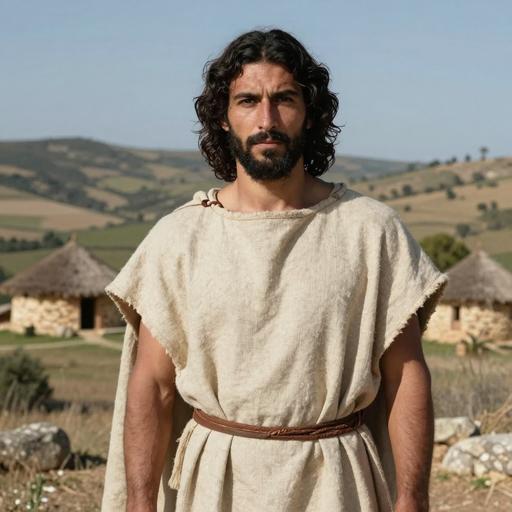
AI portrait reconstruction for A man buried in Spain in the Bronze Age era
AI-generated artistic reconstruction, not a photograph of the individual.
Record

Sample details

Recorded details and available lineage markers.

Individual

Iberian individual, Spain

Sample ID: COV20126

Date Range

1751 BCE - 1615 BCE

Cultural Period

Spain BA

Biological Sex

Male

mtDNA Haplogroup

L2a1

Y-DNA Haplogroup

G2a2b

Social Role

Laborer (AI estimate, era-typical)

Geography

Location

Where this individual was discovered

Country Spain
Locality Lucena. Covacha del Angel
Coordinates 37.4061, -4.4164
Chronology

Date range

When this individual lived in the broader context of human history

Iberian individual, Spain 1751 BCE - 1615 BCE
Context

Historical context

Background information associated with the reference record.

Region & Environment

This era unfolded across much of present-day Spain, with major activity areas particularly associated with the southeastern interior and nearby regions. The landscape combined fertile river valleys, plateaus suitable for agriculture and pasture, and rugged uplands that could support dispersed settlement and resource extraction.

Historical Context

Between roughly 2200 and 1550 BCE, Spain’s Bronze Age communities developed in a broader European context of long-distance interaction, evolving metallurgical knowledge, and shifting political and economic organization. In the later phase of the period, Iberian regions increasingly show standardized material signatures that archaeologists associate with Bronze Age cultural complexes.

Populations & Lifeways

Populations were primarily agricultural, supplemented by herding and exploitation of local resources such as stone, timber, and minerals. Lifeways likely varied by location: some communities favored more defensible or clustered settlements, while others used the surrounding countryside for cultivation and grazing. Dietary reconstruction depends on plant and animal remains, but overall subsistence would have relied on mixed farming and livestock management.

Archaeology & Material Culture

The El Argar tradition is most visible archaeologically through distinctive patterns in metal production and distribution, including bronze artifacts and the organization of craft practices. Archaeological assemblages commonly feature ceramics, metalwork, and evidence for social differentiation in mortuary practices. Settlement excavation often reveals structures and activity areas that suggest sustained local production and maintenance of economic networks.

Culture & Society

Material culture reflects social organization in which access to valuable materials and craft output mattered. The archaeological record is consistent with communities that could coordinate labor for agriculture, construction, and metalworking, and with differences in status expressed through burial treatment and artifact quantity or type. Such patterns do not require a single political model, but they do indicate more structured social relations than in earlier prehistoric periods.

Legacy & Transition

By the end of the span (around 1550 BCE), the El Argar-associated horizon gives way to subsequent Bronze Age developments across Iberia. Changes in material culture, settlement use, and regional connections mark a transition rather than an abrupt replacement, setting the stage for later Iron Age trajectories in the peninsula.

Analysis

Genetic comparisons

These comparisons show genetic similarity, not identity or origin. The populations listed are those whose genomes show statistical alignment to this ancient individual.

Similarity reflects shared history, not shared identity. These are analytical comparisons, not claims about who this person was.

Modern Genetic Admixture

This analysis compares the DNA profile with present-day reference populations, showing statistical similarity to modern reference populations from different regions. The excavation site records where this individual was found, not a fixed modern genetic identity.

Europe 99.0%
Southern European 87.6%
Iberian 53.0%
Sardinian 22.6%
Italian 12.0%
Northwestern European 11.4%
English 7.5%
Northwestern European 3.9%
Asia 0.8%
Chinese & Southeast Asian 0.8%
Chinese 0.8%

Closest Modern Populations

These are the modern populations showing the closest statistical alignment to A man buried in Spain in the Bronze Age era, ranked by genetic distance. Lower distance values indicate closer statistical similarity. Cross-region similarity can reflect shared ancestry, population movement, continuity, or later admixture.

1
Spanish La Rioja
3.4774
2
Spanish Pirineu
3.6881
3
Spanish Castello
3.7672
4
Spanish Menorca
3.8970
5
Spanish Cantabria
3.9045
6
Spanish Castilla La Mancha
3.9177
7
Spanish Terres De L'ebre
3.9372
8
Spanish Valencia
3.9385
9
Spanish Burgos
3.9720
10
French Bigorre
3.9920
Context

Related Samples

This individual exists within a broader network of ancient samples. No ancient genome stands alone.

Individual Culture/Period Date Location Action
Neolithic European individual, Spain Middle Neolithic Spain 2578 BCE Lucena. Sima del Angel, Spain View
Iberian individual, Spain Bronze Age Spain 1751 BCE Lucena. Covacha del Angel, Spain View
Western European Neolithic individual, Portugal Middle Neolithic Portugal 3008 BCE Lorga de Din, Portugal View
Western European Neolithic individual, Portugal Middle Neolithic Portugal 2566 BCE Lorga de Din, Portugal View
Iberian Ba individual, Spain 1751 BCE Lucena. Covacha del Angel, Spain View
Iberia Chl individual, Spain 2578 BCE Lucena. Sima del Angel, Spain View
Iberia Chl individual, Portugal 2566 BCE Lorga de Din, Portugal View
Iberia Chl individual, Portugal 3008 BCE Lorga de Din, Portugal View
Page 1
Individual Culture/Period Date Location Action
Iberian individual, Spain Bronze Age Spain 1600 BCE La Rioja. Cueva de los Lagos, Spain View
Iberian individual, Spain Bronze Age Spain 1863 BCE El Portalon Cave. Sierra de Atapuerca, Spain View
Iberian individual, Spain Bronze Age Spain 2100 BCE Andalusia. Priego de Córdoba, Spain View
Iberian individual, Spain Bronze Age Spain 1751 BCE Lucena. Covacha del Angel, Spain View
Page 1
Sources

References

Scientific publications and genetic data that inform this profile.

G25 Coordinates

These coordinates represent a position in genetic space, a tool for comparison, not a conclusion. You can use these to perform custom admixture analysis in G25 Studio.

COV20126,0.12305908,0.15522,0.03834304,-0.01513386,0.05511134,-0.0089123,4.358E-05,0.00744242,0.03162924,0.05057398,-0.00604524,0.01123266,-0.0186583,-0.00634898,-0.00617014,0.00445706,0.00495888,-0.00072562,0.00017334,-0.00243624,0.0014498,0.00395158,-0.00863508,-0.01569974,0.00321784
Continue in G25 Studio
Use code for 30% off • Expires Nov 16