An individual buried in Portugal in the era

Download PDF creates a visual, rasterized copy. Use Print for selectable text and better assistive-technology support.

Loading Report

Preparing your ancestry journey

Preparing the available report content...

Your report will open automatically.

Skip to main content
Reference library / Sample profile

An individual buried in Portugal in the era

Explore the recorded context, genetic comparisons and research behind this reference sample.

PortugalChalcolithic Iberia

A reference profile describes this sample. It does not establish a personal or family relationship.

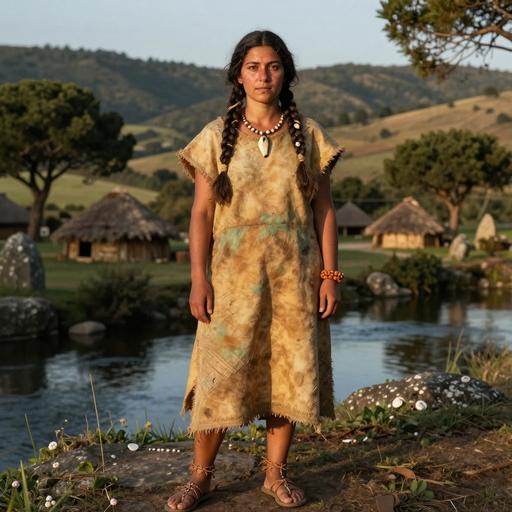
AI portrait reconstruction for An individual buried in Portugal in the  era
AI-generated artistic reconstruction, not a photograph of the individual.
Record

Sample details

Recorded details and available lineage markers.

Individual

Iberia Chl individual, Portugal

Sample ID: LU339

Date Range

3008 BCE - 2783 BCE

Cultural Period

Chalcolithic Iberia

Biological Sex

Not known

mtDNA Haplogroup

H

Y-DNA Haplogroup

Not available

Social Role

Farmer (AI estimate, era-typical)

Geography

Location

Where this individual was discovered

Country Portugal
Locality Lorga de Din

A location map is not available for this record.

Chronology

Date range

When this individual lived in the broader context of human history

Iberia Chl individual, Portugal 3008 BCE - 2783 BCE
Context

Historical context

Background information associated with the reference record.

Overview

Chalcolithic Iberia (Copper–Stone Age) is the phase when copper working appears more clearly in the archaeological record while many aspects of Neolithic lifeways continue. The period is characterized by experimentation with early metal technology, shifting regional interaction, and distinctive patterns in pottery and burial.

Region & Environment

Iberia’s diverse environments—fertile river basins, coastal zones, and upland regions—supported mixed farming and herding. Where copper was accessible, either through local deposits or through exchange, communities could incorporate metal into tools and adornment.

Historical Context

Chalcolithic societies bridged earlier Neolithic patterns and the later Bronze Age expansion of metallurgy. The archaeological record suggests growing craft activity and increasing connectivity across regions, visible through recurring motifs and shared forms in material culture.

Populations & Lifeways

Populations continued to rely on domesticated plants and animals, using established agricultural routines. Metalworking likely involved specialized or semi-specialized individuals and small-scale production, while most everyday work still depended heavily on stone tools and organic technologies.

Archaeology & Material Culture

Material culture includes:

  • Copper items (often limited in quantity) such as small tools, points, or ornaments
  • A strong background of stone tools for cutting, grinding, and woodworking
  • Pottery styles that vary by region and help define chronological phases
  • Burial practices that may include megalithic or other monument types depending on locality Because preservation and excavation coverage vary, interpretations should focus on robust patterns such as the appearance of copper objects and changes in mortuary treatment.

Culture & Society

Chalcolithic societies likely displayed emerging social differentiation, potentially linked to access to copper, craft skill, and exchange. Ritual and mortuary behavior became a key arena for expressing identity and social relationships, with differences between regions suggesting locally meaningful traditions.

Legacy & Transition

The Chalcolithic period laid groundwork for later metallurgical developments by familiarizing communities with smelting and casting processes. Transitions toward the Bronze Age are visible archaeologically through increased metal use, changes in artifact typology, and shifts in settlement and burial patterns.

Analysis

Genetic comparisons

These comparisons show genetic similarity, not identity or origin. The populations listed are those whose genomes show statistical alignment to this ancient individual.

Similarity reflects shared history, not shared identity. These are analytical comparisons, not claims about who this person was.

Modern Genetic Admixture

This analysis compares the DNA profile with present-day reference populations, showing statistical similarity to modern reference populations from different regions. The excavation site records where this individual was found, not a fixed modern genetic identity.

Europe 100.0%
Southern European 100.0%
Iberian 49.6%
Sardinian 29.8%
Italian 20.7%

Closest Modern Populations

These are the modern populations showing the closest statistical alignment to An individual buried in Portugal in the era, ranked by genetic distance. Lower distance values indicate closer statistical similarity. Cross-region similarity can reflect shared ancestry, population movement, continuity, or later admixture.

1
Sardinian
2.3968
2
French Corsica
5.9793
3
Spanish La Rioja
6.6265
4
Spanish Castilla La Mancha
6.8764
5
Spanish Menorca
6.9261
6
Spanish Murcia
6.9283
7
Spanish Castello
6.9301
8
Spanish Pirineu
6.9852
9
Spanish Andalucia
6.9869
10
Spanish Aragon
7.0186
Context

Related Samples

This individual exists within a broader network of ancient samples. No ancient genome stands alone.
Individual Culture/Period Date Location Action
Neolithic European individual, Spain Middle Neolithic Spain 2578 BCE Lucena. Sima del Angel, Spain View
Iberian individual, Spain Bronze Age Spain 1751 BCE Lucena. Covacha del Angel, Spain View
Western European Neolithic individual, Portugal Middle Neolithic Portugal 3008 BCE Lorga de Din, Portugal View
Western European Neolithic individual, Portugal Middle Neolithic Portugal 2566 BCE Lorga de Din, Portugal View
Iberian Ba individual, Spain 1751 BCE Lucena. Covacha del Angel, Spain View
Iberia Chl individual, Spain 2578 BCE Lucena. Sima del Angel, Spain View
Iberia Chl individual, Portugal 2566 BCE Lorga de Din, Portugal View
Iberia Chl individual, Portugal 3008 BCE Lorga de Din, Portugal View
Page 1
Individual Culture/Period Date Location Action
Iberia Chl individual, Spain 2578 BCE Lucena. Sima del Angel, Spain View
Iberia Chl individual, Portugal 2566 BCE Lorga de Din, Portugal View
Iberia Chl individual, Portugal 3008 BCE Lorga de Din, Portugal View
Page 1
Sources

References

Scientific publications and genetic data that inform this profile.

G25 Coordinates

These coordinates represent a position in genetic space, a tool for comparison, not a conclusion. You can use these to perform custom admixture analysis in G25 Studio.

LU339,0.12003436,0.16105756,0.02695122,-0.03848266,0.05776752,-0.0194896,-0.00210484,0.00581936,0.03853876,0.0684937,-0.00447342,0.0147476,-0.02619696,-0.0139722,-0.00879276,0.00442168,0.01036158,-0.00039794,-0.00067274,-0.00374406,0.0004459,0.00471866,-0.01220532,-0.01890682,0.00425969
Continue in G25 Studio
Use code for 30% off • Expires Nov 16