A man buried in Canada in the Pre-Columbian North America era

Download PDF creates a visual, rasterized copy. Use Print for selectable text and better assistive-technology support.

Loading Report

Preparing your ancestry journey

Preparing the available report content...

Your report will open automatically.

Skip to main content
Reference library / Sample profile

A man buried in Canada in the Pre-Columbian North America era

Explore the recorded context, genetic comparisons and research behind this reference sample.

CanadaCanada MDorset

A reference profile describes this sample. It does not establish a personal or family relationship.

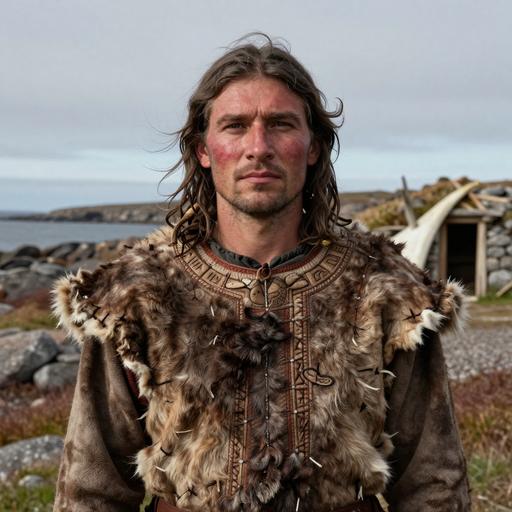
AI portrait reconstruction for A man buried in Canada in the Pre-Columbian North America era
AI-generated artistic reconstruction, not a photograph of the individual.
Record

Sample details

Recorded details and available lineage markers.

Individual

Arctic Cultures individual, Canada

Sample ID: MARC481

Date Range

1 CE - 800 CE

Cultural Period

Canada MDorset

Biological Sex

Male

mtDNA Haplogroup

Not available

Y-DNA Haplogroup

F-M89

Social Role

Hunter (AI estimate, era-typical)

Geography

Location

Where this individual was discovered

Country Canada
Locality Newfoundland. Port aux Choix
Chronology

Date range

When this individual lived in the broader context of human history

Arctic Cultures individual, Canada 1 CE - 800 CE
Context

Historical context

Background information associated with the reference record.

Middle Dorset communities in Arctic Canada lived through a maritime-focused seasonal cycle, producing small, finely made stone tools and organizing dwellings and activities suited to cold winters. The 0–800 CE period captures a stage within the broader Dorset sequence showing regional variation in how groups exploited coastal environments.

Region & Environment

Middle Dorset is documented across parts of Arctic and sub-Arctic Canada, in settings where winters were long and sea-ice conditions affected access to hunting grounds. Many communities lived near coastlines and other places that supported reliable marine resources. Local environmental factors—such as shoreline form, snow conditions, and the timing of animal availability—would have influenced seasonal movement and site choice.

Historical Context

The Middle Dorset period (about 0–800 CE) belongs to the broader Dorset tradition, following earlier Dorset developments and preceding the Late Dorset phase. During these centuries, groups maintained Dorset technological and settlement patterns while adapting to local landscapes. Change over time is best approached through archaeological differences in toolmaking and site organization rather than through a single, precisely dated historical turning point.

Populations & Lifeways

Middle Dorset populations are commonly described as small mobile groups oriented toward hunting and processing marine animal resources. Seasonal routines likely involved shifting locations as conditions changed and as animals became accessible. Everyday lifeways revolved around completing tasks necessary for winter living—repairing tools and equipment, processing hunted animals, and preparing materials for travel and storage.

Archaeology & Material Culture

Archaeologically, Middle Dorset sites typically yield stone tools and features that indicate household activity and use of winter-adapted living spaces. Toolkits often include small, carefully crafted implements suitable for cutting and processing. While organic artifacts may not always survive, the combination of tool types, site features, and repeated patterns of activity areas supports the view of practiced, hunting-oriented domestic economies.

Culture & Society

Middle Dorset culture is expressed through patterned technological traditions—particularly in stone tool manufacture—and through consistent practices visible in the layout and use of sites. Social organization is not fully knowable from material remains alone, but household cooperation for hunting and production is strongly implied by the demands of maritime subsistence and cold-weather maintenance. Shared knowledge of seasonal resources likely contributed to predictable cycles of movement and work.

Legacy & Transition

The Middle Dorset phase transitions into the Late Dorset period, with archaeological sequences showing changes in the composition and style of material culture. These developments are reflected in shifting tool traditions and differences in how sites were used across time. The overall legacy is the continued Arctic adaptation within the Dorset tradition, culminating in later variations that follow after 800 CE.

Analysis

Genetic comparisons

These comparisons show genetic similarity, not identity or origin. The populations listed are those whose genomes show statistical alignment to this ancient individual.
Similarity reflects shared history, not shared identity. These are analytical comparisons, not claims about who this person was.

Modern Genetic Admixture

This analysis compares the DNA profile with present-day reference populations, showing statistical similarity to modern reference populations from different regions. The excavation site records where this individual was found, not a fixed modern genetic identity.

Europe 55.2%
Southern European 24.0%
Sardinian 18.5%
Italian 5.5%
Eastern European 18.6%
Northwestern European 12.7%
Northwestern European 12.4%
Asia 36.8%
Northern Asian 21.2%
Siberian 13.4%
Mongolian 7.8%
Chinese & Southeast Asian 5.7%
Chinese 5.7%
Central Asian, Northern Indian & Pakistani 5.6%
Central Asian 5.6%
Northern West Asian 2.2%
Anatolian 2.2%
Arab, Egyptian & Levantine 2.0%
Arabian 2.0%
Africa 8.0%
North African 8.0%
Egyptian 4.8%
North African 3.2%

Closest Modern Populations

These are the modern populations showing the closest statistical alignment to A man buried in Canada in the Pre-Columbian North America era, ranked by genetic distance. Lower distance values indicate closer statistical similarity. Cross-region similarity can reflect shared ancestry, population movement, continuity, or later admixture.

1
Tatar Mishar
7.3645
2
Tatar Kazan
7.4595
3
Komi A
9.2042
4
Tatar Lipka
9.3496
5
Besermyan
9.6210
6
Turkish Rumeli
9.7001
7
Turkish Deliorman
9.9826
8
Russian Leshukonsky
10.2433
9
Saami Kola
10.2769
10
Roma Barcelona
10.3278
Context

Related Samples

This individual exists within a broader network of ancient samples. No ancient genome stands alone.

Individual Culture/Period Date Location Action
Arctic Cultures individual, Canada Late Dorset Culture, Canada 800 CE Truelove Lowland. North Devon Island, Canada View
Arctic Cultures individual, Canada Middle Dorset Culture, Canada 1 CE Newfoundland. Englee, Canada View
Arctic Cultures individual, Canada Middle Dorset Culture, Canada 1 CE Newfoundland. Port aux Choix, Canada View
America North Ancient individual, Canada 800 CE Truelove Lowland. North Devon Island, Canada View
America North Ancient individual, Canada 1 CE Newfoundland. Englee, Canada View
America North Ancient individual, Canada 1 CE Newfoundland. Port aux Choix, Canada View
Page 1
Individual Culture/Period Date Location Action
Arctic Cultures individual, Canada Middle Dorset Culture, Canada 50 CE Victoria Island, Canada View
Arctic Cultures individual, Canada Middle Dorset Culture, Canada 1 CE Newfoundland. Englee, Canada View
Arctic Cultures individual, Canada Middle Dorset Culture, Canada 1 CE Newfoundland. Port aux Choix, Canada View
Page 1
Sources

References

Scientific publications and genetic data that inform this profile.

G25 Coordinates

These coordinates represent a position in genetic space, a tool for comparison, not a conclusion. You can use these to perform custom admixture analysis in G25 Studio.

MARC481,0.09904052,0.03759496,0.06551214,0.02130974,0.01447132,-0.00725366,-0.00745628,0.00117138,0.01882952,0.01595298,0.01143884,0.00172882,-0.00178066,-0.02358526,-0.00250614,-0.00430332,-0.00855696,-0.00252068,-0.00501082,-0.00371164,-0.00108748,0.00985374,0.0012348,-0.00903278,-0.00207987
Continue in G25 Studio
Use code for 30% off • Expires Nov 16