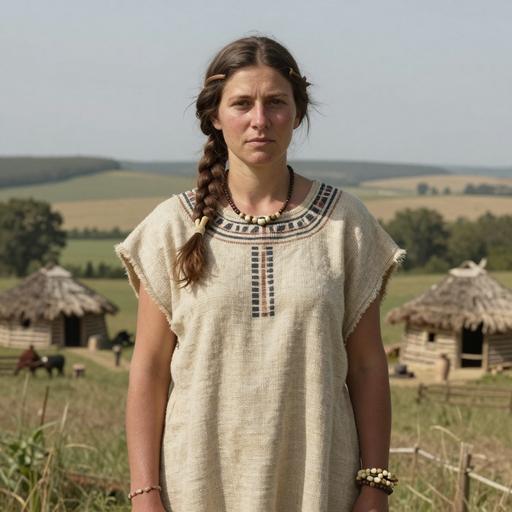
A woman buried in Hungary in the Middle Neolithic era

Download PDF creates a visual, rasterized copy. Use Print for selectable text and better assistive-technology support.

Loading Report

Preparing your ancestry journey

Preparing the available report content...

Your report will open automatically.

Skip to main content
Reference library / Sample profile

A woman buried in Hungary in the Middle Neolithic era

Explore the recorded context, genetic comparisons and research behind this reference sample.

HungaryThe Linear Pottery Culture

A reference profile describes this sample. It does not establish a personal or family relationship.

AI portrait reconstruction for A woman buried in Hungary in the Middle Neolithic era
AI-generated artistic reconstruction, not a photograph of the individual.
Record

Sample details

Recorded details and available lineage markers.

Individual

The Linear Pottery Culture individual, Hungary

Sample ID: I1506

Date Range

5306 BCE - 5064 BCE

Cultural Period

The Linear Pottery Culture

Biological Sex

Female

mtDNA Haplogroup

U5b2c

Y-DNA Haplogroup

Not available

Social Role

Laborer (AI estimate, era-typical)

Geography

Location

Where this individual was discovered

Country Hungary
Locality Polgár-Ferenci hát. M3-31
Coordinates 47.8465, 21.1494
Chronology

Date range

When this individual lived in the broader context of human history

The Linear Pottery Culture individual, Hungary 5306 BCE - 5064 BCE
Context

Historical context

Background information associated with the reference record.

Overview

Polgár-Ferenci Hát, also known as M3-31, is a significant archaeological site located in northeastern Hungary. This site is an essential part of understanding the Middle Neolithic period in the Carpathian Basin, approximately spanning from 5500 to 4500 BCE. The site is particularly associated with the Linear Pottery Culture (Linearbandkeramik or LBK) and the subsequent Tisza Culture.

Archaeological Context

The Middle Neolithic period in Hungary is marked by the development of complex farming communities, extensive trade networks, and sophisticated material culture. Polgár-Ferenci Hát provides valuable insights into these transformative changes.

1. Inhabitants and Culture:

  • Farming Communities: The inhabitants during this period were early agriculturalists who engaged in farming and animal husbandry.
  • Linear Pottery Culture (LBK): The LBK culture is characterized by its distinctive pottery with linear decorations, longhouses, and early farming practices.
  • Tisza Culture: This culture followed the LBK and is noted for its elaborate pottery, settlement structures, and burial practices.

2. Economic Activities:

  • Agriculture: The primary subsistence strategy was farming, with crops such as wheat, barley, lentils, and peas being cultivated.
  • Animal Husbandry: Domesticated animals, including cattle, sheep, goats, and pigs, played a significant role in their economy.
  • Hunting and Gathering: Hunting and gathering continued to supplement their diet, providing additional resources.

Archaeological Findings

1. Artifacts:

  • Pottery: Middle Neolithic pottery from Polgár-Ferenci Hát includes both utilitarian and decorative pieces. The ceramics often feature linear and curvilinear patterns.
  • Stone Tools: The toolkit included polished stone axes, flint blades, and sickles. These tools were essential for agricultural activities and building.
  • Bone and Antler Tools: Implements made from bone and antler, such as awls, needles, and decorative items, indicate a broad use of available materials.

2. Evidence of Habitation:

  • House Structures: Excavations have revealed the foundations of longhouses, typical of the LBK and Tisza cultures. These structures were large, rectangular, timber-framed buildings that housed extended families.
  • Storage Pits and Hearths: The presence of storage pits and hearths indicates activities such as food storage, processing, and cooking.

3. Environmental Adaptation:

  • Landscape Use: The Neolithic inhabitants adapted the landscape for agriculture by clearing forests and creating fields. The fertile soils of the Carpathian Basin were ideal for farming.
  • Resource Utilization: The region's natural resources, including water, wild game, and plant materials, were exploited to support the growing agricultural community.

Environmental and Geographic Context

1. Climate and Environment:

  • Holocene Epoch: The Middle Neolithic period falls within the Holocene Epoch, characterized by a relatively stable and warm climate that supported the growth of agriculture and permanent settlements.
  • Local Geography: Polgár-Ferenci Hát is situated in the Carpathian Basin, a region with fertile soils, abundant water sources, and a moderate climate, making it ideal for early farming communities.

2. Geographic Significance:

  • Strategic Location: The site’s location near rivers and fertile land made it an ideal settlement for Neolithic farmers. The natural environment supported diverse subsistence activities and facilitated trade and interaction.

Social and Cultural Structure

1. Social Organization:

  • Community Life: The Middle Neolithic communities were likely organized into extended family groups or clans. Social structures were centered around agricultural production and shared labor.
  • Cultural Practices: The presence of decorated pottery and other artifacts indicates the development of cultural practices, including symbolic communication and possibly ritual activities.

2. Technological Innovations:

  • Agricultural Tools: The development of polished stone tools, such as axes and sickles, facilitated the clearing of land for agriculture and the harvesting of crops.
  • Pottery Production: The introduction of pottery represented a significant technological advancement, allowing for improved storage and cooking methods.

Significance of Polgár-Ferenci Hát

1. Archaeological Importance:

  • Understanding Neolithic Life: Polgár-Ferenci Hát is crucial for understanding the Middle Neolithic period in the Carpathian Basin, providing evidence of the transition from early farming communities to more complex, settled societies.
  • Evidence of Early Agriculture: The artifacts and remains found at the site offer valuable insights into the early development of agriculture and domestication in the region.

2. Contributions to Prehistory:

  • Technological and Cultural Developments: The findings at Polgár-Ferenci Hát illustrate the technological innovations and cultural practices of Middle Neolithic communities, highlighting their adaptability and ingenuity.
  • Regional Interactions: The site contributes to our understanding of regional interactions and trade networks during the Neolithic period, showcasing the interconnectedness of early farming communities.

Conclusion

Polgár-Ferenci Hát in Hungary is a key site for studying the Middle Neolithic period. The archaeological evidence from this site provides valuable insights into the lives of early farming communities, their technological innovations, and their adaptation to the environment. The findings from Polgár-Ferenci Hát enhance our understanding of the Neolithic period and the broader prehistoric context of Central Europe.

Analysis

Genetic comparisons

These comparisons show genetic similarity, not identity or origin. The populations listed are those whose genomes show statistical alignment to this ancient individual.

Similarity reflects shared history, not shared identity. These are analytical comparisons, not claims about who this person was.

Modern Genetic Admixture

This analysis compares the DNA profile with present-day reference populations, showing statistical similarity to modern reference populations from different regions. The excavation site records where this individual was found, not a fixed modern genetic identity.

Europe 82.7%
Southern European 82.7%
Italian 36.5%
Sardinian 23.3%
Iberian 22.8%
Asia 14.8%
Arab, Egyptian & Levantine 11.1%
Levantine 11.1%
Northern West Asian 3.7%
Cypriot 3.7%
Africa 2.5%
North African 2.5%
Egyptian 2.5%

Closest Modern Populations

These are the modern populations showing the closest statistical alignment to A woman buried in Hungary in the Middle Neolithic era, ranked by genetic distance. Lower distance values indicate closer statistical similarity. Cross-region similarity can reflect shared ancestry, population movement, continuity, or later admixture.

1
Sardinian
4.6641
2
Belmonte Jew
6.2139
3
French Corsica
6.5878
4
Italian Lazio
7.0887
5
Sicilian West
7.2412
6
Italian Umbria
7.4390
7
Italian Campania
7.4414
8
Sicilian East
7.4733
9
Italian Calabria
7.4951
10
Maltese
7.5331
Context

Related Samples

This individual exists within a broader network of ancient samples. No ancient genome stands alone.

Individual Culture/Period Date Location Action
European Bronze Age individual, Hungary Late Bronze Age Kyjatice Culture, Hungary 987 BCE Ludas-Varjú dűlő, Hungary View
The Linear Pottery Culture individual, Hungary The Linear Pottery Culture 5306 BCE Polgár-Ferenci hát. M3-31, Hungary View
Steppe Cultures individual, Hungary Iron Age Pre-Scythian Culture, Hungary 983 BCE Ludas-Varju-Dulo, Hungary View
European Neolithic individual, Hungary Middle Neolithic Linear Pottery Culture, Hungary 5306 BCE Polgár-Ferenci hát. M3-31, Hungary View
Indo-European individual, Hungary Early Bronze Age Makó Culture, Hungary 2195 BCE Kompolt-Kigyoser (Jász-Nagykun-Szolnok County, Karcag), Hungary View
Early European individual, Hungary Piliny-Kyjatice Culture 987 BCE Ludas-Varjú-dűlő (Heves County, Gyöngyös), Hungary View
Late C Baden individual, Hungary Baden Culture of Hungary 3320 BCE Apc-Berekalya-1 (Heves County, Hatvan), Hungary View
LBA EIA Kyjatice Piliny-o individual, Hungary Piliny-Kyjatice Culture 983 BCE Ludas-Varjú-dűlő (Heves County, Gyöngyös), Hungary View
EN Koros-o WHG individual, Hungary Early Neolithic Körös Culture, Hungary 5788 BCE Tiszaszőlős-Domaháza_unknown-site-2 (Jász-Nagykun-Szolnok County, Tiszafüred), Hungary View
European Neolithic individual, Hungary Middle Neolithic Linear Pottery Culture, Hungary 5211 BCE Apc-Berekalya-1 (Heves County, Hatvan), Hungary View
European Neolithic individual, Hungary Late Neolithic Lengyel Culture, Hungary 4496 BCE Apc-Berekalya-1 (Heves County, Hatvan), Hungary View
Balkans Eba individual, Hungary 2195 BCE Kompolt-Kigyoser, Hungary View
Balkans Lba individual, Hungary 987 BCE Ludas-Varjú dűlő, Hungary View
Balkans Lca individual, Hungary 3320 BCE Apc-Berekalya I, Hungary View
Cimmerian Scythian individual, Hungary 983 BCE Ludas-Varju-Dulo, Hungary View
Balkans En individual, Hungary 5788 BCE Tiszaszolos-Domaháza, Hungary View
Balkans En individual, Hungary 5716 BCE Berettyóújfalu-Morotva-Liget, Hungary View
Lengyel individual, Hungary 4496 BCE Apc-Berekalya I, Hungary View
Lbk individual, Hungary 5211 BCE Apc-Berekalya I, Hungary View
Balkans Eba individual, Hungary 2195 BCE Kompolt-Kigyoser, Hungary View
Balkans En individual, Hungary 5788 BCE Tiszaszolos-Domaháza, Hungary View
Lbk individual, Hungary 5211 BCE Apc-Berekalya I, Hungary View
Lengyel individual, Hungary 4496 BCE Apc-Berekalya I, Hungary View
Balkans Lca individual, Hungary 3320 BCE Apc-Berekalya I, Hungary View
Balkans En individual, Hungary 5716 BCE Berettyóújfalu-Morotva-Liget, Hungary View
Alfold Linear Pottery individual, Hungary 5306 BCE Polgár-Ferenci hát. M3-31, Hungary View
Alfold Linear Pottery individual, Hungary 5297 BCE Debrecen Tocopart Erdoalja, Hungary View
Ceu Mn individual, Hungary 5286 BCE Garadna, Hungary View
Alfold Linear Pottery individual, Hungary 5210 BCE Polgár-Ferenci hát. M3-31, Hungary View
Alfold Linear Pottery individual, Hungary 5301 BCE Kompolt-Kigyoser, Hungary View
Alfold Linear Pottery individual, Hungary 5297 BCE Debrecen Tocopart Erdoalja, Hungary View
Ceu Mn individual, Hungary 5286 BCE Garadna, Hungary View
Alfold Linear Pottery individual, Hungary 5210 BCE Polgár-Ferenci hát. M3-31, Hungary View
Page 1
Individual Culture/Period Date Location Action
The Linear Pottery Culture individual, Hungary The Linear Pottery Culture 5306 BCE Polgár-Ferenci hát. M3-31, Hungary View
Alfold Linear Pottery individual, Hungary 5306 BCE Polgár-Ferenci hát. M3-31, Hungary View
Alfold Linear Pottery individual, Hungary 5297 BCE Debrecen Tocopart Erdoalja, Hungary View
Alfold Linear Pottery individual, Hungary 5210 BCE Polgár-Ferenci hát. M3-31, Hungary View
Alfold Linear Pottery individual, Hungary 5301 BCE Kompolt-Kigyoser, Hungary View
Alfold Linear Pottery individual, Hungary 5217 BCE Hajdúnánás-Eszlári út, Hungary View
Alfold Linear Pottery individual, Hungary 5479 BCE Mezőkövesd-Mocsolyás, Hungary View
Alfold Linear Pottery individual, Hungary 5300 BCE Polgár-Piócás, Hungary View
Alfold Linear Pottery individual, Hungary 5305 BCE Hajdúnánás-Eszlári út, Hungary View
Alfold Linear Pottery individual, Hungary 5300 BCE Pusztataskony Ledence 1, Hungary View
Alfold Linear Pottery individual, Hungary 5301 BCE Kompolt-Kigyoser, Hungary View
Alfold Linear Pottery individual, Hungary 5297 BCE Debrecen Tocopart Erdoalja, Hungary View
Alfold Linear Pottery individual, Hungary 5210 BCE Polgár-Ferenci hát. M3-31, Hungary View
Page 1
Sources

References

Scientific publications and genetic data that inform this profile.

G25 Coordinates

These coordinates represent a position in genetic space, a tool for comparison, not a conclusion. You can use these to perform custom admixture analysis in G25 Studio.

I1506,0.10707038,0.15863964,0.00475374,-0.0616784,0.04456342,-0.0293779,-0.0035267,0.00307414,0.04069842,0.06086556,-0.0003979,0.0085266,-0.01404396,-0.01174092,-0.01237626,0.00721546,0.01032654,0.0008758,0.00159812,-0.00110894,0.00168134,0.00616038,-0.01222372,-0.01666454,0.00254951
Continue in G25 Studio
Use code for 30% off • Expires Nov 16