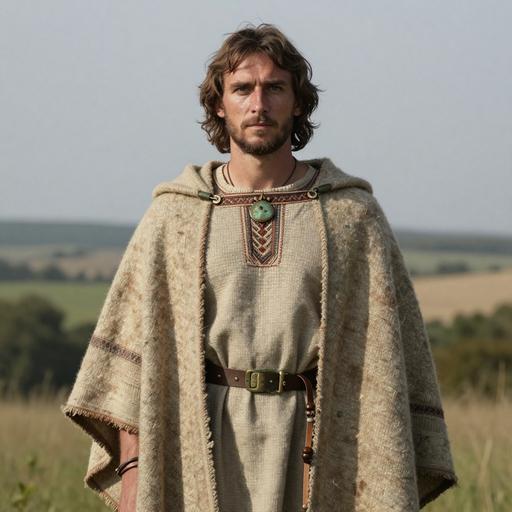
A man buried in Hungary in the Bronze Age era

Download PDF creates a visual, rasterized copy. Use Print for selectable text and better assistive-technology support.

Loading Report

Preparing your ancestry journey

Preparing the available report content...

Your report will open automatically.

Skip to main content
Reference library / Sample profile

A man buried in Hungary in the Bronze Age era

Explore the recorded context, genetic comparisons and research behind this reference sample.

HungaryPiliny-Kyjatice Culture

A reference profile describes this sample. It does not establish a personal or family relationship.

AI portrait reconstruction for A man buried in Hungary in the Bronze Age era
AI-generated artistic reconstruction, not a photograph of the individual.
Record

Sample details

Recorded details and available lineage markers.

Individual

Early European individual, Hungary

Sample ID: BR2

Date Range

987 BCE - 833 BCE

Cultural Period

Piliny-Kyjatice Culture

Biological Sex

Male

mtDNA Haplogroup

K1a1a

Y-DNA Haplogroup

J-Y17946

Social Role

Farmer (AI estimate, era-typical)

Geography

Location

Where this individual was discovered

Country Hungary
Locality Ludas-Varjú-dűlő (Heves County, Gyöngyös)
Coordinates 47.7251, 20.0862
Chronology

Date range

When this individual lived in the broader context of human history

Early European individual, Hungary 987 BCE - 833 BCE
Context

Historical context

Background information associated with the reference record.

Region & Environment

The Piliny–Kyjatice Culture is associated with parts of Hungary and Slovakia, in landscapes of river valleys and rolling terrain suitable for mixed farming and stock-keeping. Access to arable land and routes through uplands would have influenced where communities established settlements and cemeteries.

Historical Context

Between about the 13th and 7th centuries BCE, Central Europe experienced major cultural realignments. Piliny–Kyjatice belongs to this broader environment in which Urnfield traditions were prominent and in which changing metalwork styles and exchange routes helped shape local identities during the Late Bronze Age and into the early Iron Age.

Populations & Lifeways

Communities were likely settled and organized around agriculture and herding, with households producing much of what they needed and relying on exchange for metal and other valued materials. Regional differences in site density and burial organization suggest variations in wealth or community size, though overall lifeways remained broadly rural and domestic.

Archaeology & Material Culture

Archaeological recognition often relies on cemetery evidence and ceramic styles consistent with the Piliny–Kyjatice cultural attribution. As Urnfield-related contexts are characteristic, burials commonly involve cremation with the treatment of remains deposited in graves or grave clusters. Metal objects—when present—reflect Bronze Age technological traditions and regional preferences in form.

Culture & Society

Mortuary practice is a key window into social organization. The patterned use of cremation and organized deposition indicates shared norms and possibly communal rituals, while differences between graves can imply graded status or family-scale variation in access to prestige goods.

Legacy & Transition

Piliny–Kyjatice represents a late prehistoric stage in which Urnfield traditions continued while Central Europe moved toward early Iron Age material repertoires. The transition is best understood through changing artifact styles and evolving burial customs rather than as a sudden replacement of populations.

Analysis

Genetic comparisons

These comparisons show genetic similarity, not identity or origin. The populations listed are those whose genomes show statistical alignment to this ancient individual.

Similarity reflects shared history, not shared identity. These are analytical comparisons, not claims about who this person was.

Modern Genetic Admixture

This analysis compares the DNA profile with present-day reference populations, showing statistical similarity to modern reference populations from different regions. The excavation site records where this individual was found, not a fixed modern genetic identity.

Europe 100.0%
Southern European 53.3%
Balkan 19.0%
Italian 18.7%
Iberian 15.6%
Northwestern European 46.7%
Northwestern European 20.7%
English 15.3%
Finnish 6.1%
Scandinavian 4.7%

Closest Modern Populations

These are the modern populations showing the closest statistical alignment to A man buried in Hungary in the Bronze Age era, ranked by genetic distance. Lower distance values indicate closer statistical similarity. Cross-region similarity can reflect shared ancestry, population movement, continuity, or later admixture.

1
French Alsace
1.9869
2
French Nord
2.1260
3
Belgianc
2.1800
4
Swiss German
2.4085
5
Belgiana
2.5128
6
French Occitanie
2.5554
7
Belgianb
2.5849
8
French Paris
2.6402
9
French Auvergne
2.7087
10
French Pas De Calais
2.7142
Context

Related Samples

This individual exists within a broader network of ancient samples. No ancient genome stands alone.

Individual Culture/Period Date Location Action
European Bronze Age individual, Hungary Late Bronze Age Kyjatice Culture, Hungary 987 BCE Ludas-Varjú dűlő, Hungary View
The Linear Pottery Culture individual, Hungary The Linear Pottery Culture 5306 BCE Polgár-Ferenci hát. M3-31, Hungary View
Steppe Cultures individual, Hungary Iron Age Pre-Scythian Culture, Hungary 983 BCE Ludas-Varju-Dulo, Hungary View
European Neolithic individual, Hungary Middle Neolithic Linear Pottery Culture, Hungary 5306 BCE Polgár-Ferenci hát. M3-31, Hungary View
Indo-European individual, Hungary Early Bronze Age Makó Culture, Hungary 2195 BCE Kompolt-Kigyoser (Jász-Nagykun-Szolnok County, Karcag), Hungary View
Early European individual, Hungary Piliny-Kyjatice Culture 987 BCE Ludas-Varjú-dűlő (Heves County, Gyöngyös), Hungary View
Late C Baden individual, Hungary Baden Culture of Hungary 3320 BCE Apc-Berekalya-1 (Heves County, Hatvan), Hungary View
LBA EIA Kyjatice Piliny-o individual, Hungary Piliny-Kyjatice Culture 983 BCE Ludas-Varjú-dűlő (Heves County, Gyöngyös), Hungary View
EN Koros-o WHG individual, Hungary Early Neolithic Körös Culture, Hungary 5788 BCE Tiszaszőlős-Domaháza_unknown-site-2 (Jász-Nagykun-Szolnok County, Tiszafüred), Hungary View
European Neolithic individual, Hungary Middle Neolithic Linear Pottery Culture, Hungary 5211 BCE Apc-Berekalya-1 (Heves County, Hatvan), Hungary View
European Neolithic individual, Hungary Late Neolithic Lengyel Culture, Hungary 4496 BCE Apc-Berekalya-1 (Heves County, Hatvan), Hungary View
Balkans Eba individual, Hungary 2195 BCE Kompolt-Kigyoser, Hungary View
Balkans Lba individual, Hungary 987 BCE Ludas-Varjú dűlő, Hungary View
Balkans Lca individual, Hungary 3320 BCE Apc-Berekalya I, Hungary View
Cimmerian Scythian individual, Hungary 983 BCE Ludas-Varju-Dulo, Hungary View
Balkans En individual, Hungary 5788 BCE Tiszaszolos-Domaháza, Hungary View
Balkans En individual, Hungary 5716 BCE Berettyóújfalu-Morotva-Liget, Hungary View
Lengyel individual, Hungary 4496 BCE Apc-Berekalya I, Hungary View
Lbk individual, Hungary 5211 BCE Apc-Berekalya I, Hungary View
Balkans Eba individual, Hungary 2195 BCE Kompolt-Kigyoser, Hungary View
Balkans En individual, Hungary 5788 BCE Tiszaszolos-Domaháza, Hungary View
Lbk individual, Hungary 5211 BCE Apc-Berekalya I, Hungary View
Lengyel individual, Hungary 4496 BCE Apc-Berekalya I, Hungary View
Balkans Lca individual, Hungary 3320 BCE Apc-Berekalya I, Hungary View
Balkans En individual, Hungary 5716 BCE Berettyóújfalu-Morotva-Liget, Hungary View
Alfold Linear Pottery individual, Hungary 5306 BCE Polgár-Ferenci hát. M3-31, Hungary View
Alfold Linear Pottery individual, Hungary 5297 BCE Debrecen Tocopart Erdoalja, Hungary View
Ceu Mn individual, Hungary 5286 BCE Garadna, Hungary View
Alfold Linear Pottery individual, Hungary 5210 BCE Polgár-Ferenci hát. M3-31, Hungary View
Alfold Linear Pottery individual, Hungary 5301 BCE Kompolt-Kigyoser, Hungary View
Alfold Linear Pottery individual, Hungary 5297 BCE Debrecen Tocopart Erdoalja, Hungary View
Ceu Mn individual, Hungary 5286 BCE Garadna, Hungary View
Alfold Linear Pottery individual, Hungary 5210 BCE Polgár-Ferenci hát. M3-31, Hungary View
Page 1
Individual Culture/Period Date Location Action
Early European individual, Hungary Piliny-Kyjatice Culture 987 BCE Ludas-Varjú-dűlő (Heves County, Gyöngyös), Hungary View
LBA EIA Kyjatice Piliny-o individual, Hungary Piliny-Kyjatice Culture 983 BCE Ludas-Varjú-dűlő (Heves County, Gyöngyös), Hungary View
Page 1
Sources

References

Scientific publications and genetic data that inform this profile.

G25 Coordinates

These coordinates represent a position in genetic space, a tool for comparison, not a conclusion. You can use these to perform custom admixture analysis in G25 Studio.

BR2,0.1217483,0.13724272,0.05537152,0.0233289,0.0438172,0.00858832,0.00095518,0.00900338,0.01790862,0.01079056,-0.00250246,0.0018253,-0.00554606,-0.0008915,0.00667154,0.00203782,-0.00918944,0.00014708,0.00165708,-0.00070344,0.00407548,0.00339998,-0.00719508,0.00081792,0.00274686
Continue in G25 Studio
Use code for 30% off • Expires Nov 16