A woman buried in Hungary in the Early Bronze Age era

Download PDF creates a visual, rasterized copy. Use Print for selectable text and better assistive-technology support.

Loading Report

Preparing your ancestry journey

Preparing the available report content...

Your report will open automatically.

Skip to main content
Reference library / Sample profile

A woman buried in Hungary in the Early Bronze Age era

Explore the recorded context, genetic comparisons and research behind this reference sample.

HungaryEarly Bronze Age Makó Culture, Hungary

A reference profile describes this sample. It does not establish a personal or family relationship.

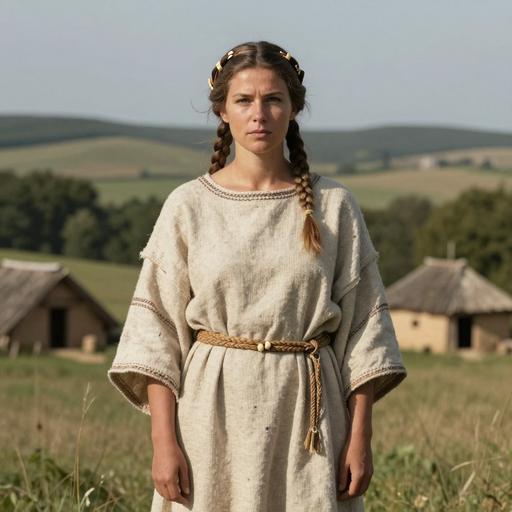
AI portrait reconstruction for A woman buried in Hungary in the Early Bronze Age era
AI-generated artistic reconstruction, not a photograph of the individual.
Record

Sample details

Recorded details and available lineage markers.

Individual

Indo-European individual, Hungary

Sample ID: BR1

Date Range

2195 BCE - 1973 BCE

Cultural Period

Early Bronze Age Makó Culture, Hungary

Biological Sex

Female

mtDNA Haplogroup

K1c1

Y-DNA Haplogroup

Not available

Social Role

Farmer (AI estimate, era-typical)

Geography

Location

Where this individual was discovered

Country Hungary
Locality Kompolt-Kigyoser (Jász-Nagykun-Szolnok County, Karcag)
Coordinates 47.1670, 20.8330
Chronology

Date range

When this individual lived in the broader context of human history

Indo-European individual, Hungary 2195 BCE - 1973 BCE
Context

Historical context

Background information associated with the reference record.

Overview

The Makó culture is an Early Bronze Age archaeological horizon in Hungary, dated here to 2300–2000 BCE. It is characterized by recognizable ceramic traditions and settlement patterns that place these communities within the wider Early Bronze Age of central Europe while maintaining regional distinctiveness.

Region & Environment

Makó culture sites are associated with the Hungarian portion of the Carpathian Basin, where lowlands and river corridors facilitated agriculture and movement. Such environments supported predictable access to water and arable land, promoting sustained settlement rather than purely nomadic lifeways. Grazing areas in surrounding landscapes would have supplemented crop production.

Historical Context

During the Early Bronze Age, central European societies experienced changes in technology, craft organization, and long-distance contact. The adoption and spread of bronze-related knowledge occurred alongside continued reliance on farming and herding. Communities such as those of the Makó horizon participated in shared regional trends while expressing them through local material styles.

Populations & Lifeways

People associated with the Makó culture are best seen as part of sedentary farming populations, with households managing crops and livestock. Everyday activities likely included food processing, building maintenance, and routine craft work. Evidence for social differentiation is most often sought through differences in material assemblages, including how goods were placed in households and, where present, in special deposit or funerary contexts.

Archaeology & Material Culture

The archaeological visibility of the Makó culture strongly reflects ceramics—vessel forms and decorative practices that distinguish the horizon. Assemblages from settlement contexts indicate that pottery and other domestic items were central to daily life. Metal artifacts, when recovered, can help situate the culture within the broader Early Bronze Age metal-using world, but many inferences must remain general because preservation varies.

Culture & Society

Makó culture material patterns suggest shared conventions in pottery manufacture and consumption practices. This points to ongoing social learning and interaction within a network of communities. The overall emphasis on durable domestic technologies indicates stable village-oriented life, while connections implied by certain artifact traits suggest contact with neighboring groups.

Legacy & Transition

The Makó horizon contributes to understanding how Early Bronze Age societies developed in the Carpathian Basin through continued farming, craft production, and selective use of new materials. Later periods build on these foundations, with changing cultural groups and artifact traditions reflecting evolving regional dynamics.

Analysis

Genetic comparisons

These comparisons show genetic similarity, not identity or origin. The populations listed are those whose genomes show statistical alignment to this ancient individual.

Similarity reflects shared history, not shared identity. These are analytical comparisons, not claims about who this person was.

Modern Genetic Admixture

This analysis compares the DNA profile with present-day reference populations, showing statistical similarity to modern reference populations from different regions. The excavation site records where this individual was found, not a fixed modern genetic identity.

Europe 100.0%
Southern European 40.3%
Balkan 23.2%
Iberian 11.1%
Sardinian 6.0%
Northwestern European 40.1%
Northwestern European 21.0%
Scandinavian 9.3%
English 8.9%
Finnish 0.9%
Eastern European 19.6%

Closest Modern Populations

These are the modern populations showing the closest statistical alignment to A woman buried in Hungary in the Early Bronze Age era, ranked by genetic distance. Lower distance values indicate closer statistical similarity. Cross-region similarity can reflect shared ancestry, population movement, continuity, or later admixture.

1
Austrian
2.1472
2
German Erlangen
2.3901
3
Hungarian
2.5495
4
Slovenian
2.5772
5
Croatian
2.6860
6
German
2.7132
7
German East
2.9798
8
Czech
2.9804
9
German Hamburg
3.2071
10
French Alsace
3.3228
Context

Related Samples

This individual exists within a broader network of ancient samples. No ancient genome stands alone.

Individual Culture/Period Date Location Action
European Bronze Age individual, Hungary Late Bronze Age Kyjatice Culture, Hungary 987 BCE Ludas-Varjú dűlő, Hungary View
The Linear Pottery Culture individual, Hungary The Linear Pottery Culture 5306 BCE Polgár-Ferenci hát. M3-31, Hungary View
Steppe Cultures individual, Hungary Iron Age Pre-Scythian Culture, Hungary 983 BCE Ludas-Varju-Dulo, Hungary View
European Neolithic individual, Hungary Middle Neolithic Linear Pottery Culture, Hungary 5306 BCE Polgár-Ferenci hát. M3-31, Hungary View
Indo-European individual, Hungary Early Bronze Age Makó Culture, Hungary 2195 BCE Kompolt-Kigyoser (Jász-Nagykun-Szolnok County, Karcag), Hungary View
Early European individual, Hungary Piliny-Kyjatice Culture 987 BCE Ludas-Varjú-dűlő (Heves County, Gyöngyös), Hungary View
Late C Baden individual, Hungary Baden Culture of Hungary 3320 BCE Apc-Berekalya-1 (Heves County, Hatvan), Hungary View
LBA EIA Kyjatice Piliny-o individual, Hungary Piliny-Kyjatice Culture 983 BCE Ludas-Varjú-dűlő (Heves County, Gyöngyös), Hungary View
EN Koros-o WHG individual, Hungary Early Neolithic Körös Culture, Hungary 5788 BCE Tiszaszőlős-Domaháza_unknown-site-2 (Jász-Nagykun-Szolnok County, Tiszafüred), Hungary View
European Neolithic individual, Hungary Middle Neolithic Linear Pottery Culture, Hungary 5211 BCE Apc-Berekalya-1 (Heves County, Hatvan), Hungary View
European Neolithic individual, Hungary Late Neolithic Lengyel Culture, Hungary 4496 BCE Apc-Berekalya-1 (Heves County, Hatvan), Hungary View
Balkans Eba individual, Hungary 2195 BCE Kompolt-Kigyoser, Hungary View
Balkans Lba individual, Hungary 987 BCE Ludas-Varjú dűlő, Hungary View
Balkans Lca individual, Hungary 3320 BCE Apc-Berekalya I, Hungary View
Cimmerian Scythian individual, Hungary 983 BCE Ludas-Varju-Dulo, Hungary View
Balkans En individual, Hungary 5788 BCE Tiszaszolos-Domaháza, Hungary View
Balkans En individual, Hungary 5716 BCE Berettyóújfalu-Morotva-Liget, Hungary View
Lengyel individual, Hungary 4496 BCE Apc-Berekalya I, Hungary View
Lbk individual, Hungary 5211 BCE Apc-Berekalya I, Hungary View
Balkans Eba individual, Hungary 2195 BCE Kompolt-Kigyoser, Hungary View
Balkans En individual, Hungary 5788 BCE Tiszaszolos-Domaháza, Hungary View
Lbk individual, Hungary 5211 BCE Apc-Berekalya I, Hungary View
Lengyel individual, Hungary 4496 BCE Apc-Berekalya I, Hungary View
Balkans Lca individual, Hungary 3320 BCE Apc-Berekalya I, Hungary View
Balkans En individual, Hungary 5716 BCE Berettyóújfalu-Morotva-Liget, Hungary View
Alfold Linear Pottery individual, Hungary 5306 BCE Polgár-Ferenci hát. M3-31, Hungary View
Alfold Linear Pottery individual, Hungary 5297 BCE Debrecen Tocopart Erdoalja, Hungary View
Ceu Mn individual, Hungary 5286 BCE Garadna, Hungary View
Alfold Linear Pottery individual, Hungary 5210 BCE Polgár-Ferenci hát. M3-31, Hungary View
Alfold Linear Pottery individual, Hungary 5301 BCE Kompolt-Kigyoser, Hungary View
Alfold Linear Pottery individual, Hungary 5297 BCE Debrecen Tocopart Erdoalja, Hungary View
Ceu Mn individual, Hungary 5286 BCE Garadna, Hungary View
Alfold Linear Pottery individual, Hungary 5210 BCE Polgár-Ferenci hát. M3-31, Hungary View
Page 1
Individual Culture/Period Date Location Action
Indo-European individual, Hungary Early Bronze Age Makó Culture, Hungary 2195 BCE Kompolt-Kigyoser, Hungary View
Indo-European individual, Hungary Early Bronze Age Makó Culture, Hungary 2195 BCE Kompolt-Kigyoser (Jász-Nagykun-Szolnok County, Karcag), Hungary View
Page 1
Sources

References

Scientific publications and genetic data that inform this profile.

G25 Coordinates

These coordinates represent a position in genetic space, a tool for comparison, not a conclusion. You can use these to perform custom admixture analysis in G25 Studio.

BR1,0.13264208,0.13662758,0.05768014,0.03480944,0.04634748,0.0147133,0.00525324,0.00996258,0.01269114,0.00718592,-0.00741162,0.00257266,0.0022856,0.00698056,-0.00486224,0.0051793,0.00276482,5.318E-05,0.0021375,-4.816E-05,0.0014346,0.00060902,0.00181518,-0.0044126,-0.00024879
Continue in G25 Studio
Use code for 30% off • Expires Nov 16