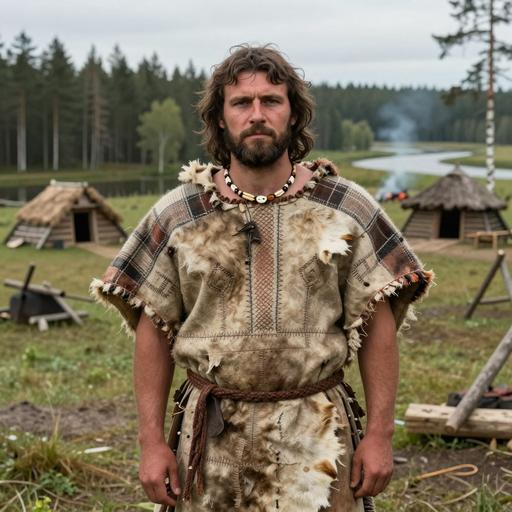
A man buried in Estonia in the Neolithic era

Download PDF creates a visual, rasterized copy. Use Print for selectable text and better assistive-technology support.

Loading Report

Preparing your ancestry journey

Preparing the available report content...

Your report will open automatically.

Skip to main content
Reference library / Sample profile

A man buried in Estonia in the Neolithic era

Explore the recorded context, genetic comparisons and research behind this reference sample.

EstoniaNeolithic Comb Ceramic Culture, Estonia

A reference profile describes this sample. It does not establish a personal or family relationship.

AI portrait reconstruction for A man buried in Estonia in the Neolithic era
AI-generated artistic reconstruction, not a photograph of the individual.
Record

Sample details

Recorded details and available lineage markers.

Individual

Baltic Hunter-Gatherers individual, Estonia

Sample ID: MA975

Date Range

3646 BCE - 3376 BCE

Cultural Period

Neolithic Comb Ceramic Culture, Estonia

Biological Sex

Male

mtDNA Haplogroup

U2e1

Y-DNA Haplogroup

R-M459

Social Role

Potter (AI estimate, era-typical)

Geography

Location

Where this individual was discovered

Country Estonia
Locality Kudruküla (Ida-Viru County, Narva-Jõesuu Municipality, Narva-Jõesuu Town)
Coordinates 59.4500, 28.0800
Chronology

Date range

When this individual lived in the broader context of human history

Baltic Hunter-Gatherers individual, Estonia 3646 BCE - 3376 BCE
Context

Historical context

Background information associated with the reference record.

In Estonia, the Neolithic span associated with Comb Ceramic Culture (c. 4200–2900 BCE) is characterized mainly by a distinctive approach to pottery decoration. The long duration of this horizon indicates durable Neolithic lifeways shaped by the region’s water-rich environments.

Region & Environment

Estonia combines coastlines with lake and river systems and large forested areas. These ecological zones supported both aquatic resource use (fishing and water-associated foraging) and inland activities such as hunting, foraging, and wood-based technologies needed for tools and everyday equipment.

Historical Context

The Neolithic in Northern Europe involved a gradual shift toward pottery use and more structured subsistence strategies. Comb Ceramic Culture belongs to a wider Neolithic horizon in which ceramic style and production practices served as important cultural markers across communities.

Populations & Lifeways

Archaeologically inferred lifeways point to household-based economies that drew on multiple food sources: cultivation and livestock where local conditions allowed, combined with continued fishing and hunting. Pottery production suggests regular cooking and storage practices, supporting more dependable food processing across seasons.

Archaeology & Material Culture

The principal diagnostic material is pottery decorated with comb-impressed patterns. Assemblages from settlements also include stone tools and organic implements that reflect daily work—processing foods, maintaining tools, and preparing materials for habitation. The persistence of ceramic traditions over centuries implies steady craft knowledge and community teaching.

Culture & Society

Comb-impressed decoration indicates shared conventions and social communication. The cultural meaning of the pottery is best approached cautiously: it likely reflects belonging to a recognizable tradition and may have facilitated exchange relationships or patterned interactions between neighboring groups.

Legacy & Transition

The Neolithic Comb Ceramic horizon contributes to a long-term cultural sequence in Estonia, providing a framework for later developments in ceramic styles and material practices. Its end phase points to transformation rather than a sudden replacement, as subsequent periods reorganized technologies and social networks.

Analysis

Genetic comparisons

These comparisons show genetic similarity, not identity or origin. The populations listed are those whose genomes show statistical alignment to this ancient individual.

Similarity reflects shared history, not shared identity. These are analytical comparisons, not claims about who this person was.

Modern Genetic Admixture

This analysis compares the DNA profile with present-day reference populations, showing statistical similarity to modern reference populations from different regions. The excavation site records where this individual was found, not a fixed modern genetic identity.

Europe 93.6%
Eastern European 49.3%
Northwestern European 44.3%
Finnish 35.4%
Northwestern European 7.1%
Scandinavian 1.9%
America 6.4%
America 6.4%
Native American 6.4%

Closest Modern Populations

These are the modern populations showing the closest statistical alignment to A man buried in Estonia in the Neolithic era, ranked by genetic distance. Lower distance values indicate closer statistical similarity. Cross-region similarity can reflect shared ancestry, population movement, continuity, or later admixture.

1
Russian Leshukonsky
4.0704
2
Russian Pinezhsky
4.1298
3
Russian Pinega
4.3811
4
Komi A
4.5207
5
Vepsian
4.7773
6
Russian Krasnoborsky
4.9283
7
Karelian
5.0537
8
Tatar Mishar
5.2666
9
Mordovian
5.3233
10
Erzya
5.3764
Context

Related Samples

This individual exists within a broader network of ancient samples. No ancient genome stands alone.

Individual Culture/Period Date Location Action
Proto-Indo-European individual, Estonia Corded Ware Culture, Estonia 2575 BCE Kursi. Jõgeva, Estonia View
Proto-Indo-European individual, Estonia Corded Ware Culture, Estonia 2872 BCE Ardu. Harju, Estonia View
Proto-Indo-European individual, Estonia Corded Ware Culture, Estonia 2850 BCE Kursi. Jõgeva, Estonia View
Baltic Hunter-Gatherers individual, Estonia Neolithic Comb Ceramic Culture, Estonia 3785 BCE Kudruküla. Ida-Viru, Estonia View
Baltic Hunter-Gatherers individual, Estonia Neolithic Comb Ceramic Culture, Estonia 3646 BCE Kudruküla. Ida-Viru, Estonia View
Baltic Hunter-Gatherers individual, Estonia Neolithic Comb Ceramic Culture, Estonia 3785 BCE Kudruküla (Ida-Viru County, Narva-Jõesuu Municipality, Narva-Jõesuu Town), Estonia View
Baltic Hunter-Gatherers individual, Estonia Neolithic Comb Ceramic Culture, Estonia 3646 BCE Kudruküla (Ida-Viru County, Narva-Jõesuu Municipality, Narva-Jõesuu Town), Estonia View
Corded Ware individual, Estonia 2872 BCE Ardu. Harju, Estonia View
Corded Ware individual, Estonia 2850 BCE Kursi. Jõgeva, Estonia View
Neolithic individual, Estonia 3646 BCE Kudruküla. Ida-Viru, Estonia View
Baltic Ln individual, Estonia 2575 BCE Kursi. Jõgeva, Estonia View
Page 1
Individual Culture/Period Date Location Action
Baltic Hunter-Gatherers individual, Estonia Neolithic Comb Ceramic Culture, Estonia 3785 BCE Kudruküla. Ida-Viru, Estonia View
Baltic Hunter-Gatherers individual, Estonia Neolithic Comb Ceramic Culture, Estonia 3646 BCE Kudruküla. Ida-Viru, Estonia View
Baltic Hunter-Gatherers individual, Estonia Neolithic Comb Ceramic Culture, Estonia 3785 BCE Kudruküla (Ida-Viru County, Narva-Jõesuu Municipality, Narva-Jõesuu Town), Estonia View
Baltic Hunter-Gatherers individual, Estonia Neolithic Comb Ceramic Culture, Estonia 3646 BCE Kudruküla (Ida-Viru County, Narva-Jõesuu Municipality, Narva-Jõesuu Town), Estonia View
Page 1
Sources

References

Scientific publications and genetic data that inform this profile.

G25 Coordinates

These coordinates represent a position in genetic space, a tool for comparison, not a conclusion. You can use these to perform custom admixture analysis in G25 Studio.

MA975,0.11815236,0.0462338,0.08040058,0.08001186,0.0094155,0.02338548,-0.01006826,-0.00775792,-0.002641,-0.03161486,0.00153734,-0.00930874,0.01934726,0.01363554,-0.00647748,0.00230758,-0.00415286,0.00066288,0.0003168,0.00531284,0.00477666,-0.00041212,0.00210486,-0.00215524,0.00561019
Continue in G25 Studio
Use code for 30% off • Expires Nov 16