A woman buried in Russia in the era

Download PDF creates a visual, rasterized copy. Use Print for selectable text and better assistive-technology support.

Loading Report

Preparing your ancestry journey

Preparing the available report content...

Your report will open automatically.

Skip to main content
Reference library / Sample profile

A woman buried in Russia in the era

Explore the recorded context, genetic comparisons and research behind this reference sample.

RussiaThe Ancient Eurasian Steppe

A reference profile describes this sample. It does not establish a personal or family relationship.

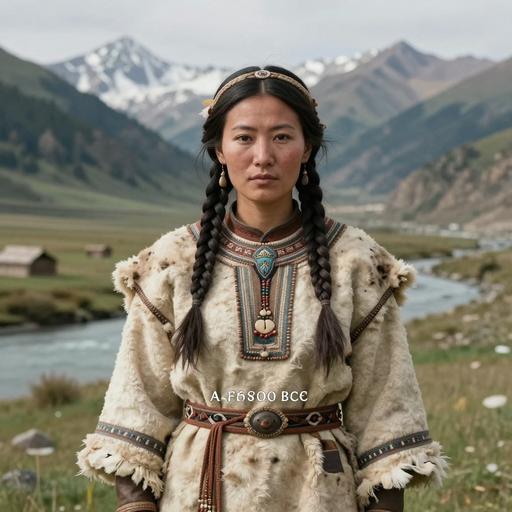
AI portrait reconstruction for A woman buried in Russia in the  era
AI-generated artistic reconstruction, not a photograph of the individual.
Record

Sample details

Recorded details and available lineage markers.

Individual

Afanasievo individual, Russia

Sample ID: I3388

Date Range

2800 BCE - 2600 BCE

Cultural Period

The Ancient Eurasian Steppe

Biological Sex

Female

mtDNA Haplogroup

U5a1d2b*

Y-DNA Haplogroup

Not available

Social Role

Pastoralist (AI estimate, era-typical)

Geography

Location

Where this individual was discovered

Country Russia
Locality Altai Mountains. Yenisey River. left bank of Karasuk tributary. Karasuk III

A location map is not available for this record.

Chronology

Date range

When this individual lived in the broader context of human history

Afanasievo individual, Russia 2800 BCE - 2600 BCE
Context

Historical context

Background information associated with the reference record.

Overview

Afanasievo sites belong to early Bronze Age lifeways on the Eurasian steppe, notable for their graves and the durable material signatures they left behind. The archaeological record shows organized settlement and recurring patterns of craft and burial rather than a single, unified “empire.”

Region & Environment

The Afanasievo horizon is associated with steppe and meadow-steppe settings where seasonal movement and access to pasture would have been important. In such environments, water sources, grazing routes, and sheltered land for seasonal camps influence where people built settlements and buried their dead.

Historical Context

Chronologically, Afanasievo falls in the late 4th to early 3rd millennium BCE. It is part of broader steppe-era developments that included changing technologies, wider networks of exchange, and shifting social organization across grassland corridors.

Populations & Lifeways

Populations are commonly characterized as herders relying on domestic animals, with mobility likely varying by local ecology and family-scale planning. Evidence from settlements and burials indicates continuing occupation and social coordination, while craft activities suggest groups could concentrate labor and materials at particular times and places.

Archaeology & Material Culture

Afanasievo material culture is most clearly visible in mortuary practices and in portable goods. Graves often contain items such as stone tools, ceramics, and personal ornaments, alongside metal objects where preserved. Artifact styles and construction details help archaeologists link sites across wide distances.

Culture & Society

Repeated burial features and standardized artifact selections imply shared traditions, social roles, and mechanisms for transmitting identity across generations. Daily technologies—spinning, weaving, woodworking, and basic metalworking—would have supported herding economies and the maintenance of mobile households.

Legacy & Transition

As later steppe cultures emerged, Afanasievo practices did not simply “disappear”; rather, archaeological differences suggest changing traditions, new influences, and reorganization of networks. The transition is best observed through shifts in burial customs, artifact styles, and settlement patterns in the centuries that follow.

Analysis

Genetic comparisons

These comparisons show genetic similarity, not identity or origin. The populations listed are those whose genomes show statistical alignment to this ancient individual.

Similarity reflects shared history, not shared identity. These are analytical comparisons, not claims about who this person was.

Modern Genetic Admixture

This analysis compares the DNA profile with present-day reference populations, showing statistical similarity to modern reference populations from different regions. The excavation site records where this individual was found, not a fixed modern genetic identity.

Europe 65.7%
Eastern European 48.0%
Northwestern European 17.7%
Scandinavian 16.9%
Finnish 0.8%
Asia 33.8%
Northern West Asian 26.6%
Caucasian 26.6%
Central Asian, Northern Indian & Pakistani 7.2%
Pakistan 7.2%

Closest Modern Populations

These are the modern populations showing the closest statistical alignment to A woman buried in Russia in the era, ranked by genetic distance. Lower distance values indicate closer statistical similarity. Cross-region similarity can reflect shared ancestry, population movement, continuity, or later admixture.

1
Tatar Mishar
6.4562
2
Turkish Deliorman
7.3595
3
Moksha
7.5063
4
Mordovian
7.5701
5
Erzya
7.6701
6
Pamiri Rushan
7.6940
7
Tatar Kazan
7.7195
8
Tajik Yaghnobi
7.7537
9
Turkish Rumeli
8.1095
10
Russian Kostroma
8.3464
Context

Related Samples

This individual exists within a broader network of ancient samples. No ancient genome stands alone.

Individual Culture/Period Date Location Action
Indo-European individual, Russia Afanasievo Culture 2800 BCE Altai Mountains. Yenisey River. left bank of Karasuk tributary. Karasuk III, Russia View
Indo-European individual, Russia Afanasievo Culture 2844 BCE Altai Mountains. Yenisey River. left bank of Karasuk tributary. Karasuk III, Russia View
Indo-European individual, Russia Afanasievo Culture 2879 BCE Altai Mountains. Yenisey River. left bank of Karasuk tributary. Karasuk III, Russia View
Indo-European individual, Russia Afanasievo Culture 2618 BCE Altai Mountains. Yenisey River. left bank of Karasuk tributary. Karasuk III, Russia View
Afanasievo individual, Russia 2800 BCE Altai Mountains. Yenisey River. left bank of Karasuk tributary. Karasuk III, Russia View
Afanasievo individual, Russia 2844 BCE Altai Mountains. Yenisey River. left bank of Karasuk tributary. Karasuk III, Russia View
Afanasievo individual, Russia 2879 BCE Altai Mountains. Yenisey River. left bank of Karasuk tributary. Karasuk III, Russia View
Afanasievo individual, Russia 2618 BCE Altai Mountains. Yenisey River. left bank of Karasuk tributary. Karasuk III, Russia View
Page 1
Individual Culture/Period Date Location Action
Afanasievo individual, Russia 2889 BCE Bateni, Russia View
Afanasievo individual, Russia 2618 BCE Altai Mountains. Yenisey River. left bank of Karasuk tributary. Karasuk III, Russia View
Afanasievo individual, Russia 3323 BCE River Kuyum, Russia View
Afanasievo individual, Russia 2848 BCE Bateni, Russia View
Afanasievo individual, Russia 2909 BCE Bateni, Russia View
Afanasievo individual, Russia 2800 BCE Altai Mountains. Yenisey River. left bank of Karasuk tributary. Karasuk III, Russia View
Afanasievo individual, Russia 2844 BCE Altai Mountains. Yenisey River. left bank of Karasuk tributary. Karasuk III, Russia View
Afanasievo individual, Russia 2879 BCE Altai Mountains. Yenisey River. left bank of Karasuk tributary. Karasuk III, Russia View
Afanasievo individual, Russia 2618 BCE Altai Mountains. Yenisey River. left bank of Karasuk tributary. Karasuk III, Russia View
Afanasievo individual, Russia 2800 BCE Altai Mountains. Yenisey River. left bank of Karasuk tributary. Karasuk III, Russia View
Page 1
Sources

References

Scientific publications and genetic data that inform this profile.

G25 Coordinates

These coordinates represent a position in genetic space, a tool for comparison, not a conclusion. You can use these to perform custom admixture analysis in G25 Studio.

I3388,0.1120796,0.07250416,0.02621816,0.042813,-0.01230112,0.01762844,0.01104828,0.00752132,-0.0251498,-0.0331134,0.00315828,-0.00265228,0.00528308,-0.00164536,0.00011076,-0.00256312,-0.0043038,-0.0012376,-0.0026602,-0.0062752,-0.00048408,0.00081376,-0.00428024,0.00821096,-0.00148895
Continue in G25 Studio
Use code for 30% off • Expires Nov 16