Menu
Store
Blog
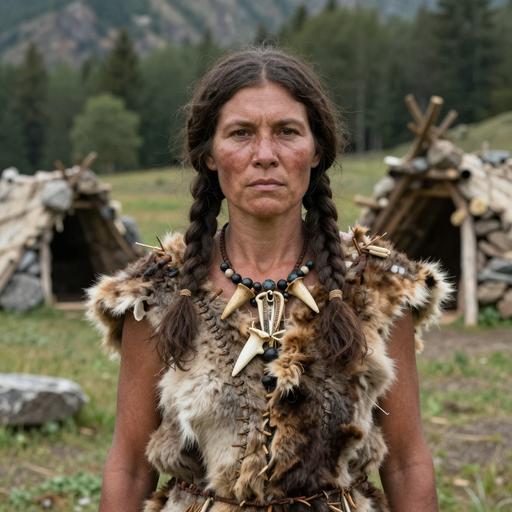
Portrait reconstruction of Altai
Ancient Individual

A woman buried in Russia in the Pleistocene era

Altai
128050 BCE - 88950 BCE
Female
Altai Neanderthal
Russia
Scroll to begin
Chapter I

Identity

The biological and cultural markers that define this ancient individual

Sample ID

Altai

Date Range

128050 BCE - 88950 BCE

Biological Sex

Female

mtDNA Haplogroup

ND1a

Cultural Period

Altai Neanderthal

Chapter II

Place

Where this individual was discovered

Country Russia
Locality Denisova Cave. Altai
Coordinates 51.4090, 84.6890
Chapter III

Time

When this individual lived in the broader context of human history

Altai 128050 BCE - 88950 BCE
Chapter IV

Story

The narrative of this ancient life

The Altai Neanderthal refers to a group of archaic humans that belonged to the broader Neanderthal species, known scientifically as Homo neanderthalensis. This particular group is named after the Altai Mountains, situated in Southern Siberia, where significant archaeological and genetic discoveries have been made. The Altai Neanderthals provide crucial insights into the lifestyle, genetic diversity, and interactions of Neanderthals with other hominin groups during the Paleolithic era.

Geographic and Temporal Context

The Altai Mountains are a rugged mountain range in Southern Siberia, which serves as a transition zone between the European part of Russia and Central Asia. The site most closely associated with the Altai Neanderthals is the Denisova Cave, which has become one of the most important archaeological sites for studying both Neanderthal and Denisovan remains. The habitation of this region by Neanderthals is dated to have occurred roughly between 100,000 and 40,000 years ago, placing their existence well into the middle to late Paleolithic era.

Physical Characteristics

Like other Neanderthals, the Altai group would have possessed robust anatomical features, adapted for cold climates. They are characterized by their large cranial capacity, robust build, shorter limbs compared to modern humans, and a prominent brow ridge. Their muscular physique and physiological adaptations suggest they were well-suited to the cold environments of the Altai region, with efficient thermoregulation and strength to perform physically demanding tasks.

Culture and Technology

Although there is limited cultural material directly linked to the Altai Neanderthals, other Neanderthal groups provide a reasonable basis from which to extrapolate their likely cultural traits. Neanderthals are known to have used a toolkit associated with the Mousterian industry, characterized by the use of stone flakes and Levallois cores. There is evidence of advanced tool-making skills including the use of hafted tools, suggesting cognitive complexity and adaptability.

Additionally, Neanderthals engaged in symbolic behavior, with evidence from other sites of possible body adornments, use of pigments, and burial practices. While direct evidence from the Altai Neanderthals is scarce, it is possible they engaged in similar behaviors.

Genetic Insights

One of the most significant contributions of the Altai Neanderthals to archaeology and anthropology is the genetic data extracted from fossil remains found in the Denisova Cave. These genetic materials have undergone extensive analysis, revealing considerable information about interbreeding among hominin species. The Altai Neanderthals interbred not only with Denisovans but also with early modern humans, as evidenced by traces of Neanderthal DNA in modern human populations, especially those outside Africa.

The genetic study has also highlighted the differences and similarities between the Altai Neanderthals and their counterparts in Europe and Western Asia, suggesting that the Neanderthals were a diverse group of hominins with regionally distinct populations.

Interactions with Other Hominins

The Altai region was a melting pot for hominin species, including the Neanderthals, Denisovans, and anatomically modern humans (Homo sapiens). This region is particularly important because it provides evidence of direct interactions between these groups. Crossbreeding events suggest a degree of social interaction that likely included competition, coexistence, and assimilation of different cultural practices and technologies over time.

Conclusion

The study of the Altai Neanderthals is crucial for unraveling the narrative of Neanderthal life and their interactions with other hominin species. This group not only contributes to our understanding of Neanderthal adaptation and migration but also significantly impacts our knowledge on genetic heritage and inter-species interactions during the Paleolithic era. As excavations and analyses continue, more details about the Altai Neanderthals and their role in human evolution are likely to emerge, enriching our understanding of both our ancestral origins and the dynamics of ancient human populations.

Chapter V

Context

Other ancient individuals connected to this sample

Sources

References

Scientific publications and genetic data

Scientific Publication

The complete genome sequence of a Neanderthal from the Altai Mountains

Authors Prüfer K, Racimo F, Patterson N
Abstract

We present a high-quality genome sequence of a Neanderthal woman from Siberia. We show that her parents were related at the level of half-siblings and that mating among close relatives was common among her recent ancestors. We also sequenced the genome of a Neanderthal from the Caucasus to low coverage. An analysis of the relationships and population history of available archaic genomes and 25 present-day human genomes shows that several gene flow events occurred among Neanderthals, Denisovans and early modern humans, possibly including gene flow into Denisovans from an unknown archaic group. Thus, interbreeding, albeit of low magnitude, occurred among many hominin groups in the Late Pleistocene. In addition, the high-quality Neanderthal genome allows us to establish a definitive list of substitutions that became fixed in modern humans after their separation from the ancestors of Neanderthals and Denisovans.

Use code for 40% off Expires Feb 26