Menu
Store
Blog
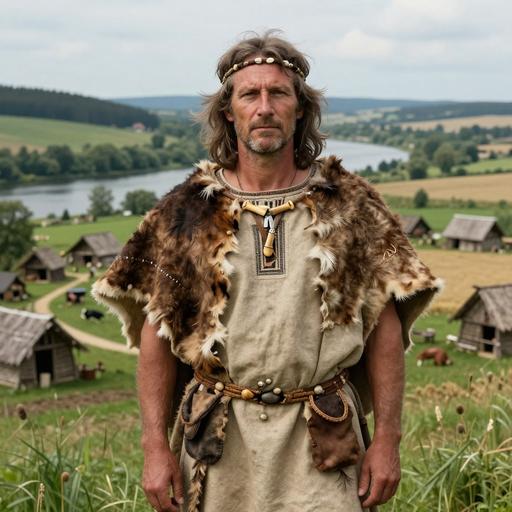
Portrait reconstruction of BRZ001
Ancient Individual

A man buried in Czech Republic in the Neolithic era

BRZ001
3957 BCE - 3797 BCE
Male
Neolithic Jordanow-Michelsberg Culture, Bohemia, Czech Republic
Czech Republic
Scroll to begin
Chapter I

Identity

The biological and cultural markers that define this ancient individual

Sample ID

BRZ001

Date Range

3957 BCE - 3797 BCE

Biological Sex

Male

mtDNA Haplogroup

L3

Y-DNA Haplogroup

I

Cultural Period

Neolithic Jordanow-Michelsberg Culture, Bohemia, Czech Republic

Chapter II

Place

Where this individual was discovered

Country Czech Republic
Locality Bohemia. Březno u Loun
Coordinates 50.3575, 13.7436
Chapter III

Time

When this individual lived in the broader context of human history

BRZ001 3957 BCE - 3797 BCE
Chapter IV

Story

The narrative of this ancient life

The Jordanow-Michelsberg culture, often associated with the Neolithic period, represents a significant archaeological culture that stretched across parts of Central Europe, including regions like Bohemia in the Czech Republic. This culture is typically dated to approximately 4300–3500 BCE and is part of the broader Neolithic revolution in Europe, which saw the transition from hunting and gathering to more settled agricultural societies.

Geographical Spread

The Jordanow-Michelsberg culture occupied several regions in Central Europe, with Bohemia being one of its prominent centers. This area is characterized by its fertile landscape, rivers, and valleys—optimal conditions for early agrarian societies. The terrain facilitated the cultivation of various crops and the domestication of animals, which were central to the culture's economy.

Economy and Subsistence

The economy of the Jordanow-Michelsberg culture was primarily agrarian, relying significantly on farming and animal husbandry. Archaeological evidence suggests that the people cultivated a variety of crops, including wheat, barley, and legumes. They also domesticated cattle, sheep, goats, and pigs, which played vital roles in their diet and provided materials such as wool and leather.

Fishing and foraging for wild plants and berries likely supplemented their diet. The presence of well-crafted stone tools, sickles, and grinding stones in archaeological sites highlights the advanced nature of their agricultural practices.

Settlements and Architecture

The settlements of the Jordanow-Michelsberg culture were typically situated on elevated terrains or near water sources. These settlements consisted of large, rectangular longhouses constructed from timber and thatch. The longhouses, which functioned as both living quarters and communal spaces, indicate a level of social organization and cooperation among these Neolithic communities.

In addition to domestic structures, the culture is known for constructing earthen enclosures or causewayed camps, which were large ring-shaped fortifications. These enclosures likely served multiple purposes, including defense, ceremonial activities, or as central locations for trade.

Material Culture and Craftsmanship

Artifacts from this culture reveal a sophisticated level of craftsmanship. Pottery from the Jordanow-Michelsberg culture is notably distinct, characterized by intricate designs and decorations which often included incised lines and patterns. These ceramics were not only practical but also held symbolic significance, possibly related to rituals or social status.

The culture is also known for its stone tools crafted from flint and other local materials. These included finely made axes, adzes, and arrowheads, demonstrating a mastery in tool-making techniques.

Social Structure and Organization

While direct evidence of social structures is limited, the size and complexity of settlements suggest a community-oriented lifestyle, possibly with hierarchical social structures. The existence of longhouses implies extended family living arrangements, indicating a social framework that valued kinship and collective effort.

Artifacts and settlement patterns also hint at potential trade networks, both within the Jordanow-Michelsberg culture and with neighboring cultures. Goods such as flint, amber, and pottery may have been exchanged, fostering a sense of interconnectedness and economic interdependence.

Religion and Rituals

As with many Neolithic cultures, the spiritual and ritualistic aspects of the Jordanow-Michelsberg people remain partially speculative. However, burial practices provide insights into their beliefs and customs. Grave goods and the orientation of burials suggest a belief in an afterlife or a form of ancestor worship.

Ceremonial structures, such as the aforementioned earthen enclosures, may have been sites for religious rites or community gatherings, indicating a complex spiritual life intertwined with their daily existence.

Conclusion

The Jordanow-Michelsberg culture represents a vibrant chapter in the Neolithic history of Central Europe. Through innovations in agriculture, social organization, and craftsmanship, they laid foundational developments that influenced succeeding cultures in the region. The blend of economic stability, social structures, and cultural practices paints a picture of a society adapting and thriving through the waves of technological and cultural advancements characteristic of the Neolithic age.

Chapter V

Genetics

The genetic ancestry of this ancient individual

Ancient Genetic Admixture

This analysis compares the DNA profile of BRZ001 with ancient reference populations, showing the genetic composition in terms of prehistoric ancestral groups.

Neolithic Farmers 66.5%
Western Steppe Pastoralists 22.4%
European Hunter-Gatherers 11.2%

Modern Genetic Admixture

This analysis compares the DNA profile with present-day reference populations, showing what percentage of genetic makeup resembles modern populations from different regions.

Europe 98.1%
Southern European 98.1%
Iberian 57.7%
Sardinian 26.0%
Italian 14.4%
Asia 1.9%
Chinese & Southeast Asian 1.2%
Tibetan 1.0%
Japanese & Korean 0.7%
Japanese 0.7%

Closest Modern Populations

These are the modern populations showing the closest statistical alignment to A man buried in Czech Republic in the Neolithic era, ranked by genetic distance. Lower distance values indicate closer statistical similarity.

1
Sardinian
2.7533
2
French Corsica
5.7259
3
Spanish La Rioja
6.1647
4
Spanish Castilla La Mancha
6.4210
5
Spanish Castello
6.4872
6
Spanish Menorca
6.5013
7
Spanish Murcia
6.5045
8
Spanish Pirineu
6.5335
9
Spanish Andalucia
6.5343
10
Spanish Aragon
6.5615
Chapter VI

Context

Other ancient individuals connected to this sample

Sources

References

Scientific publications and genetic data

Scientific Publication

Dynamic changes in genomic and social structures in third millennium BCE central Europe

Authors Papac L, Ernée M, Dobeš M
Abstract

Europe's prehistory oversaw dynamic and complex interactions of diverse societies, hitherto unexplored at detailed regional scales. Studying 271 human genomes dated ~4900 to 1600 BCE from the European heartland, Bohemia, we reveal unprecedented genetic changes and social processes. Major migrations preceded the arrival of "steppe" ancestry, and at ~2800 BCE, three genetically and culturally differentiated groups coexisted. Corded Ware appeared by 2900 BCE, were initially genetically diverse, did not derive all steppe ancestry from known Yamnaya, and assimilated females of diverse backgrounds. Both Corded Ware and Bell Beaker groups underwent dynamic changes, involving sharp reductions and complete replacements of Y-chromosomal diversity at ~2600 and ~2400 BCE, respectively, the latter accompanied by increased Neolithic-like ancestry. The Bronze Age saw new social organization emerge amid a ≥40% population turnover.

G25 Coordinates

The G25 coordinates for sample BRZ001 can be used for detailed admixture analysis in our G25 Studio tool.

BRZ001,0.11875748,0.16061466,0.02890032,-0.03533556,0.0576293,-0.01811448,-0.00210666,0.00602214,0.03785846,0.06668162,-0.00498222,0.01462102,-0.02596224,-0.0135205,-0.00736762,0.00419652,0.00824028,-0.00050016,-0.00068888,-0.0035648,0.0009629,0.00488342,-0.01207708,-0.01857136,0.00427549
Analyze in G25 Studio
Use code for 40% off Expires Feb 27