Menu
Store
Blog
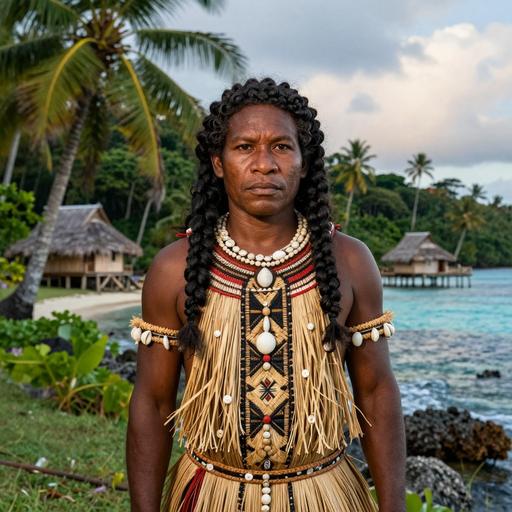
Portrait reconstruction of FUT006
Ancient Individual

A man buried in Vanuatu in the Late Prehistoric era

FUT006
680 CE - 850 CE
Male
Vanuatu 1,200 Years Ago
Vanuatu
Scroll to begin
Chapter I

Identity

The biological and cultural markers that define this ancient individual

Sample ID

FUT006

Date Range

680 CE - 850 CE

Biological Sex

Male

mtDNA Haplogroup

P1d2a

Y-DNA Haplogroup

S-M230

Cultural Period

Vanuatu 1,200 Years Ago

Chapter II

Place

Where this individual was discovered

Country Vanuatu
Locality Futuna
Chapter III

Time

When this individual lived in the broader context of human history

FUT006 680 CE - 850 CE
Chapter IV

Story

The narrative of this ancient life

Vanuatu, located in the South Pacific Ocean, is an archipelago consisting of around 83 islands. The period 1,200 years ago places us in the early medieval era, around 800 CE. During this time, Vanuatu was under the influence of Austronesian culture, which had a significant impact on its social, cultural, and technological development. Let's explore the extensive and detailed aspects of this era and culture.

Historical Context

  1. Austronesian Expansion:

    • The Austronesians were a group of people who, starting from Taiwan or southern China, spread across the oceans to Southeast Asia, Micronesia, Melanesia, and Polynesia. Their expansion was marked by advanced seafaring skills.
    • By 800 CE, the Maritime skills of these people facilitated the settlement of the Vanuatu archipelago, connecting it culturally and economically to other islands.
  2. Lapita Culture:

    • The Lapita culture, which existed from roughly 1600 BCE to 500 BCE, laid the foundational aspects of the culture in Vanuatu. Although 1,200 years ago falls after the decline of the pure Lapita culture, its influence was still significant, particularly in pottery and social organization.

Social and Political Structure

  1. Clan and Village Life:

    • Society was organized into clans, with each clan likely consisting of extended families. The village served as the main unit of social interaction.
    • Leadership was often hereditary, and chiefs held authority over their clan or village. These roles often combined political, religious, and economic leadership.
  2. Trade and Communication:

    • Vanuatu's location made it a central point for inter-island trade within the region. Islanders traded goods such as pottery, shell ornaments, and stone tools.
    • Canoe construction and navigation were highly advanced, allowing for communication and the spread of ideas.

Cultural Aspects

  1. Language and Oral Traditions:

    • The Melanesian language group prevailed, and languages are known as Oceanic languages, a subgroup of the Austronesian family, were spoken.
    • Oral tradition played a crucial role in transmitting history, cultural norms, and shared knowledge.
  2. Art and Pottery:

    • Remnants of Lapita pottery, characterized by intricate geometric patterns, indicate a rich tradition of ceramic art that probably continued in form and influence.
    • Art also manifested in carvings and tattoos, which played a part in religious and social symbolism.

Religion and Spirituality

  1. Animism and Ancestral Worship:

    • Religious beliefs were predominantly animistic, meaning the inhabitants believed that spirits resided in natural objects and ancestors watched over the living.
    • Rituals and ceremonies were integral to maintaining harmony with the spiritual world, involving music, dance, and offerings.
  2. Sacred Spaces:

    • Certain parts of the landscape were considered sacred, including stones, trees, and mountains. These spaces were often used for rituals and as places of worship.

Economy

  1. Subsistence and Agriculture:

    • The economy was largely subsistence-based. The islanders practiced slash-and-burn agriculture, growing crops such as taro, yams, and bananas.
    • Fishing and foraging supplemented diet and trade.
  2. Tools and Technology:

    • The use of tools made from stone, shell, and wood was predominant. Stone axes and adzes were common in clearing land and constructing canoes.

Challenges and Adaptations

  1. Environmental Issues:

    • Living on islands exposed these communities to environmental challenges, including cyclones and volcanic eruptions. Adaptability was key to survival.
    • Resource management techniques were developed to utilize the land and sea sustainably.
  2. Conflict and Cohesion:

    • Inter-clan rivalries existed, but so did alliances which facilitated trade and peace across islands. Warfare and headhunting occurred, driven by resource competition or vendettas.

In summary, 1,200 years ago, Vanuatu was inhabited by a socioculturally rich society with deep Austronesian roots. The people were highly skilled navigators and clever resource managers with a sophisticated understanding of their environment. The era was marked by a robust tradition of craftsmanship, trade, and social organization that influenced the Pacific region's development well beyond that time period.

Chapter V

Genetics

The genetic ancestry of this ancient individual

Ancient Genetic Admixture

This analysis compares the DNA profile of FUT006 with ancient reference populations, showing the genetic composition in terms of prehistoric ancestral groups.

Ancient Oceanians 69.4%
Ancient Asians 24.2%
Western Steppe Pastoralists 4.2%
Ancient Africans 2.3%

Modern Genetic Admixture

This analysis compares the DNA profile with present-day reference populations, showing what percentage of genetic makeup resembles modern populations from different regions.

Oceania 80.2%
Melanesian 80.2%
Papuan 80.2%
Asia 17.3%
Chinese & Southeast Asian 6.9%
Vietnamese 5.9%
Chinese 1.0%
Northern Asian 5.1%
Mongolian 5.0%
Central Asian, Northern Indian & Pakistani 3.9%
Indian 3.9%
Japanese & Korean 1.5%
Japanese 1.5%
Africa 2.0%
West African 1.3%
Nigerian 1.3%
African Hunter-Gatherer 0.7%
Europe 0.5%
Northwestern European 0.5%
Finnish 0.5%

Closest Modern Populations

These are the modern populations showing the closest statistical alignment to A man buried in Vanuatu in the Late Prehistoric era, ranked by genetic distance. Lower distance values indicate closer statistical similarity.

1
Papuan Highland B
5.0491
2
Australian
5.8590
3
Nasoi
9.3859
4
Kosipe
16.3891
5
Koinanbe
18.6197
6
Papuan
18.6655
7
Papuan Highland A
19.1856
8
Jarawa
42.4092
9
Onge
42.5504
10
Bajo
43.3520
Chapter VI

Context

Other ancient individuals connected to this sample

Sources

References

Scientific publications and genetic data

Scientific Publication

Language continuity despite population replacement in Remote Oceania

Authors Posth C, Nägele K, Colleran H
Abstract

Recent genomic analyses show that the earliest peoples reaching Remote Oceania-associated with Austronesian-speaking Lapita culture-were almost completely East Asian, without detectable Papuan ancestry. However, Papuan-related genetic ancestry is found across present-day Pacific populations, indicating that peoples from Near Oceania have played a significant, but largely unknown, ancestral role. Here, new genome-wide data from 19 ancient South Pacific individuals provide direct evidence of a so-far undescribed Papuan expansion into Remote Oceania starting ~2,500 yr BP, far earlier than previously estimated and supporting a model from historical linguistics. New genome-wide data from 27 contemporary ni-Vanuatu demonstrate a subsequent and almost complete replacement of Lapita-Austronesian by Near Oceanian ancestry. Despite this massive demographic change, incoming Papuan languages did not replace Austronesian languages. Population replacement with language continuity is extremely rare-if not unprecedented-in human history. Our analyses show that rather than one large-scale event, the process was incremental and complex, with repeated migrations and sex-biased admixture with peoples from the Bismarck Archipelago.

G25 Coordinates

The G25 coordinates for sample FUT006 can be used for detailed admixture analysis in our G25 Studio tool.

FUT006,-0.03809196,-0.26454516,-0.20353366,0.2204809,0.16601324,-0.36579024,-0.00112482,0.00180936,-0.02811678,-0.0066396,-0.00984258,0.00393372,-0.00252634,-0.00298246,0.0007689,0.00088234,-0.0015116,-0.00164178,0.00041012,-0.00217752,0.00399766,-0.0019824,-0.00114542,0.00128602,0.00398046
Analyze in G25 Studio
Use code for 40% off Expires Feb 27