Menu
Store
Blog
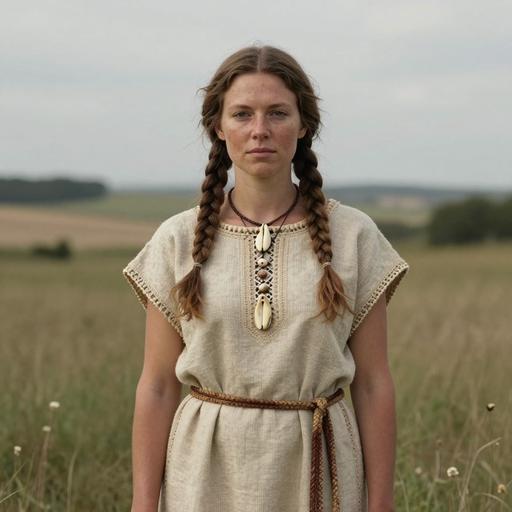
Portrait reconstruction of Herx
Ancient Individual

A woman buried in Germany in the Neolithic era

Herx
5216 BCE - 5045 BCE
Female
Early Neolithic Linear Pottery Culture, Herxheim, Germany
Germany
Scroll to begin
Chapter I

Identity

The biological and cultural markers that define this ancient individual

Sample ID

Herx

Date Range

5216 BCE - 5045 BCE

Biological Sex

Female

mtDNA Haplogroup

K1a4a1i

Cultural Period

Early Neolithic Linear Pottery Culture, Herxheim, Germany

Chapter II

Place

Where this individual was discovered

Country Germany
Locality Rhineland-Palatinate. Herxheim
Coordinates 49.1411, 8.2139
Chapter III

Time

When this individual lived in the broader context of human history

Herx 5216 BCE - 5045 BCE
Chapter IV

Story

The narrative of this ancient life

The Herxheim site in Germany is an important archaeological location associated with the Linear Pottery Culture (LBK - Linearbandkeramik), which was predominant in Central Europe during the Early Neolithic period, roughly between 5500 and 4500 BCE. This era is characterized by the advent of agriculture and sedentary lifestyles in Europe, marking a significant shift from the previous hunter-gatherer societies.

Overview of the Linear Pottery Culture (LBK)

The Linear Pottery Culture is recognized for its pottery, which often features linear decorations—hence the name. This culture is one of the earliest farming societies in Europe and is credited with introducing agriculture to the European landscape. It spread across what is now Germany, Austria, Switzerland, Czech Republic, Poland, and parts of France and the Netherlands.

Key Features of the LBK:

  1. Settlements and Architecture:

    • LBK communities lived in small, semi-permanent settlements consisting of longhouses. These structures were made from wood and thatched roofs, typically measuring 20-40 meters in length.
    • Settlements were often situated near rivers or on fertile loess soil, which would have been ideal for agriculture.
  2. Agriculture and Diet:

    • The economy was based primarily on farming, cultivating crops such as emmer wheat, barley, and peas. They also domesticated animals like cattle, pigs, sheep, and goats.
    • Their diet was complemented by hunting, fishing, and foraging.
  3. Social Organization:

    • The LBK communities were likely organized in familial or clan-based units. The social structure remains the subject of scholarly debate, with some evidence suggesting hierarchical elements.
  4. Pottery:

    • LBK pottery is characterized by its linear and geometric decorations. Bowls, cups, and storage vessels were common, reflecting both practical and aesthetic functions.

The Herxheim Site

The Herxheim site is located in southwestern Germany and represents one of the more enigmatic and intriguing sites linked to the LBK culture. Discovered in the 1990s, it has provided archaeologists with considerable evidence about the end of this cultural period.

Unique Aspects of the Herxheim Site:

  1. Mass Graves and Cannibalism Hypothesis:

    • A distinguishing feature of the Herxheim site is the presence of pits containing human bones, sometimes numbering in the hundreds. Initial interpretations suggest the possibility of mass graves.
    • Some evidence, including cut marks on bones, suggests ritualistic cannibalism; however, the interpretation remains contentious. It might have been a symbolically rich funeral practice rather than survival cannibalism.
  2. Art and Grave Goods:

    • Pottery and other artifacts found at the site include intricately decorated ceramics and flint tools. These are significant in understanding the art and technological aspects of the LBK.
    • The careful placement of human remains alongside pottery suggests complex ritual practices.
  3. Ritualistic Practices:

    • The Herxheim site might have been a regional center for ritual activities, reflecting a complex spiritual or social importance, potentially involving rites of passage, ancestor worship, or appeasement ceremonies.
  4. Site Abandonment:

    • Evidence indicates that Herxheim was eventually abandoned, possibly due to climate changes, resource depletion, or social upheaval, marking the decline of the LBK culture in the area.

Influence and Legacy

The Herxheim site and the LBK more broadly are crucial for understanding the transition from foraging to farming in Europe. The changes in subsistence, social structures, and cultural practices associated with this period laid the groundwork for subsequent European prehistoric cultures.

  • Cultural Integration: The LBK's legacy is evident in the way it set patterns for subsequent Neolithic and Bronze Age cultures, blending farming with previously nomadic lifestyles.
  • Diffusion of Agriculture: The LBK is instrumental in demonstrating the spread of agrarian practices across Europe, showing how early farming communities adapted to different European environments.

In summary, Herxheim, within the context of the Early Neolithic Linear Pottery Culture, offers a fascinating window into the life, culture, and eventually the decline, of one of Europe's earliest farming societies. The site remains a focal point for debates about social and ritual life in prehistoric Europe.

Chapter V

Genetics

The genetic ancestry of this ancient individual

Modern Genetic Admixture

This analysis compares the DNA profile with present-day reference populations, showing what percentage of genetic makeup resembles modern populations from different regions.

Europe 90.5%
Southern European 90.5%
Iberian 44.6%
Italian 24.8%
Sardinian 21.1%
Asia 9.5%
Northern West Asian 7.9%
Cypriot 7.9%
Arab, Egyptian & Levantine 1.6%
Arabian 1.6%

Closest Modern Populations

These are the modern populations showing the closest statistical alignment to A woman buried in Germany in the Neolithic era, ranked by genetic distance. Lower distance values indicate closer statistical similarity.

1
Sardinian
5.5158
2
Belmonte Jew
6.2443
3
French Corsica
7.1060
4
Sicilian West
7.3103
5
Italian Lazio
7.3613
6
Italian Jew
7.4337
7
Turkish Sabbatean
7.4886
8
Maltese
7.4964
9
Sicilian East
7.5173
10
Italian Campania
7.5327
Chapter VI

Context

Other ancient individuals connected to this sample

Sources

References

Scientific publications and genetic data

Scientific Publication

The genomic origins of the world's first farmers

Authors Marchi N, Winkelbach L, Schulz I
Abstract

The precise genetic origins of the first Neolithic farming populations in Europe and Southwest Asia, as well as the processes and the timing of their differentiation, remain largely unknown. Demogenomic modeling of high-quality ancient genomes reveals that the early farmers of Anatolia and Europe emerged from a multiphase mixing of a Southwest Asian population with a strongly bottlenecked western hunter-gatherer population after the last glacial maximum. Moreover, the ancestors of the first farmers of Europe and Anatolia went through a period of extreme genetic drift during their westward range expansion, contributing highly to their genetic distinctiveness. This modeling elucidates the demographic processes at the root of the Neolithic transition and leads to a spatial interpretation of the population history of Southwest Asia and Europe during the late Pleistocene and early Holocene.

G25 Coordinates

The G25 coordinates for sample Herx can be used for detailed admixture analysis in our G25 Studio tool.

Herx,0.10317576,0.15809892,0.00237716,-0.0660528,0.04330118,-0.03182294,-0.00383408,0.00290306,0.04426232,0.05811108,0.000557,0.00666448,-0.0096819,-0.01106816,-0.0118832,0.00828634,0.00725146,0.00128728,0.00237428,0.00034192,0.00368444,0.00777708,-0.01267058,-0.01672998,0.00214664
Analyze in G25 Studio
Use code for 35% off Expires Apr 16