Menu
Store
Blog
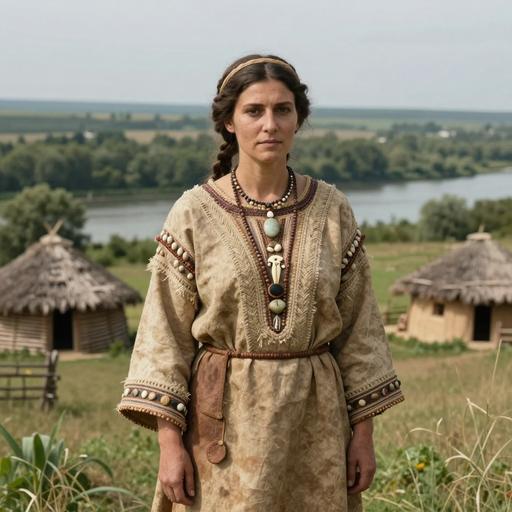
Portrait reconstruction of STAR1
Ancient Individual

A woman buried in Serbia in the Neolithic era

STAR1
5641 BCE - 5528 BCE
Female
Early Neolithic Starčevo Culture, Grad-Starčevo, Serbia
Serbia
Scroll to begin
Chapter I

Identity

The biological and cultural markers that define this ancient individual

Sample ID

STAR1

Date Range

5641 BCE - 5528 BCE

Biological Sex

Female

mtDNA Haplogroup

T2e2

Cultural Period

Early Neolithic Starčevo Culture, Grad-Starčevo, Serbia

Chapter II

Place

Where this individual was discovered

Country Serbia
Locality Grad-Starčevo
Coordinates 44.8174, 20.5719
Chapter III

Time

When this individual lived in the broader context of human history

STAR1 5641 BCE - 5528 BCE
Chapter IV

Story

The narrative of this ancient life

The Starčevo Culture is one of the earliest Neolithic cultures in Southeast Europe, dating back to approximately 6200–4500 BCE. It is named after the site of Grad-Starčevo near the village of Starčevo, located on the Danube River in Serbia. This prehistoric culture is significant for understanding the spread of agriculture and settled life in the Balkans and Central Europe during the Neolithic period.

Geographical Scope

The Starčevo Culture primarily flourished in the central and western Balkans, encompassing modern-day Serbia, Hungary, Bosnia, Croatia, and Romania. Its proximity to riverine systems like the Danube significantly influenced the settlement patterns, facilitating trade, transportation, and communication with neighboring regions.

Chronology

The chronological framework of the Starčevo Culture suggests that it was contemporaneous with other early Neolithic cultures, such as the Körös Culture in Hungary and the Criș Culture in Romania, often collectively referred to as the Körös-Starčevo-Criș complex. This timeframe indicates an early contribution to the Neolithic revolution in Europe.

Settlement Patterns

Settlements of the Starčevo Culture were usually small, consisting of several semi-subterranean or above-ground structures. These dwellings were primarily built using wattle and daub techniques, with thatched roofs supported by wooden poles. The selection of settlement locations near fertile river valleys suggests a strategic choice aimed at maximizing agricultural production.

Economy

The economy of the Starčevo Culture was mixed, involving agriculture, animal husbandry, fishing, and foraging. Evidence shows the cultivation of cereals like wheat and barley, as well as legumes such as lentils and peas. Domesticated animals included cattle, sheep, goats, and pigs, which played a crucial role in their agrarian-based economy.

Material Culture

Pottery is one of the defining features of the Starčevo Culture, characterized by its variety in form and decoration. The ceramics were typically hand-made and decorated with incised, painted, or impressed designs, reflecting both functional and aesthetic considerations. The use of red ochre for painting suggests influences from or interactions with other contemporary cultures.

Tools and Technology

The Starčevo people used a range of stone tools, including polished axes, adzes, and flint blades, which were essential for agriculture and construction. Bone tools and ceramic figurines have also been found, indicating the diverse technological practices and the possible presence of spiritual or ritual activities.

Social Organization

Understanding the social structure of the Starčevo Culture is challenging due to the limited archaeological evidence. However, the size and complexity of settlements suggest relatively simple social organization, potentially based on kinship groups or extended family units. The presence of communal storage pits implies some degree of cooperative behavior and resource sharing.

Art and Symbolism

The Starčevo Culture is also noted for its artistic expressions, including pottery decoration and small statuettes. These artifacts may have served religious or symbolic purposes, indicating an emerging complexity in cognitive and cultural development.

Conclusion

The Starčevo Culture represents a pivotal transition from hunter-gatherer societies to more sedentary and complex agrarian communities in Southeast Europe. Its influence is seen in later Neolithic cultures, signifying the spread of agricultural practices and new social dynamics throughout Europe. The archaeological site at Grad-Starčevo remains a crucial point for understanding the early stages of European prehistory, providing insight into the adaptability and ingenuity of early Neolithic communities.

Chapter V

Genetics

The genetic ancestry of this ancient individual

Modern Genetic Admixture

This analysis compares the DNA profile with present-day reference populations, showing what percentage of genetic makeup resembles modern populations from different regions.

Europe 79.1%
Southern European 79.1%
Italian 40.9%
Sardinian 30.5%
Balkan 7.7%
Asia 20.9%
Arab, Egyptian & Levantine 19.7%
Levantine 10.0%
Arabian 9.7%
Northern West Asian 1.2%
Cypriot 1.2%

Closest Modern Populations

These are the modern populations showing the closest statistical alignment to A woman buried in Serbia in the Neolithic era, ranked by genetic distance. Lower distance values indicate closer statistical similarity.

1
Sardinian
5.2900
2
Belmonte Jew
6.0379
3
French Corsica
7.3330
4
Sicilian West
7.6212
5
Maltese
7.6541
6
Turkish Sabbatean
7.8298
7
Spanish Canarias
7.8429
8
Italian Lazio
7.8453
9
Italian Jew
7.9290
10
Moroccan Jew
7.9718
Chapter VI

Context

Other ancient individuals connected to this sample

Sources

References

Scientific publications and genetic data

Scientific Publication

The genomic origins of the world's first farmers

Authors Marchi N, Winkelbach L, Schulz I
Abstract

The precise genetic origins of the first Neolithic farming populations in Europe and Southwest Asia, as well as the processes and the timing of their differentiation, remain largely unknown. Demogenomic modeling of high-quality ancient genomes reveals that the early farmers of Anatolia and Europe emerged from a multiphase mixing of a Southwest Asian population with a strongly bottlenecked western hunter-gatherer population after the last glacial maximum. Moreover, the ancestors of the first farmers of Europe and Anatolia went through a period of extreme genetic drift during their westward range expansion, contributing highly to their genetic distinctiveness. This modeling elucidates the demographic processes at the root of the Neolithic transition and leads to a spatial interpretation of the population history of Southwest Asia and Europe during the late Pleistocene and early Holocene.

G25 Coordinates

The G25 coordinates for sample STAR1 can be used for detailed admixture analysis in our G25 Studio tool.

STAR1,0.09025192,0.15649324,0.00748954,-0.06159192,0.04739064,-0.02936834,-0.00650066,0.00453228,0.04459252,0.063837,0.00025742,0.00745388,-0.01219638,-0.01328302,-0.00996546,0.00531792,0.01218932,-0.00110288,-0.00657244,-0.00037042,-0.00108482,-0.00016426,-0.00659932,-0.01598668,0.00278989
Analyze in G25 Studio
Use code for 35% off Expires Apr 16