Menu
Store
Blog
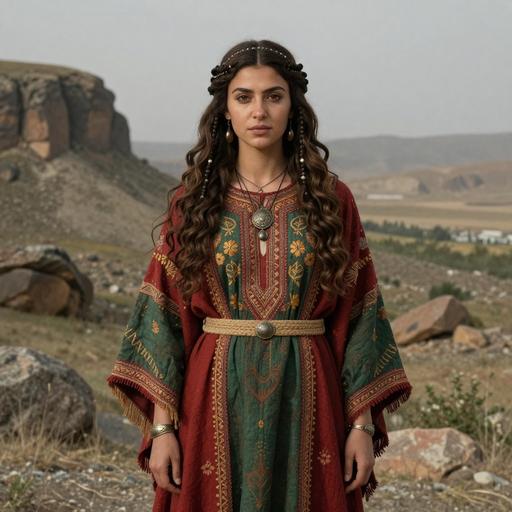
Portrait reconstruction of I10252
Ancient Individual

A woman buried in Armenia in the Medieval era

I10252
100 BCE - 300 CE
Female
Ancient Armenia
Armenia
Scroll to begin
Chapter I

Identity

The biological and cultural markers that define this ancient individual

Sample ID

I10252

Date Range

100 BCE - 300 CE

Biological Sex

Female

mtDNA Haplogroup

U7b

Cultural Period

Ancient Armenia

Chapter II

Place

Where this individual was discovered

Country Armenia
Locality Vardbakh. Yerevan 2 Cave
Coordinates 40.8333, 43.9167
Chapter III

Time

When this individual lived in the broader context of human history

I10252 100 BCE - 300 CE
Chapter IV

Story

The narrative of this ancient life

Ancient Armenia has a rich and complex history, especially during its time as part of the Byzantine Empire. The interactions between Armenia and the Byzantine Empire were marked by political, religious, and cultural exchanges that significantly shaped the region's development.

Historical Context

Ancient Armenia, due to its strategic location between Europe and Asia, often found itself at the crossroads of competing empires, notably the Roman, Byzantine, and Persian empires. The Armenian plateau was a region of significant military and strategic importance, bridging the East and West. This led to a long history of conquest, division, and cultural assimilation.

Byzantine Influence

Armenia's relationship with the Byzantine Empire was multifaceted, involving alliances, conflicts, and periods of Byzantine control. The Byzantine influence on Armenia was particularly prominent after the fall of the Western Roman Empire and during the early periods of Byzantine strength.

  1. Political Dynamics:

    • Armenia frequently oscillated between Byzantine and Persian control due to its pivotal location. The Byzantine emperors sought to control Armenia either directly or through local Armenian nobility.
    • The Treaty of Nvarsak in 484 granted religious freedom and relative autonomy to Armenia, reducing Persian influence and increasing Byzantine sway.
  2. Religious Influence:

    • Christianity had already been adopted as the state religion of Armenia in 301 AD, preceding Rome itself, and during the Byzantine era, there were attempts to align Armenian Christianity with the Chalcedonian creed followed by Byzantium.
    • The Council of Chalcedon in 451 created theological tensions, as Armenia rejected the decisions of the council, creating a distinct Armenian Apostolic Church. Despite this, Byzantine rulers continued their efforts to bring Armenians under the ecclesiastical jurisdiction of Constantinople.
  3. Cultural Exchange:

    • Byzantine culture left a lasting impact on Armenian art, architecture, and literature. The architectural style of many Armenian churches and monastic buildings reflect Byzantine influences through the use of domes and intricate mosaics.
    • Armenian manuscripts from this period often display Byzantine artistic techniques and iconography, while maintaining unique Armenian stylistic elements.
  4. Military Aspects:

    • Armenians served as a vital component of the Byzantine military, with Armenian soldiers and generals often holding high positions in the Byzantine army. The strategic significance of Armenia as a buffer zone against Persian incursions was well-recognized.
  5. Administrative Integration:

    • During periods of direct Byzantine control, Armenia was divided into administrative districts (themes), and the Byzantine system of governance was applied, albeit with local adaptations.

Decline of Byzantine Influence

By the late 11th century, the Byzantine Empire encountered significant setbacks due to the rise of the Seljuk Turks, who captured much of Armenia. The shifting geopolitical landscape with the Crusades and other regional powers rising led to a reduction in Byzantine influence in Armenia, which subsequently paved the way for Armenian autonomous principalities and the later Cilician Armenian Kingdom.

Legacy

The interactions between Ancient Armenia and the Byzantine Empire left a lasting legacy. Despite differences, the era is seen as one of significant cultural growth, with Armenia maintaining its distinct Christian traditions and identity while incorporating Byzantine cultural and administrative practices. This period laid the foundation for Armenia’s unique position as a bridge between Eastern and Western Christian traditions and created a resilient Armenian identity that has endured through centuries.

Chapter V

Genetics

The genetic ancestry of this ancient individual

Ancient Genetic Admixture

This analysis compares the DNA profile of I10252 with ancient reference populations, showing the genetic composition in terms of prehistoric ancestral groups.

Neolithic Farmers 68.9%
European Hunter-Gatherers 19.1%
Western Steppe Pastoralists 9.2%
Ancient Asians 2.9%

Modern Genetic Admixture

This analysis compares the DNA profile with present-day reference populations, showing what percentage of genetic makeup resembles modern populations from different regions.

Asia 95.0%
Northern West Asian 66.5%
Mesopotamian 33.0%
Caucasian 24.9%
Cypriot 8.6%
Arab, Egyptian & Levantine 23.2%
Levantine 23.2%
Central Asian, Northern Indian & Pakistani 5.2%
Indian 5.2%
Europe 5.0%
Southern European 5.0%
Italian 5.0%

Closest Modern Populations

These are the modern populations showing the closest statistical alignment to A woman buried in Armenia in the Medieval era, ranked by genetic distance. Lower distance values indicate closer statistical similarity.

1
Turkish Erzurum
2.1201
2
Andian A
2.3499
3
Udi
2.4470
4
Azerbaijani Republic Shaki
2.5699
5
Georgian Kart
2.6143
6
Georgian Kakh
2.7114
7
Armenian Artsakh
2.8300
8
Ahiska
3.0049
9
Alevi Dersim
3.0610
10
Armenian Syunik
3.1161
Chapter VI

Context

Other ancient individuals connected to this sample

Sources

References

Scientific publications and genetic data

Scientific Publication

The genetic history of the Southern Arc: A bridge between West Asia and Europe | Science

Authors Lazaridis I, Alpaslan-Roodenberg S, Acar A
Abstract

The period from the Copper Age to the Bronze Age marked major social and economic transformations in West Eurasia. To better understand these changes and their genetic impacts, we generated genome-wide data from 727 individuals who lived between 5000 and 1000 BCE in southeastern Europe and southwestern Asia.

G25 Coordinates

The G25 coordinates for sample I10252 can be used for detailed admixture analysis in our G25 Studio tool.

I10252,0.09728378,0.12041274,-0.05538134,-0.0417319,-0.04033884,-0.01036862,0.00557382,-0.00521402,-0.03876364,-0.0182674,-0.00108252,0.00183186,-0.00684608,0.00440954,0.0060366,-0.00548656,0.00373788,-0.00425582,-0.00234012,0.00637142,0.00586962,-0.00029042,0.0022691,-0.00374658,-0.00234193
Analyze in G25 Studio
Use code for 40% off Expires Feb 26