Menu
Store
Blog
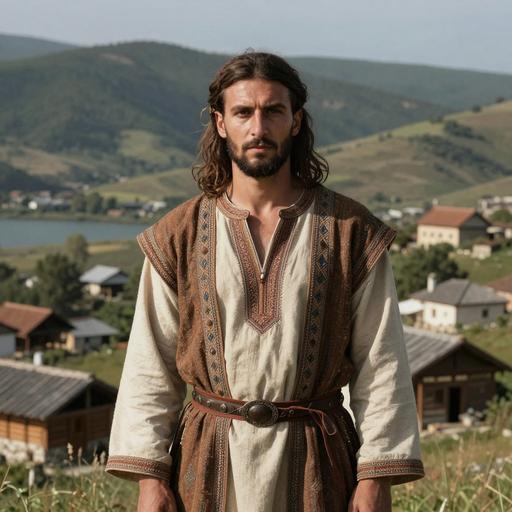
Portrait reconstruction of I14622
Ancient Individual

A man buried in Albania in the Middle Ages era

I14622
773 CE - 885 CE
Male
Medieval Albania
Albania
Scroll to begin
Chapter I

Identity

The biological and cultural markers that define this ancient individual

Sample ID

I14622

Date Range

773 CE - 885 CE

Biological Sex

Male

mtDNA Haplogroup

H11a

Y-DNA Haplogroup

Not available

Cultural Period

Medieval Albania

Chapter II

Place

Where this individual was discovered

Country Albania
Locality Kënetë (Norteastern. Kukes District)
Coordinates 42.0369, 20.3972
Chapter III

Time

When this individual lived in the broader context of human history

I14622 773 CE - 885 CE
Chapter IV

Story

The narrative of this ancient life

Medieval Albania, particularly during the time it was under the influence and control of the Byzantine Empire, is a fascinating period marked by a blend of cultures, shifting borders, and significant historical events. While modern Albania's territory was not entirely encompassed by the Byzantine Empire throughout the medieval period, major regions like Dyrrachium (modern Durrës) were significant Byzantine strongholds. Here's an extensive and detailed description of this era.

Geopolitical Context

During the medieval period, Albania was situated at a crossroads of empires, primarily influenced by the Byzantine Empire to the east and often contested by various powers, including the Normans, Venetians, and later the Ottoman Turks. The strategic location of Albania along the Adriatic coast made it a vital point for trade, military, and cultural exchanges.

From the late antiquity until approximately the 14th century, the region saw a succession of dominant cultures, importantly marked by the Byzantine Empire's presence. The area served as a buffer zone and a frontier for Byzantine defense, particularly against Slavic invasions from the north and Norman incursions from the west.

Cultural Influences

The Byzantine influence on medieval Albanian culture was profound, as seen in art, architecture, religion, and governance:

  1. Religion and Ecclesiastical Influence: Christianity was well-established, with the Eastern Orthodox Church dominating religious life. Important religious centers, such as the bishopric in Durrës, played a crucial role in both spiritual and administrative matters. Byzantine ecclesiastical architecture influenced local church designs, characterized by domes and intricate frescoes.

  2. Architecture and Art: Byzantine architectural styles were prevalent, particularly in religious buildings. Monasteries and churches from this era often display ornate frescoes with biblical scenes, featuring a distinctive Byzantine flair in iconography. The use of mosaics was also common, reflecting a blend of local and imperial artistic traditions.

  3. Language and Literature: Greek, the administrative and liturgical language of the Byzantine Empire, was widely used, influencing the development of the Albanian language and script. Latin also held some sway due to Western influences. This blend of languages facilitated a rich tapestry of cultural literature and legal documents during this period.

Social and Economic Life

Medieval Albania under Byzantine influence saw a feudal system where local lords owed allegiance to the Byzantine emperor. The economy was primarily agrarian but also benefited from its strategic position as trade routes traversed its land, connecting the Adriatic with the interior Balkan regions.

  1. Feudal Society: Land ownership was crucial, with local aristocrats wielding significant power. Society was structured around these landowning elites, who controlled both rural and urban centers.

  2. Trade and Commerce: Coastal cities, especially Dyrrachium, were key commercial hubs. Trade goods included salt, wine, olive oil, and metals, facilitated by robust trade routes connecting the Adriatic Sea with inland territories.

  3. Rural Life: The majority of the population engaged in agriculture, cultivating grains, olives, and vineyards. Shepherding and pastoral activities were also significant, reflecting a rural lifestyle deeply connected to the land.

Historical Events and Challenges

Medieval Albania faced numerous invasions and shifts in power dynamics:

  1. Slavic Invasions: In the early medieval period, Slavic tribes penetrated the Balkans, influencing local cultures and demographics. The Byzantines often struggled to maintain control over these incursions.

  2. Norman and Venetian Influence: In the 11th and 12th centuries, Norman forces from Southern Italy launched invasions, capturing important cities like Dyrrachium. Later, the Venetians exerted commercial and military influence, especially in coastal regions.

  3. The Rise of Independent Principalities: As Byzantine influence waned in the late medieval period, local leaders began to assert more autonomy, paving the way for the formation of independent Albanian principalities and setting the stage for the later Ottoman conquest.

Legacy

Medieval Albania under Byzantine influence was a period of profound cultural synthesis and transition, laying the groundwork for future developments in Albanian identity and statehood. The enduring Byzantine impact is still visible today through religious traditions, architectural heritage, and cultural practices that echo the rich tapestry of medieval Albanian history.

Chapter V

Genetics

The genetic ancestry of this ancient individual

Ancient Genetic Admixture

This analysis compares the DNA profile of I14622 with ancient reference populations, showing the genetic composition in terms of prehistoric ancestral groups.

Neolithic Farmers 56.1%
European Hunter-Gatherers 27.2%
Western Steppe Pastoralists 16.7%

Modern Genetic Admixture

This analysis compares the DNA profile with present-day reference populations, showing what percentage of genetic makeup resembles modern populations from different regions.

Europe 75.0%
Southern European 58.9%
Balkan 32.4%
Italian 20.5%
Sardinian 6.0%
Northwestern European 16.1%
Northwestern European 9.2%
English 6.9%
Asia 24.4%
Northern West Asian 14.3%
Anatolian 4.1%
Mesopotamian 4.0%
Caucasian 3.7%
Cypriot 2.5%
Arab, Egyptian & Levantine 10.1%
Levantine 6.7%
Arabian 3.5%
Africa 0.6%
North African 0.6%
North African 0.6%

Closest Modern Populations

These are the modern populations showing the closest statistical alignment to A man buried in Albania in the Middle Ages era, ranked by genetic distance. Lower distance values indicate closer statistical similarity.

1
Italian Apulia
1.4993
2
Italian Abruzzo
1.6144
3
Italian Basilicata
1.6192
4
Italian Campania
1.7168
5
Greek Cyclades Milos
1.7884
6
Italian Molise
1.8340
7
Greek South Tsakonia
1.8513
8
Greek Deep Mani
1.9091
9
Greek North Tsakonia
1.9412
10
Sicilian East
1.9530
Chapter VI

Context

Other ancient individuals connected to this sample

Sources

References

Scientific publications and genetic data

Scientific Publication

The genetic history of the Southern Arc: A bridge between West Asia and Europe | Science

Authors Lazaridis I, Alpaslan-Roodenberg S, Acar A
Abstract

The period from the Copper Age to the Bronze Age marked major social and economic transformations in West Eurasia. To better understand these changes and their genetic impacts, we generated genome-wide data from 727 individuals who lived between 5000 and 1000 BCE in southeastern Europe and southwestern Asia.

G25 Coordinates

The G25 coordinates for sample I14622 can be used for detailed admixture analysis in our G25 Studio tool.

I14622,0.1146295,0.14186808,-0.01008154,-0.0342388,0.01455124,-0.01130314,0.00215682,0.00221402,0.00343742,0.0216048,-9.8E-05,0.00273906,-0.00846932,0.00245266,-0.0061159,-0.005152,0.00115842,-0.00013262,0.00351142,-0.00199192,-0.00330426,0.00262444,-0.00240364,-0.00072924,0.00179158
Analyze in G25 Studio
Use code for 40% off Expires Feb 27