Menu
Store
Blog
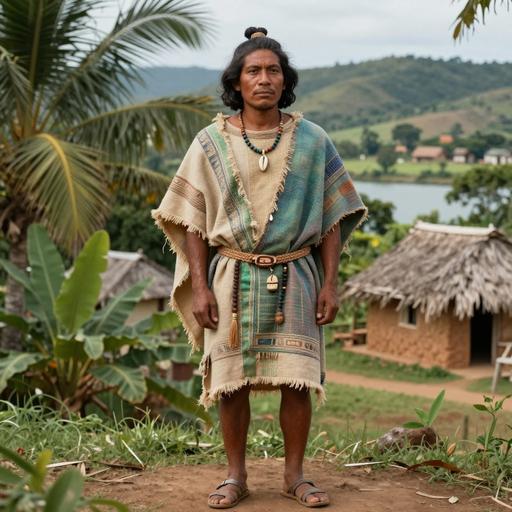
Portrait reconstruction of I17894
Ancient Individual

A man buried in Venezuela in the Pre-Columbian Caribbean era

I17894
395 BCE - 209 BCE
Male
Ceramic Period Las Locas, Venezuela
Venezuela
Scroll to begin
Chapter I

Identity

The biological and cultural markers that define this ancient individual

Sample ID

I17894

Date Range

395 BCE - 209 BCE

Biological Sex

Male

mtDNA Haplogroup

B2d

Y-DNA Haplogroup

Q-M902

Cultural Period

Ceramic Period Las Locas, Venezuela

Chapter II

Place

Where this individual was discovered

Country Venezuela
Locality Las Locas
Chapter III

Time

When this individual lived in the broader context of human history

I17894 395 BCE - 209 BCE
Chapter IV

Story

The narrative of this ancient life

The Ceramic Period of Las Locas in Venezuela, particularly associated with the Arawak culture, is a fascinating chapter in the pre-Columbian history of South America. This period, characterized by the development and proliferation of ceramic technology, provides essential insights into the social, economic, and cultural evolution of the indigenous peoples of this region. Below is an extensive and detailed description of this era:

Historical Context

The Ceramic Period in Venezuela is believed to have begun around 500 BCE and extended until the arrival of European colonizers in the late 15th century. The Arawak, a significant indigenous group that spread across the Caribbean and parts of South America, were known for their advanced social structures and interactions with other cultures. The Las Locas site represents one of the numerous Arawak settlements during this period, highlighting the group's adaptability and extensive trade networks.

Geographic and Environmental Setting

Las Locas is situated within the diverse landscapes of Venezuela, which includes coastal regions, mountainous areas, and plains. This geographical diversity provided the Arawak with abundant resources, ranging from marine and riverine food sources to fertile lands for agriculture. The environment played a crucial role in shaping the subsistence strategies and lifestyle of the Arawak people during the Ceramic Period.

Ceramic Technology

The hallmark of this era is the sophisticated ceramic technology developed by the Arawak. Pottery from this period displays intricate designs and a variety of forms, indicating both practical and ceremonial uses. Common features include finely made bowls, jars, and griddles used for everyday activities such as cooking and storage. Decorative elements on these ceramics often include geometric patterns, anthropomorphic figures, and symbols that may have held cultural or religious significance.

Techniques and Styles

  • Coiling and Firing: The Arawak used hand-coiling methods to shape the clay, followed typically by open-fire or pit firing techniques, which imparted distinctive hues to the finished products based on the firing temperatures and conditions.
  • Surface Treatments: Many ceramics were polished or burnished to create a smooth finish. Some pieces were also painted or incised with motifs prior to firing.
  • Variety of Forms: The ceramics display a wide range of forms from simple utilitarian objects to complex, ceremonial vessels. This variety suggests a society with diverse needs and a rich cultural life.

Social and Cultural Dynamics

The presence of such sophisticated ceramics is indicative of complex social structures and cultural practices. Ceramics were likely central to daily life, trade, and social interactions. They would have been used not only for practical purposes but also in social feasts, religious rituals, and as status symbols.

Social Organization

  • Settlements: Arawak communities during this period were organized into village clusters, with evidence indicating a sedentary and agrarian lifestyle complemented by fishing and hunting.
  • Trade and Interaction: The Arawak were part of extensive trade networks, exchanging goods such as ceramics, tools, and possibly even food and labor with neighboring groups.
  • Ritual and Ceremonial Life: The designs on ceramics often point to their use in rituals and ceremonies, possibly related to agricultural cycles, social hierarchy, or religious beliefs.

Subsistence and Economy

Subsistence strategies during the Ceramic Period included agriculture, fishing, and hunting. The Arawak cultivated crops such as cassava, maize, and other tubers. The domestication and processing of these crops were likely aided by ceramic tools and cooking vessels.

Archaeological Significance

The Las Locas site is critical for understanding the Ceramic Period in Venezuela. Excavations have revealed not only ceramics but also tools, ornaments, and remnants of structures. These findings provide critical data on the technological innovations, cultural exchanges, and environmental adaptations of the Arawak.

Conclusion

The Ceramic Period Las Locas of the Arawak in Venezuela exemplifies the cultural richness and adaptability of indigenous groups prior to European colonization. Through advanced ceramic technology, complex social structures, and an integrated economy, the Arawak left a lasting legacy crucial to understanding the broader narrative of human civilization in the Americas. Research on this period continues to evolve, offering new insights into the prehistoric lifeways and interactions of the Arawak and their lasting impact on the cultural landscape of Venezuela.

Chapter V

Genetics

The genetic ancestry of this ancient individual

Ancient Genetic Admixture

This analysis compares the DNA profile of I17894 with ancient reference populations, showing the genetic composition in terms of prehistoric ancestral groups.

Ancient Native Americans 81.2%
Ancient Asians 18.8%

Modern Genetic Admixture

This analysis compares the DNA profile with present-day reference populations, showing what percentage of genetic makeup resembles modern populations from different regions.

America 93.4%
America 93.4%
Native American 93.4%
Asia 5.9%
Chinese & Southeast Asian 4.1%
Chinese 4.1%
Northern Asian 1.8%
Siberian 1.8%
Europe 0.6%
Northwestern European 0.6%
Finnish 0.6%

Closest Modern Populations

These are the modern populations showing the closest statistical alignment to A man buried in Venezuela in the Pre-Columbian Caribbean era, ranked by genetic distance. Lower distance values indicate closer statistical similarity.

1
Piapoco
1.6712
2
Aymara
2.1393
3
Wichi
2.1833
4
Yukpa
2.2766
5
Karitiana
3.0870
6
Bolivian Lapaz
3.3454
7
Colla
3.8417
8
Surui
4.1735
9
Cachi
4.4236
10
Mixe
4.5236
Chapter VI

Context

Other ancient individuals connected to this sample

Sources

References

Scientific publications and genetic data

Scientific Publication

A genetic history of the pre-contact Caribbean

Authors Fernandes DM, Sirak KA, Ringbauer H
Abstract

Humans settled the Caribbean about 6,000 years ago, and ceramic use and intensified agriculture mark a shift from the Archaic to the Ceramic Age at around 2,500 years ago1-3. Here we report genome-wide data from 174 ancient individuals from The Bahamas, Haiti and the Dominican Republic (collectively, Hispaniola), Puerto Rico, Curaçao and Venezuela, which we co-analysed with 89 previously published ancient individuals. Stone-tool-using Caribbean people, who first entered the Caribbean during the Archaic Age, derive from a deeply divergent population that is closest to Central and northern South American individuals; contrary to previous work4, we find no support for ancestry contributed by a population related to North American individuals. Archaic-related lineages were >98% replaced by a genetically homogeneous ceramic-using population related to speakers of languages in the Arawak family from northeast South America; these people moved through the Lesser Antilles and into the Greater Antilles at least 1,700 years ago, introducing ancestry that is still present. Ancient Caribbean people avoided close kin unions despite limited mate pools that reflect small effective population sizes, which we estimate to be a minimum of 500-1,500 and a maximum of 1,530-8,150 individuals on the combined islands of Puerto Rico and Hispaniola in the dozens of generations before the individuals who we analysed lived. Census sizes are unlikely to be more than tenfold larger than effective population sizes, so previous pan-Caribbean estimates of hundreds of thousands of people are too large5,6. Confirming a small and interconnected Ceramic Age population7, we detect 19 pairs of cross-island cousins, close relatives buried around 75 km apart in Hispaniola and low genetic differentiation across islands. Genetic continuity across transitions in pottery styles reveals that cultural changes during the Ceramic Age were not driven by migration of genetically differentiated groups from the mainland, but instead reflected interactions within an interconnected Caribbean world1,8.

G25 Coordinates

The G25 coordinates for sample I17894 can be used for detailed admixture analysis in our G25 Studio tool.

I17894,0.05662786,-0.31963438,0.11174128,0.1005679,-0.11356842,-0.00980294,-0.30693134,-0.36088178,-0.01566402,-0.01717638,0.00042996,-0.0011649,-0.00099966,0.02502312,-0.0057835,-0.00014604,0.00637176,0.00254488,0.00017678,-0.00220746,-0.0011668,0.0079936,-0.0020552,-0.00502996,-0.00617736
Analyze in G25 Studio
Use code for 40% off Expires Feb 27