Menu
Store
Blog
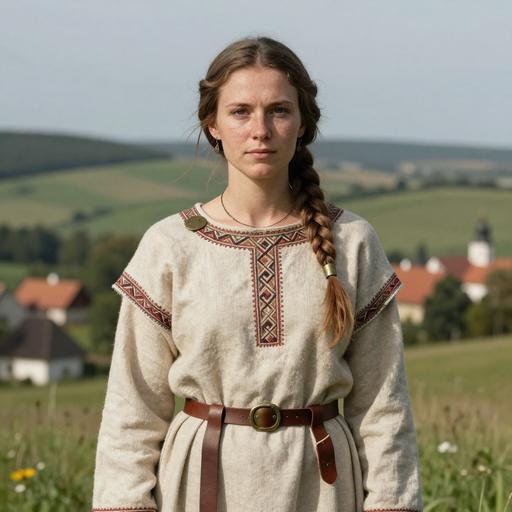
Portrait reconstruction of I4137
Ancient Individual

A woman buried in Czech Republic in the Middle Ages era

I4137
660 CE - 774 CE
Female
Early Slavic Period, Czech Republic
Czech Republic
Scroll to begin
Chapter I

Identity

The biological and cultural markers that define this ancient individual

Sample ID

I4137

Date Range

660 CE - 774 CE

Biological Sex

Female

mtDNA Haplogroup

H1af

Cultural Period

Early Slavic Period, Czech Republic

Chapter II

Place

Where this individual was discovered

Country Czech Republic
Locality Brandysek
Coordinates 50.1900, 14.1580
Chapter III

Time

When this individual lived in the broader context of human history

I4137 660 CE - 774 CE
Chapter IV

Story

The narrative of this ancient life

The Early Slavic Period in the region that is now the Czech Republic is a fascinating era that spans approximately from the 5th to the 9th century. This period marks the significant transformation of Central Europe with the migration and settlement of Slavic peoples, as well as the developments that paved the way for the formation of future states such as the early Czech state of Great Moravia.

Historical Context

During the Migration Period, following the decline of the Roman Empire, various tribes and groups moved across Europe. The Slavic peoples were among these groups, having originally settled in the forests and marshes of Eastern Europe. By the 6th century, they began migrating westward, reaching the territories of present-day Czech Republic.

Settlement and Society

The Slavic settlers were predominantly agrarian, establishing small village communities that relied on agriculture, animal husbandry, and local resources. They settled primarily along river valleys, which provided fertile land for farming and water access. Archaeological evidence suggests that these communities practiced a mixed economy with crop cultivation (such as millet, wheat, and barley) and livestock farming.

Slavic society during this period was primarily organized around family units and kinship groups, with loose tribal affiliations. Leadership was typically provided by chieftains or elders. These structures were relatively egalitarian compared to the hierarchical systems that would develop later in medieval European society.

Culture and Religion

The Slavic culture of this era was rich with oral traditions and folklore. They revered natural and ancestral spirits, practicing a polytheistic religion that involved the worship of gods such as Perun (god of thunder) and Veles (god of the underworld and cattle). The Slavs employed rituals and offerings to ensure agricultural prosperity and protection from harm.

Artistic expressions in the Early Slavic Period were notable for their use of geometric patterns and simple, functional designs. These were evident in pottery, tools, and textiles, with minimalistic decoration that was both practical and symbolic.

Linguistic Contributions

The Slavic migration brought with it the Proto-Slavic language, which later diversified into various Slavic languages, including Czech. The common language facilitated communication and cultural cohesion among the dispersed Slavic groups.

Political Developments

As Slavic communities settled and grew, they began to form larger political entities. By the 7th century, the Samo's Realm, the first known political organization of Slavs in Central Europe, emerged. Although it collapsed after three decades, it set a precedent for later state formations and alliances.

The most significant political development during the Early Slavic Period in the region was the establishment of Great Moravia in the 9th century. This early medieval state, encompassing parts of the Czech Republic, Slovakia, and beyond, marked the consolidation of Slavic power and influence in Central Europe.

Christianization

The Christianization of the Slavic people began in earnest during the 9th century, with the Byzantine Empire sending missionaries like Saints Cyril and Methodius to Moravia. They introduced the Glagolitic script, the precursor to Cyrillic, facilitating the translation of liturgical texts into the Slavic language. This not only spread Christianity but also significantly influenced Slavic cultural and literacy development.

Conclusion

The Early Slavic Period in the Czech lands was a formative era characterized by migration, settlement, and cultural transformation. It laid the groundwork for the later medieval states and distinct cultural identities that emerged in Central Europe. Through archaeological discoveries, linguistic studies, and historical analysis, we continue to gain insights into the dynamic and influential period of the Early Slavs in the Czech Republic.

Chapter V

Genetics

The genetic ancestry of this ancient individual

Ancient Genetic Admixture

This analysis compares the DNA profile of I4137 with ancient reference populations, showing the genetic composition in terms of prehistoric ancestral groups.

Western Steppe Pastoralists 40.8%
European Hunter-Gatherers 38.4%
Neolithic Farmers 18.2%
Ancient Asians 2.7%

Modern Genetic Admixture

This analysis compares the DNA profile with present-day reference populations, showing what percentage of genetic makeup resembles modern populations from different regions.

Europe 97.7%
Northwestern European 45.2%
Northwestern European 15.1%
Scandinavian 12.9%
Finnish 9.0%
English 8.2%
Southern European 30.1%
Balkan 16.6%
Italian 11.1%
Sardinian 2.4%
Eastern European 22.4%
Asia 2.3%
Northern West Asian 2.3%
Cypriot 2.1%

Closest Modern Populations

These are the modern populations showing the closest statistical alignment to A woman buried in Czech Republic in the Middle Ages era, ranked by genetic distance. Lower distance values indicate closer statistical similarity.

1
Moldovan O
2.2912
2
Ukrainian Zakarpattia
2.6455
3
Slovakian
2.7699
4
Polish Silesian
3.3515
5
Hungarian
3.3736
6
Czech
3.4350
7
Croatian
3.5925
8
Ukrainian Dnipro
3.7064
9
Ukrainian Lviv
3.7162
10
Polish
3.8138
Chapter VI

Context

Other ancient individuals connected to this sample

Sources

References

Scientific publications and genetic data

Scientific Publication

Population genomics of Bronze Age Eurasia

Authors Allentoft ME, Sikora M, Sjögren KG
Abstract

The Bronze Age of Eurasia (around 3000-1000 BC) was a period of major cultural changes. However, there is debate about whether these changes resulted from the circulation of ideas or from human migrations, potentially also facilitating the spread of languages and certain phenotypic traits. We investigated this by using new, improved methods to sequence low-coverage genomes from 101 ancient humans from across Eurasia. We show that the Bronze Age was a highly dynamic period involving large-scale population migrations and replacements, responsible for shaping major parts of present-day demographic structure in both Europe and Asia. Our findings are consistent with the hypothesized spread of Indo-European languages during the Early Bronze Age. We also demonstrate that light skin pigmentation in Europeans was already present at high frequency in the Bronze Age, but not lactose tolerance, indicating a more recent onset of positive selection on lactose tolerance than previously thought.

G25 Coordinates

The G25 coordinates for sample I4137 can be used for detailed admixture analysis in our G25 Studio tool.

I4137,0.12696446,0.11725896,0.05066394,0.04736368,0.02869688,0.01597034,0.01054376,0.00902142,-0.0081059,-0.01889446,-0.0001909,-0.00364982,0.0071502,0.0078594,-0.002898,0.00732506,0.01579324,-0.0018263,-0.00292312,0.00599632,-0.00441994,-0.00127676,0.0001605,0.00166848,0.00026186
Analyze in G25 Studio
Use code for 40% off Expires Feb 26