Menu
Store
Blog
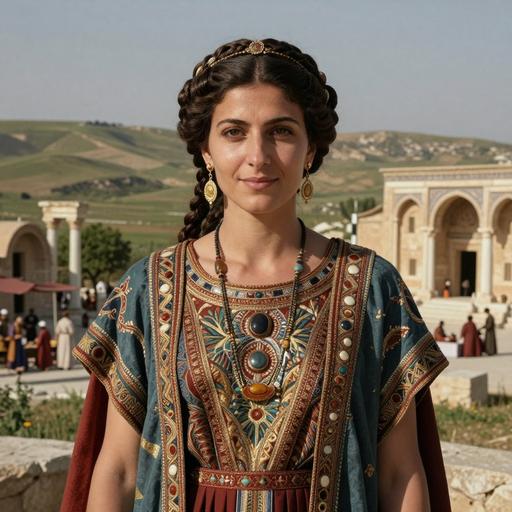
Portrait reconstruction of I4613
Ancient Individual

A woman buried in Turkey in the Late Antiquity era

I4613
500 CE - 700 CE
Female
Roman-Byzantine Period 3 Turkey
Turkey
Scroll to begin
Chapter I

Identity

The biological and cultural markers that define this ancient individual

Sample ID

I4613

Date Range

500 CE - 700 CE

Biological Sex

Female

mtDNA Haplogroup

X2+225+@153

Cultural Period

Roman-Byzantine Period 3 Turkey

Chapter II

Place

Where this individual was discovered

Country Turkey
Locality Aktaş Mevki (Southeast. Mardin. Midyat)
Coordinates 37.4150, 41.3730
Chapter III

Time

When this individual lived in the broader context of human history

I4613 500 CE - 700 CE
Chapter IV

Story

The narrative of this ancient life

The Roman-Byzantine Period in what is now modern-day Turkey, particularly during its later stages often identified as the Byzantine Empire's middle period, spans roughly from the 5th century AD to the 11th century AD. This era is marked by a rich cultural, political, and religious tapestry, with Constantinople (modern-day Istanbul) serving as the hub of the Byzantine Empire.

Political Context

Administration and Governance: The Byzantine Empire inherited Roman governmental structures, maintaining a centralized bureaucratic system. The Emperor was considered the supreme ruler, often viewed as God's representative on Earth. This era saw a succession of dynamic and sometimes tumultuous leadership, including emperors like Justinian I, who left a lasting legacy through legal reforms with the Corpus Juris Civilis (Body of Civil Law).

Military and Territorial Changes: Throughout this period, the military was a central pillar of Byzantine power. The themes (military and administrative districts) system was developed to provide an efficient military defense. The empire faced numerous threats, including incursions from the Persians, Arabs, and later the Seljuk Turks, leading to substantial territorial loss by the end of this period.

Cultural and Religious Influence

Orthodox Christianity: Christianity was not only the dominant religion but also central to Byzantine culture and politics. The Orthodox Church played an integral role, with the Patriarch of Constantinople holding significant sway. This period witnessed theological debates, such as the Iconoclasm controversy, which revolved around the use of religious images and led to a significant rift within the church.

Art and Architecture: This era is renowned for its unique contributions to art and architecture, characterized by the use of mosaics, iconography, and the development of the Byzantine architectural style. The Church of Hagia Sophia in Constantinople stands as an architectural marvel from this period, exemplifying the empire's artistic and engineering prowess.

Literature and Education: Byzantine culture valued scholarship and learning, preserving classical Greco-Roman works and producing significant theological and historical writings. The empire's monasteries and schools served as important centers of learning and literary activity.

Economy and Society

Trade and Economy: The Byzantine Empire was a crucial economic powerhouse, serving as a crossroads for trade between Asia, the Middle East, and Europe. Constantinople was a bustling metropolis, thriving on trade in silk, spices, textiles, and other goods. The solidus, a gold coin introduced by Constantine the Great, remained a stable currency throughout this period.

Society and Daily Life: Byzantine society was stratified, with a complex class system influenced by Roman traditions. The urban elite and wealthy landowners held substantial power, while the majority of the population lived as free peasants or serfs under a feudal-like system. Social life was deeply intertwined with religious practices, with the church influencing various aspects of daily life.

Regional Impact

Integration with Local Cultures: In what is now Turkey, Byzantine influence was pervasive, yet the region retained numerous local customs and traditions. Cities like Ephesus and Antioch remained important cultural and religious centers, integrating Roman, Greek, and Christian influences.

Legacy: The enduring legacy of the Byzantine Empire in Turkey is seen today in its surviving architectural wonders, religious traditions, and historical influence on the region’s cultural development. It stands as a testament to a period where the Eastern Roman Empire navigated the complexities of maintaining power between East and West, Christianity and Islam, and traditional Roman culture and emerging Byzantine identity.

In conclusion, the Roman-Byzantine Period 3 in Turkey represents an era of dynamic transformation and enduring legacy. It is a period where cultural synthesis, religious fervor, and imperial ambition were interwoven, leaving an indelible mark on the historical landscape of the region.

Chapter V

Genetics

The genetic ancestry of this ancient individual

Ancient Genetic Admixture

This analysis compares the DNA profile of I4613 with ancient reference populations, showing the genetic composition in terms of prehistoric ancestral groups.

Neolithic Farmers 75.8%
European Hunter-Gatherers 21.5%
Ancient Asians 2.7%

Modern Genetic Admixture

This analysis compares the DNA profile with present-day reference populations, showing what percentage of genetic makeup resembles modern populations from different regions.

Asia 75.9%
Arab, Egyptian & Levantine 38.1%
Levantine 28.9%
Arabian 9.2%
Northern West Asian 36.6%
Mesopotamian 30.2%
Anatolian 6.4%
Central Asian, Northern Indian & Pakistani 1.2%
Indian 1.2%
Europe 22.0%
Southern European 22.0%
Italian 15.1%
Balkan 4.4%
Sardinian 2.5%
Africa 2.1%
North African 2.1%
Egyptian 1.7%

Closest Modern Populations

These are the modern populations showing the closest statistical alignment to A woman buried in Turkey in the Late Antiquity era, ranked by genetic distance. Lower distance values indicate closer statistical similarity.

1
Lebanese Druze
1.8318
2
Druze
2.0061
3
Alawite
2.0202
4
Iraqi Jew
2.3500
5
Kurdish Jew
2.3874
6
Mountain Jew Dagestan
2.5268
7
Lebanese Muslim
2.6737
8
Lebanese Christian
2.6802
9
Armenian Urfa
2.7086
10
Mountain Jew Azerbaijan
2.8360
Chapter VI

Context

Other ancient individuals connected to this sample

Sources

References

Scientific publications and genetic data

Scientific Publication

The genetic history of the Southern Arc: A bridge between West Asia and Europe | Science

Authors Lazaridis I, Alpaslan-Roodenberg S, Acar A
Abstract

The period from the Copper Age to the Bronze Age marked major social and economic transformations in West Eurasia. To better understand these changes and their genetic impacts, we generated genome-wide data from 727 individuals who lived between 5000 and 1000 BCE in southeastern Europe and southwestern Asia.

G25 Coordinates

The G25 coordinates for sample I4613 can be used for detailed admixture analysis in our G25 Studio tool.

I4613,0.09295178,0.13918254,-0.05432388,-0.06972316,-0.0198281,-0.02620074,-0.0002144,-0.00829134,-0.00773934,0.00178048,0.00235134,-0.00299596,0.00430022,0.00327762,-0.00719494,0.0023857,-0.00837784,0.00077908,0.00260394,-0.00085144,0.00389842,0.00488364,0.00039188,-0.00069088,0.00190442
Analyze in G25 Studio
Use code for 40% off Expires Feb 27