Menu
Store
Blog
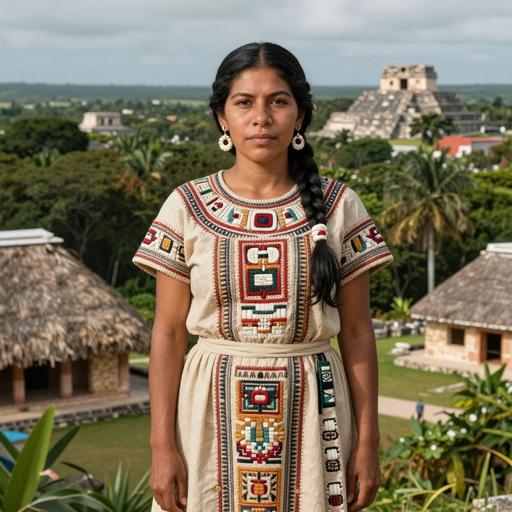
Portrait reconstruction of I8556
Ancient Individual

A woman buried in Mexico in the Modern era

I8556
1540 CE - 1680 CE
Female
Colonial Maya Mexico
Mexico
Scroll to begin
Chapter I

Identity

The biological and cultural markers that define this ancient individual

Sample ID

I8556

Date Range

1540 CE - 1680 CE

Biological Sex

Female

mtDNA Haplogroup

A2r

Cultural Period

Colonial Maya Mexico

Chapter II

Place

Where this individual was discovered

Country Mexico
Locality Campeche. Campeche
Chapter III

Time

When this individual lived in the broader context of human history

I8556 1540 CE - 1680 CE
Chapter IV

Story

The narrative of this ancient life

The Colonial Maya period in Mexico is a fascinating era that straddles the intersection between the declining indigenous Maya civilization and the burgeoning influence of European, particularly Spanish, colonial powers. This period, which broadly spans from the early 16th century until the 18th century, was a time of profound transformation, marked by cultural syncretism, resistance, adaptation, and survival.

Historical Context

The Maya civilization, known for its remarkable achievements in architecture, mathematics, astronomy, and literacy, had already experienced significant decline by the time the Spanish arrived in the early 16th century. The arrival of the Spanish conquistadors, led by figures such as Hernán Cortés, marked the beginning of a new era. The conquest of the Yucatán Peninsula was not straightforward; it took almost two centuries for the Spanish to fully subdue the region due primarily to the fierce resistance of the Maya people and the challenging geography of the area.

Social and Political Changes

Colonial Administration

The Spanish imposed a new social and political system on the Maya, which was characterized by the encomienda and repartimiento systems. The encomienda system was supposed to be a grant by the Crown to Spanish settlers conferring the right to extract tribute and labor from the indigenous peoples. However, it often led to exploitation and severe abuse, although less intense than initially in Mexico due to logistical challenges.

Resistance and Adaptation

The Colonial Maya did not passively submit to Spanish rule. They engaged in a variety of resistance strategies, from outright rebellion, such as the famous Caste War of the mid-19th century, to subtler forms of resistance such as working slowly or only pretending to convert to Christianity while secretly maintaining their traditional beliefs and practices.

Societal Structure

Under Spanish influence, traditional Maya social structures were transformed. The caciques, or local leaders, often had to navigate new alliances and roles under Spanish oversight. Commoners experienced the heaviest burden of the tribute and forced labor systems but also were key in maintaining cultural continuity through their resilience.

Cultural Transformation

Religion and Syncretism

One of the most significant transformations was religious. The Spanish were intent on converting the Maya to Christianity, often using forceful means. However, the result was a syncretic blend of Catholic and traditional Maya beliefs. Today, this hybrid form of religion is evident in the religious practices of many Maya communities, which often incorporate traditional ceremonies and deities alongside Catholic saints and rituals.

Language and Literacy

The Spanish introduced the Latin script, which allowed some elements of Maya written culture, which was originally recorded in the hieroglyphic script, to survive. Missionaries and Maya scribes created bilingual texts that were instrumental in preserving aspects of Maya history, mythology, and language.

Art and Architecture

Spanish colonial architecture left an indelible mark on the Yucatán Peninsula with the introduction of European styles. However, Maya artisans adapted these influences, creating unique structures and artworks that reflected a blend of old and new. Churches were often built over or near existing Maya temples, embodying the fusion of cultures.

Economic Changes

The Spanish reoriented the economies of Maya regions toward European markets, focusing on agriculture, livestock, and mining. The introduction of new crops and animals, such as wheat, cattle, and horses, alongside the exploitation of indigenous labor for agriculture and resource extraction, deeply altered the economic landscape. Traditional Maya subsistence practices, like maize cultivation, continued but were largely overlaid with the demands of colonial economic policies.

Legacy and Continuing Influence

Despite colonial pressures and transformations, Maya culture did not disappear. Instead, it evolved, retaining much of its pre-Columbian heritage while integrating aspects of colonial influence. The Colonial Maya period set the stage for the modern Maya identity, a resilient culture that has preserved its language, traditions, and knowledge systems into the present day.

In sum, the Colonial Maya era in Mexico is characterized by a remarkable story of adaptation and survival. It highlights the resilience of the Maya people, illustrating how they endured the challenges of colonization while retaining core elements of their cultural identity. This era remains a significant chapter in the broader history of Mesoamerican civilizations and continues to inform contemporary understanding of post-colonial cultural dynamics in the region.

Chapter V

Genetics

The genetic ancestry of this ancient individual

Modern Genetic Admixture

This analysis compares the DNA profile with present-day reference populations, showing what percentage of genetic makeup resembles modern populations from different regions.

America 91.1%
America 91.1%
Native American 91.1%
Asia 8.9%
Northern Asian 7.8%
Mongolian 4.5%
Siberian 3.3%
Chinese & Southeast Asian 1.1%
Tibetan 0.5%
Chinese 0.5%

Closest Modern Populations

These are the modern populations showing the closest statistical alignment to A woman buried in Mexico in the Modern era, ranked by genetic distance. Lower distance values indicate closer statistical similarity.

1
Aymara
2.3677
2
Bolivian Lapaz
2.5845
3
Piapoco
2.8761
4
Yukpa
3.0166
5
Mixe
3.0661
6
Colla
3.0964
7
Cachi
3.1643
8
Wichi
3.2449
9
Mayan
3.8338
10
Huichol
3.9285
Chapter VI

Context

Other ancient individuals connected to this sample

Sources

References

Scientific publications and genetic data

G25 Coordinates

The G25 coordinates for sample I8556 can be used for detailed admixture analysis in our G25 Studio tool.

I8556,0.05673086,-0.31547104,0.11255994,0.1001043,-0.11527932,-0.0145025,-0.29467196,-0.34594664,-0.01382896,-0.01645418,0.00332128,-0.00096422,-0.00106172,0.0235281,-0.0064222,-0.0012693,0.0058265,0.00357514,0.00186202,-0.00126816,0.00027308,0.00670722,-0.00172104,-0.00505688,-0.00522898
Analyze in G25 Studio
Use code for 30% off Expires May 03