Menu
Store
Blog
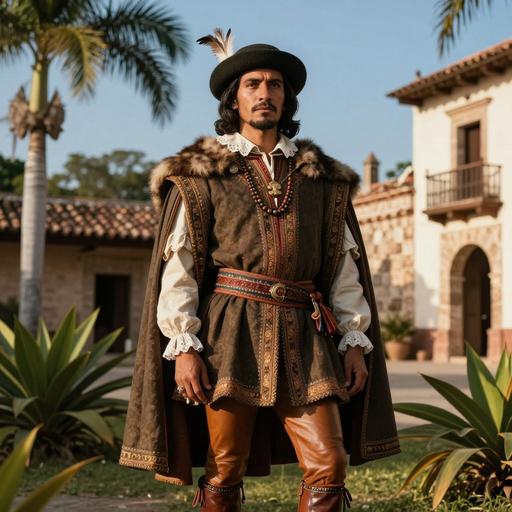
Portrait reconstruction of I8558
Ancient Individual

A man buried in Mexico in the Modern era

I8558
1540 CE - 1680 CE
Male
Colonial European Mexico
Mexico
Scroll to begin
Chapter I

Identity

The biological and cultural markers that define this ancient individual

Sample ID

I8558

Date Range

1540 CE - 1680 CE

Biological Sex

Male

mtDNA Haplogroup

X2d2

Y-DNA Haplogroup

Not available

Cultural Period

Colonial European Mexico

Chapter II

Place

Where this individual was discovered

Country Mexico
Locality Campeche. Campeche
Chapter III

Time

When this individual lived in the broader context of human history

I8558 1540 CE - 1680 CE
Chapter IV

Story

The narrative of this ancient life

Colonial European Mexico, often referred to as New Spain, represents a significant era in the history of the Americas, marked by the deep interactions between European settlers, primarily from Spain, and the diverse indigenous populations already inhabiting the region. This period began with the arrival of Hernán Cortés and the fall of the Aztec Empire in 1521, lasting until the Mexican War of Independence, which culminated in 1821. The ensuing three centuries saw profound changes in the political, social, economic, and cultural landscape of what is now modern-day Mexico.

Political Structure

The political structure of colonial Mexico was established under the viceroyalty system. The Viceroyalty of New Spain became a crucial part of the Spanish Empire, overseen by a viceroy appointed by the Spanish crown. This centralized administration was designed to implement the crown's interests, from economic exploitation to religious conversion and maintaining social order.

Audiencias, or high courts, were established in major cities, such as Mexico City, to govern and mediate disputes. Below them, local administrations were formed, known as cabildos, which allowed some involvement of local elites, particularly in urban centers.

Social Hierarchy and Culture

Society in colonial Mexico was characterized by a rigid caste system known as the \Sistema de Castas," which categorized people based on their ethnic background and ancestry. At the top were the peninsulares, Spaniards born in Spain, followed by the criollos, people of Spanish descent born in the New World. Below them were the mestizos, people of mixed European and indigenous descent, and mulatos, of mixed European and African descent. Indigenous people, Africans, and their descendants occupied the lower rungs of this social hierarchy.

This social stratification had significant consequences on cultural development. A fusion of European, indigenous, and African elements led to a unique cultural identity, seen in language, art, religion, and daily customs. The Spanish language and Catholicism were dominant forces, but indigenous languages, traditions, and beliefs persisted and even blended with European customs.

Religion

The Catholic Church played a central role in colonial society. It was not only a spiritual authority but also a powerful political and economic force. The Church was instrumental in the colonization process through missionary work aimed at converting indigenous populations. Monasteries, cathedrals, and schools were established, making the Church a key player in education and the spread of European cultural values.

Religious practices often meshed, as indigenous deities and customs were incorporated into Christian rituals, resulting in a syncretic form of worship unique to the region. Festivals that mixed pre-Columbian and Catholic traditions became commonplace, enriching the cultural tapestry of New Spain.

Economy

The economy of colonial Mexico was strongly oriented towards the interests of the Spanish Empire, focusing on resource extraction and agriculture. Silver mining became the backbone of the economy, with significant mines in Zacatecas and Guanajuato providing wealth for the Spanish crown. The encomienda and hacienda systems were established to organize labor, often exploiting indigenous labor forces under harsh conditions.

Agriculture was diverse, with crops like maize, beans, and squash cultivated alongside European-introduced wheat, sugarcane, and livestock. The introduction of these European goods profoundly altered the indigenous agricultural landscape.

Art and Architecture

The artistic and architectural landscape of colonial Mexico reflects its complex socio-cultural dynamics. Baroque style dominated, with elaborate and ornate churches, public buildings, and homes showcasing both European techniques and local aesthetics. Indigenous artisans contributed significantly, blending pre-Hispanic motifs with European styles in what became known as "Barroco Novohispano."

Fine arts thrived, with artists often sponsored by the Church or wealthy criollo patrons. This patronage system allowed for the development of a distinctive Mexican Baroque style in painting, sculpture, and literature, characterized by a vibrant blend of color, intricate detailing, and religious themes.

Influence and Legacy

The colonial European era left an indelible mark on Mexico, shaping its social structures, linguistic landscape, and cultural identity. The period was one of adaptation, resistance, and synthesis, where despite the often oppressive colonial rule, a rich and diverse cultural heritage emerged.

Today, the legacy of colonial Mexico is evident in its architecture, language, religious practices, and societal norms. Understanding this era is crucial to grasping the complexities of modern Mexican identity and its position within the broader context of Latin American history."

Chapter V

Genetics

The genetic ancestry of this ancient individual

Modern Genetic Admixture

This analysis compares the DNA profile with present-day reference populations, showing what percentage of genetic makeup resembles modern populations from different regions.

Europe 82.1%
Southern European 52.9%
Iberian 33.1%
Balkan 11.6%
Italian 4.8%
Sardinian 3.3%
Northwestern European 29.2%
English 17.6%
Scandinavian 6.4%
Northwestern European 4.4%
Finnish 0.8%
Africa 10.6%
North African 10.4%
North African 10.4%
Asia 6.7%
Arab, Egyptian & Levantine 5.4%
Levantine 5.4%
Northern West Asian 1.2%
Caucasian 0.8%
America 0.7%
America 0.7%
Native American 0.7%

Closest Modern Populations

These are the modern populations showing the closest statistical alignment to A man buried in Mexico in the Modern era, ranked by genetic distance. Lower distance values indicate closer statistical similarity.

1
Spanish Galicia
1.9197
2
Spanish Mallorca
1.9593
3
Portuguese
1.9635
4
Spanish Murcia
2.0275
5
Spanish Baleares
2.0449
6
Spanish Eivissa
2.0599
7
Spanish Alacant
2.1372
8
Spanish Extremadura
2.1419
9
Spanish Andalucia
2.2136
10
Spanish Castilla Y Leon
2.2275
Chapter VI

Context

Other ancient individuals connected to this sample

Sources

References

Scientific publications and genetic data

G25 Coordinates

The G25 coordinates for sample I8558 can be used for detailed admixture analysis in our G25 Studio tool.

I8558,0.10571894,0.1392329,0.03571782,-0.0018173,0.0340501,0.00305416,-0.00332872,0.00266878,0.01680184,0.02415126,-0.00520538,0.00636056,-0.01208952,-0.01116612,0.00595094,-0.00241912,0.00113806,0.0003034,-0.0002972,0.00064054,0.0022042,-0.00071938,-0.00164748,-0.00333292,0.00035339
Analyze in G25 Studio
Use code for 30% off Expires May 03