Menu
Store
Blog
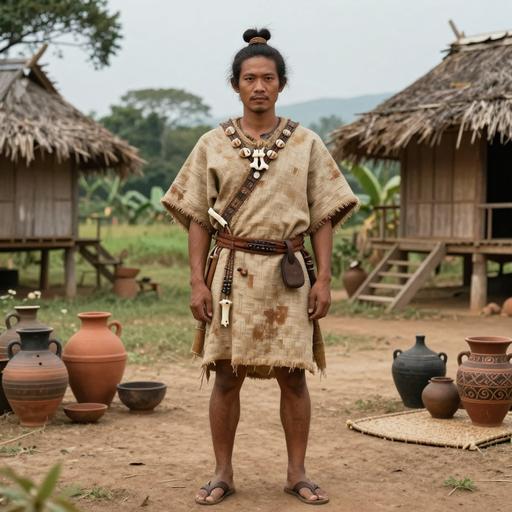
Portrait reconstruction of I8970
Ancient Individual

A man buried in Thailand in the Iron Age era

I8970
600 BCE - 400 BCE
Male
Iron Age Thailand
Thailand
Scroll to begin
Chapter I

Identity

The biological and cultural markers that define this ancient individual

Sample ID

I8970

Date Range

600 BCE - 400 BCE

Biological Sex

Male

mtDNA Haplogroup

M72a

Y-DNA Haplogroup

NO-M214

Cultural Period

Iron Age Thailand

Chapter II

Place

Where this individual was discovered

Country Thailand
Locality Ban Chiang
Chapter III

Time

When this individual lived in the broader context of human history

I8970 600 BCE - 400 BCE
Chapter IV

Story

The narrative of this ancient life

The Iron Age in Thailand, dating from around 500 BCE to 500 CE, represents a pivotal period in the development of Southeast Asian civilizations. This era is marked by significant advancements in technology, society, and culture, contributing to the foundations of complex societies that would emerge later in the region.

Technological Advancements and Metallurgy

One of the defining features of the Iron Age in Thailand is the widespread adoption of iron over the previously used bronze. Iron technology allowed for the production of more durable and effective tools and weapons, which in turn accelerated agricultural productivity and enabled the expansion of settlements. This technological shift was instrumental for social transformation, as it supported increased food production, allowing for larger population densities and more complex societal structures.

Settlements and Urbanization

Iron Age Thailand saw the growth of larger and more permanent settlements. Archaeological evidence points to the emergence of proto-urban centers, which functioned as hubs of economic and social activity. Sites like Ban Chiang and Ban Non Wat provide insights into these emerging communities. These settlements were often strategically located near resources such as fertile land, water, and trade routes, facilitating their growth and sustainability.

Social Structure and Economy

This period witnessed the initial stages of social stratification, with evidence suggesting the presence of hierarchical social structures. As communities became more complex, roles within society diversified, leading to the development of specialized crafts and professions. The economy during this era was largely agrarian, supplemented by hunting, gathering, and fishing. However, the production of iron goods, pottery, and textiles indicated a broadening economic base and the beginnings of trade networks that extended beyond the immediate region.

Trade and Interaction

The Iron Age in Thailand was characterized by increasing interaction with neighboring regions, which facilitated the exchange of goods, ideas, and cultural practices. Thailand occupied a strategic position in Southeast Asia, serving as a crossroads between India and China. This facilitated the flow of trade items such as ceramics, beads, and precious metals, and enabled cultural exchanges that introduced new religious and artistic ideas to the area.

Religious and Cultural Developments

Cultural life in Iron Age Thailand was rich and dynamic, heavily influenced by both indigenous beliefs and contacts with Indian and Chinese civilizations. Religious practices during this time likely included animism and ancestor worship, as evidenced by burial sites and artifacts found at archaeological sites. The region's exposure to Indian culture introduced early concepts of Buddhism and Hinduism, which would later become significant in shaping the spiritual landscape of Southeast Asia.

Art and Craftsmanship

The period is marked by notable development in art and craftsmanship, with significant achievements in pottery and metallurgy. Artifacts from this era, including intricately designed ceramics and metalwork, reflect a high degree of skill and aesthetic sensibility. The artistic traditions of Iron Age Thailand illustrate both local innovation and external influences, with styles evolving through contact with trading partners.

Environmental Impact and Adaptation

The communities of Iron Age Thailand were adept at adapting to their environmental conditions. The region's fertile plains and river valleys supported agricultural development, particularly rice cultivation, which became a staple of the diet. As populations grew, there was increasing pressure on natural resources, which necessitated innovative agricultural practices and water management techniques, setting the stage for sustainable development strategies in subsequent eras.

In summary, the Iron Age in Thailand was a transformative period marked by technological innovation, increased social complexity, and significant cultural exchange. It laid crucial groundwork for the evolution of later Southeast Asian societies, influencing the region's historical trajectory and leaving a lasting legacy in its cultural and technological practices.

Chapter V

Genetics

The genetic ancestry of this ancient individual

Ancient Genetic Admixture

This analysis compares the DNA profile of I8970 with ancient reference populations, showing the genetic composition in terms of prehistoric ancestral groups.

Ancient Asians 64.0%
Ancient Native Americans 14.6%
European Hunter-Gatherers 7.6%
Ancient Oceanians 7.1%
Neolithic Farmers 6.8%

Modern Genetic Admixture

This analysis compares the DNA profile with present-day reference populations, showing what percentage of genetic makeup resembles modern populations from different regions.

Asia 72.5%
Chinese & Southeast Asian 71.3%
Vietnamese 29.8%
Chinese 28.5%
Indonesian Khmer Thai Myanma 13.0%
Central Asian, Northern Indian & Pakistani 1.2%
Indian 1.2%
Africa 10.4%
North African 10.0%
Egyptian 10.0%
America 10.0%
America 10.0%
Native American 10.0%
Oceania 7.2%
Melanesian 7.2%
Papuan 7.2%

Closest Modern Populations

These are the modern populations showing the closest statistical alignment to A man buried in Thailand in the Iron Age era, ranked by genetic distance. Lower distance values indicate closer statistical similarity.

1
Malay
6.0614
2
Nyah Kur
7.5478
3
Indonesian Bali
7.6444
4
Khmer
8.1491
5
Batak
8.2335
6
Thai
8.2848
7
Vizayan
8.3312
8
Kuy Suay
8.5341
9
Cambodian
8.6472
10
Indonesian Java
8.7855
Chapter VI

Context

Other ancient individuals connected to this sample

Sources

References

Scientific publications and genetic data

Scientific Publication

Ancient genomes document multiple waves of migration in Southeast Asian prehistory

Authors Lipson M, Cheronet O, Mallick S
Abstract

Southeast Asia is home to rich human genetic and linguistic diversity, but the details of past population movements in the region are not well known. Here, we report genome-wide ancient DNA data from 18 Southeast Asian individuals spanning from the Neolithic period through the Iron Age (4100 to 1700 years ago). Early farmers from Man Bac in Vietnam exhibit a mixture of East Asian (southern Chinese agriculturalist) and deeply diverged eastern Eurasian (hunter-gatherer) ancestry characteristic of Austroasiatic speakers, with similar ancestry as far south as Indonesia providing evidence for an expansive initial spread of Austroasiatic languages. By the Bronze Age, in a parallel pattern to Europe, sites in Vietnam and Myanmar show close connections to present-day majority groups, reflecting substantial additional influxes of migrants.

G25 Coordinates

The G25 coordinates for sample I8970 can be used for detailed admixture analysis in our G25 Studio tool.

I8970,0.0015694,-0.36705512,-0.06386476,-0.00448768,0.11339328,0.02843824,-0.0300182,-0.03766732,-0.01139,-0.01908836,0.06037436,0.0068251,-0.00990972,0.0066244,0.00969964,-0.00341328,-0.0100272,0.00180964,0.00100022,-0.00063216,-0.006918,-0.01085324,-0.01313546,-0.00529906,-0.00239734
Analyze in G25 Studio
Use code for 40% off Expires Feb 27