Menu
Store
Blog
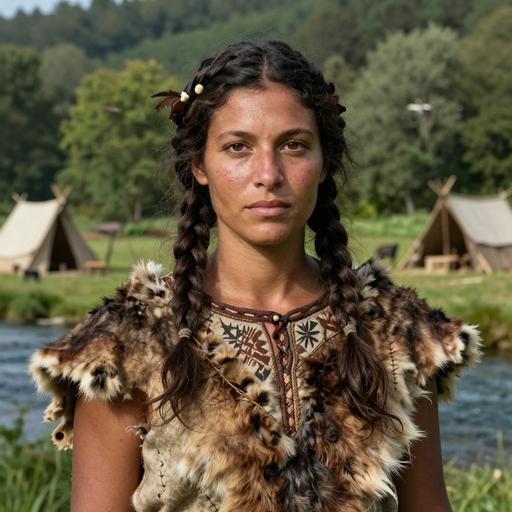
Portrait reconstruction of LesCloseaux13
Ancient Individual

A woman buried in France in the Mesolithic era

LesCloseaux13
8282 BCE - 7608 BCE
Female
Les Closeaux 13 Site, France
France
Scroll to begin
Chapter I

Identity

The biological and cultural markers that define this ancient individual

Sample ID

LesCloseaux13

Date Range

8282 BCE - 7608 BCE

Biological Sex

Female

mtDNA Haplogroup

U5a2

Cultural Period

Les Closeaux 13 Site, France

Chapter II

Place

Where this individual was discovered

Country France
Locality Les Closeaux
Coordinates 48.5200, 2.1100
Chapter III

Time

When this individual lived in the broader context of human history

LesCloseaux13 8282 BCE - 7608 BCE
Chapter IV

Story

The narrative of this ancient life

The Les Closeaux 13 site, located in France, represents a pivotal era in the history of Western European hunter-gatherers during the Mesolithic period, approximately between 10,000 to 5,000 BCE. This period followed the Paleolithic era and preceded the Neolithic era, marking a transition characterized by significant environmental and societal changes. The culture of the inhabitants of the Les Closeaux 13 site exemplifies the adaptations and innovations that were necessary for survival in a post-glacial landscape.

Environmental Context

During the Mesolithic, the climatic conditions of Western Europe were undergoing significant transformations as the Ice Age retreated, leading to the development of lush forests replacing the tundra. The forest composition primarily included deciduous trees such as oak, elm, and hazel, offering a diverse range of resources. The geography of France during this period included a variety of ecosystems—coastal areas, rivers, woodlands, and grasslands—each providing different opportunities and challenges for the hunter-gatherer communities.

Subsistence and Economy

The inhabitants of Les Closeaux 13 were highly mobile and relied on a detailed knowledge of their environment to sustain themselves. Their subsistence strategy was based on hunting, fishing, and gathering. They hunted a wide array of game, from large animals such as deer and wild boars to smaller creatures like birds and hares. The development of microlithic tools, such as small bladelets and arrowheads made from flint, facilitated efficient hunting.

Fishing also played a crucial role in their diet, with rivers and lakes providing rich sources of fish, mollusks, and other aquatic resources. The gathering of plant material was equally important, with evidence suggesting the collection of nuts, berries, and tubers. This diverse diet ensured a balanced nutrition and allowed the Les Closeaux 13 people to thrive in their environment.

Tools and Technology

Technological innovations during this era included the refinement of stone tools, with microliths being a core component of their toolkit. These small, sharp flint implements were used as composite tools, often set into wooden or bone handles, enhancing their utility in tasks such as hunting and processing animal hides. Bone and antler were also utilized to create tools such as harpoons, needles, and decorative items.

The Mesolithic tool assemblage demonstrates an adept understanding of raw material properties and an ability to adapt to different tasks. Crafting of canoes or other forms of watercraft might have occurred, facilitating fishing and the movement of people and resources along waterways.

Social Structure and Habitation

The social structure of Les Closeaux 13 would have been organized around small, kin-based groups. These groups were generally egalitarian, with decisions likely made collectively or by consensus. Seasonal movements dictated by resource availability led to the establishment of temporary camps, with more permanent semi-sedentary settlements becoming common in resource-rich areas.

Archaeological evidence from sites similar to Les Closeaux 13 shows structures made of wood, stone, and organic material, such as skin or bark, indicating shelters that were both temporary and easily dismantled. These would have been strategically located to optimize access to resources and provide protection from the elements.

Art and Symbolism

Though less is known about the artistic expressions of Mesolithic societies compared to their Paleolithic predecessors, the inhabitants of sites like Les Closeaux 13 likely engaged in symbolic practices. Artifacts such as carved bone and antler, personal ornaments, and possibly rudimentary art forms reflect a culture with complex social and spiritual dimensions.

The presence of such items suggests these people had rich symbolic lives, possibly involving rituals or shamanistic practices. Art and ornamentation might have served as a means of communication, social bonding, or expressing identity and status within and between groups.

Conclusion

The Les Closeaux 13 site illustrates a dynamic phase in the cultural and technological evolution of Western European hunter-gatherers. Adapting to a rapidly changing environment, these communities showcased remarkable ingenuity and resilience. Their adaptations not only ensured their survival but also laid the groundwork for subsequent societal transformations that would lead into the Neolithic era, characterized by the inception of agriculture and more permanent settlements. This era was crucial in the long-term narrative of human history and continues to be a subject of extensive archaeological and anthropological interest.

Chapter V

Genetics

The genetic ancestry of this ancient individual

Ancient Genetic Admixture

This analysis compares the DNA profile of LesCloseaux13 with ancient reference populations, showing the genetic composition in terms of prehistoric ancestral groups.

Western Steppe Pastoralists 50.7%
European Hunter-Gatherers 21.2%
Neolithic Farmers 19.8%
Ancient Asians 5.2%
Ancient Oceanians 3.1%

Modern Genetic Admixture

This analysis compares the DNA profile with present-day reference populations, showing what percentage of genetic makeup resembles modern populations from different regions.

Europe 92.4%
Northwestern European 92.4%
Finnish 39.2%
Scandinavian 36.5%
English 13.2%
Northwestern European 3.6%
Oceania 7.2%
Melanesian 7.2%
Papuan 7.2%

Closest Modern Populations

These are the modern populations showing the closest statistical alignment to A woman buried in France in the Mesolithic era, ranked by genetic distance. Lower distance values indicate closer statistical similarity.

1
Swedish
2.2827
2
Norwegian
2.5514
3
Danish
2.6660
4
German Hamburg
2.7160
5
Icelandic
2.7188
6
Shetlandic
3.0035
7
Orcadian
3.0472
8
Dutch
3.0805
9
Scottish
3.1364
10
Irish
3.3362
Chapter VI

Context

Other ancient individuals connected to this sample

Sources

References

Scientific publications and genetic data

Scientific Publication

The genetic history of Ice Age Europe

Authors Fu Q, Posth C, Hajdinjak M
Abstract

Modern humans arrived in Europe ~45,000 years ago, but little is known about their genetic composition before the start of farming ~8,500 years ago. Here we analyse genome-wide data from 51 Eurasians from ~45,000-7,000 years ago. Over this time, the proportion of Neanderthal DNA decreased from 3-6% to around 2%, consistent with natural selection against Neanderthal variants in modern humans. Whereas there is no evidence of the earliest modern humans in Europe contributing to the genetic composition of present-day Europeans, all individuals between ~37,000 and ~14,000 years ago descended from a single founder population which forms part of the ancestry of present-day Europeans. An ~35,000-year-old individual from northwest Europe represents an early branch of this founder population which was then displaced across a broad region, before reappearing in southwest Europe at the height of the last Ice Age ~19,000 years ago. During the major warming period after ~14,000 years ago, a genetic component related to present-day Near Easterners became widespread in Europe. These results document how population turnover and migration have been recurring themes of European prehistory.

G25 Coordinates

The G25 coordinates for sample LesCloseaux13 can be used for detailed admixture analysis in our G25 Studio tool.

LesCloseaux13,0.13375064,0.12067242,0.0563223,0.06194502,0.04385988,0.0169406,0.00379276,0.0077333,0.0034179,-0.0088562,-0.00779254,0.00578702,0.00191776,-0.00661688,0.01292336,0.00090004,-0.00947664,0.00081512,-0.001365,1.598E-05,0.00613718,0.00353748,0.00054906,0.0095563,-0.00101025
Analyze in G25 Studio
Use code for 40% off Expires Feb 27