Menu
Store
Blog
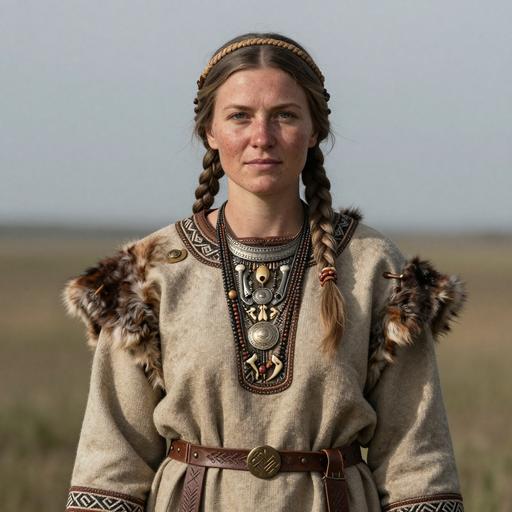
Portrait reconstruction of NEO233
Ancient Individual

A woman buried in Russia in the Iron Age era

NEO233
121 CE - 325 CE
Female
Iron Age Uelen, Russia
Russia
Scroll to begin
Chapter I

Identity

The biological and cultural markers that define this ancient individual

Sample ID

NEO233

Date Range

121 CE - 325 CE

Biological Sex

Female

mtDNA Haplogroup

D4b1a2a1

Cultural Period

Iron Age Uelen, Russia

Chapter II

Place

Where this individual was discovered

Country Russia
Locality Uelen
Chapter III

Time

When this individual lived in the broader context of human history

NEO233 121 CE - 325 CE
Chapter IV

Story

The narrative of this ancient life

Iron Age Uelen, located in the Chukotka region of Russia, represents one of the most intriguing and lesser-known cultures within the broader study of Arctic civilizations. During the Iron Age, which is generally considered to be around 500 BC to 500 AD in different parts of the world, Uelen rose as a cultural hub that highlights the adaptability and resilience of human societies in extreme conditions.

Geographic and Environmental Context

Uelen is situated on the Chukchi Peninsula, the northeasternmost point of Russia, and acts as a gateway between the Bering Sea to the south and the Arctic Ocean to the north. The area is characterized by harsh climatic conditions, including long, frigid winters and short, cool summers. Despite these challenges, the location offered abundant marine resources which were central to the subsistence strategies of Iron Age populations.

Subsistence and Economy

The inhabitants of Iron Age Uelen primarily relied on a combination of hunting, fishing, and gathering, with a distinct focus on marine resources. The region teemed with marine life including seals, walruses, and whales, which played a critical role in the Uelen diet and economy. The community developed sophisticated hunting tools and techniques to exploit these resources effectively. The use of skin boats, harpoons, and traps facilitated efficient hunting in Arctic waters.

Aside from marine resources, terrestrial hunting of reindeer and small game, as well as the gathering of available plant resources, supplemented their diet. The economic practices of Uelen illustrate a high degree of specialization and adaptation, as the community effectively balanced maritime and terrestrial sources of sustenance.

Social Structure

The social structure of Iron Age Uelen likely reflected a complex interplay between communal and hierarchical organization necessary for survival in such an environment. Evidence suggests a communal lifestyle with structured roles that may have been influenced by kinship ties and seasonal requirements. The cooperative nature of hunting large marine mammals probably necessitated organized group efforts, while skilled artisans and spiritual leaders may have held elevated status within the society.

Art and Cultural Expression

Iron Age Uelen is particularly noted for its rich artistic traditions. Archaeological discoveries from the region have revealed an impressive array of decorative and functional objects, including intricately carved bone and ivory from walrus tusks and whale bone. These artifacts often feature detailed depictions of animals and human figures, indicating not only artistic skill but also a deep spiritual or symbolic connection to the natural world.

Additionally, the art might suggest trade and cultural exchange with neighboring regions, as certain motifs and techniques show influence or affinity with other Arctic cultures, such as those in Alaska and across the Bering Strait.

Technology and Craftsmanship

The technological innovations of the Uelen culture during the Iron Age were largely centered around improving efficiency in hunting and survival in the Arctic environment. The production of warm clothing from animal skins, the construction of semi-subterranean dwellings insulated against the cold, and the development of advanced seafaring vessels underscore their ingenuity.

Their craftsmanship extended beyond utility, with artisans in Uelen contributing significantly to the decorative arts. The sophistication in tool production was evident, with items crafted from stone, bone, and metalwork, showcasing both functional design and aesthetic embellishment.

Religion and Belief Systems

Religious and spiritual life in Iron Age Uelen is inferred from archaeological finds and ethnographic parallels with later and nearby Arctic peoples. Totemistic and shamanistic practices are suggested through the symbolic use of animal imagery and the presence of ritualistic objects. These elements might have played a role in societal cohesion, as well as in practices surrounding hunting, healing, and navigation of the Arctic environment.

Conclusion

Iron Age Uelen of the Arctic cultures epitomizes human adaptability and creativity in one of the planet's most challenging environments. By effectively managing and harnessing their resources, both marine and terrestrial, and developing complex social structures and rich cultural traditions, the people of Uelen not only survived but flourished. The legacy of their artistic achievements and technological prowess continues to inform our understanding of Arctic cultural history, offering valuable insights into the interconnectedness of ancient human societies.

Chapter V

Genetics

The genetic ancestry of this ancient individual

Ancient Genetic Admixture

This analysis compares the DNA profile of NEO233 with ancient reference populations, showing the genetic composition in terms of prehistoric ancestral groups.

Ancient Asians 52.5%
Ancient Native Americans 25.8%
European Hunter-Gatherers 21.8%

Modern Genetic Admixture

This analysis compares the DNA profile with present-day reference populations, showing what percentage of genetic makeup resembles modern populations from different regions.

Asia 55.3%
Northern Asian 24.5%
Mongolian 24.5%
Chinese & Southeast Asian 17.5%
Tibetan 13.4%
Indonesian Khmer Thai Myanma 4.1%
Northern West Asian 12.3%
Cypriot 12.3%
Japanese & Korean 1.1%
Japanese 1.1%
America 44.7%
America 44.7%
Native American 44.7%

Closest Modern Populations

These are the modern populations showing the closest statistical alignment to A woman buried in Russia in the Iron Age era, ranked by genetic distance. Lower distance values indicate closer statistical similarity.

1
Greenlander East
13.4853
2
Greenlander West
14.3975
3
Cree
15.7586
4
Teleut
16.4363
5
Khakass
16.4849
6
Shor Mountain
16.7799
7
Kirghiz
16.8054
8
Tubalar
16.8344
9
Shor Khakassia
16.8661
10
Kirghiz China
16.8975
Chapter VI

Context

Other ancient individuals connected to this sample

Sources

References

Scientific publications and genetic data

Scientific Publication

The population history of northeastern Siberia since the Pleistocene

Authors Sikora M, Pitulko VV, Sousa VC
Abstract

Northeastern Siberia has been inhabited by humans for more than 40,000 years but its deep population history remains poorly understood. Here we investigate the late Pleistocene population history of northeastern Siberia through analyses of 34 newly recovered ancient genomes that date to between 31,000 and 600 years ago. We document complex population dynamics during this period, including at least three major migration events: an initial peopling by a previously unknown Palaeolithic population of 'Ancient North Siberians' who are distantly related to early West Eurasian hunter-gatherers; the arrival of East Asian-related peoples, which gave rise to 'Ancient Palaeo-Siberians' who are closely related to contemporary communities from far-northeastern Siberia (such as the Koryaks), as well as Native Americans; and a Holocene migration of other East Asian-related peoples, who we name 'Neo-Siberians', and from whom many contemporary Siberians are descended. Each of these population expansions largely replaced the earlier inhabitants, and ultimately generated the mosaic genetic make-up of contemporary peoples who inhabit a vast area across northern Eurasia and the Americas.

G25 Coordinates

The G25 coordinates for sample NEO233 can be used for detailed admixture analysis in our G25 Studio tool.

NEO233,0.04645298,-0.26626362,0.05902006,0.0289858,-0.01206618,0.00952096,-0.08667368,-0.09818604,-0.01213888,-0.01464238,0.00419326,-0.00620638,0.00898998,-0.01357056,-0.007646,-0.00286642,0.0010321,0.00163572,-9.03E-05,-0.00879334,0.00169952,0.01395228,0.01413716,-0.00310426,-0.00494548
Analyze in G25 Studio
Use code for 40% off Expires Feb 27