Menu
Store
Blog
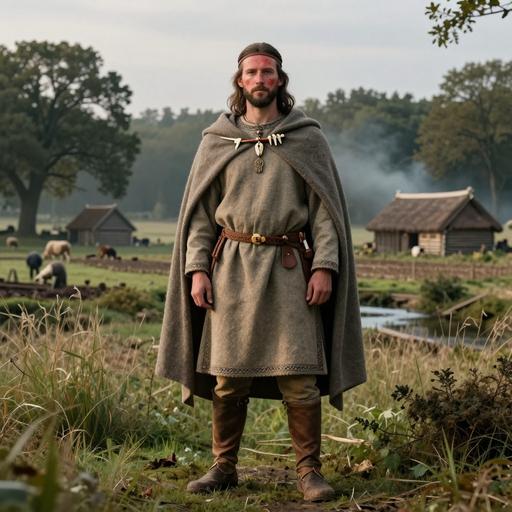
Portrait reconstruction of NEO792
Ancient Individual

A man buried in Denmark in the Neolithic era

NEO792
2627 BCE - 2465 BCE
Male
Funnel Beaker Culture (TRB) and Corded Ware Culture (CWC) in Denmark
Denmark
Scroll to begin
Chapter I

Identity

The biological and cultural markers that define this ancient individual

Sample ID

NEO792

Date Range

2627 BCE - 2465 BCE

Biological Sex

Male

mtDNA Haplogroup

U2e2a1a2

Y-DNA Haplogroup

I-L161

Cultural Period

Funnel Beaker Culture (TRB) and Corded Ware Culture (CWC) in Denmark

Chapter II

Place

Where this individual was discovered

Country Denmark
Locality Næs (Falster region)
Coordinates 54.8700, 12.1160
Chapter III

Time

When this individual lived in the broader context of human history

NEO792 2627 BCE - 2465 BCE
Chapter IV

Story

The narrative of this ancient life

The Funnel Beaker Culture (TRB) and the Corded Ware Culture (CWC) represent significant prehistoric cultural phases in Denmark and broadly Nordic and Indo-European prehistory. These cultures, both distinct and overlapping in time, highlight important transitions in the Neolithic and early Bronze Age periods.

Funnel Beaker Culture (TRB)

Chronology and Origin

The Funnel Beaker Culture, named after its characteristic pottery with funnel-shaped necks, flourished during the Neolithic period, roughly between 4000 and 2800 BCE. It extended across Northern Europe, including Denmark, parts of Germany, the Netherlands, and Poland. This culture marks a crucial transition from a primarily hunter-gatherer lifestyle to one based more heavily on agriculture and animal husbandry.

Society and Economy

TRB communities are often regarded as the first to establish farming in this region. They cultivated cereals such as wheat and barley and reared livestock, including cattle, sheep, and pigs. This marked a significant shift towards a more sedentary lifestyle. Settlements varied from small, dispersed farmsteads to larger, more complex communities.

The society appears to have been clan-based, with evidence of social stratification. This is suggested by the varied grave goods found in burial sites, indicating differing levels of wealth and status within the community.

Material Culture and Technology

The Funnel Beaker Culture is renowned for its pottery, specifically the distinctive funnel-necked beakers that give the culture its name. These vessels were often elaborately decorated with geometric and linear patterns.

Apart from pottery, TRB communities are known for their large megalithic structures, such as dolmens and passage graves. Constructed from large stones, these structures were likely used as communal burial sites and played a role in religious or ceremonial activities. The craftsmanship involved in creating these impressive monuments indicates a sophisticated understanding of engineering and communal effort.

Religion and Rituals

TRB societies appear to have had complex spiritual beliefs, as inferred from their burial customs and megalithic architecture. Burials often included grave goods such as pottery, stone tools, and animal remains, suggesting beliefs in an afterlife where such items would be needed. The collective nature of the megalithic tombs implies a focus on community and ancestry, potentially serving as focal points for ritual activities.

Corded Ware Culture (CWC)

Chronology and Origin

The Corded Ware Culture succeeded the Funnel Beaker Culture, emerging around 2900 BCE and lasting until about 2350 BCE. It represents a wide-spread Indo-European culture that reached across much of Central and Northern Europe. In Denmark, it represents the arrival of new cultural influences and possibly new populations.

Society and Economy

The Corded Ware culture is associated with a more mobile lifestyle compared to the TRB, likely relying significantly on pastoralism. There is evidence of mixed farming, but animal husbandry, especially involving cattle and sheep, played a more central role.

Social structures appear to have been less communal than in the TRB, with more emphasis on individual family units or clans, as evidenced by single-grave burials rather than communal megaliths. These individual graves often contained cord-decorated pottery and stone battle axes, items which are emblematic of this culture.

Material Culture and Technology

The Corded Ware Culture is characterized by its distinctive pottery, often featuring cord-like impressions, and the presence of battle axes or stone tools as grave goods. These tools are believed to symbolize not only function but status and possibly the warrior status of individuals.

The period also saw advances in metallurgy and the introduction of wheel-and-axle technologies, which facilitated trade and communication across regions.

Religion and Rituals

CWC religious practices are less understood but are believed to involve a strong emphasis on the cult of the individual, indicated by the single burials and associated grave goods. The presence of weapons in graves suggests a culture that perhaps placed value on warfare, individual prowess, or protection in the afterlife.

Interaction and Transition

The transition from the Funnel Beaker to the Corded Ware culture in Denmark was not abrupt but involved a period of overlap and interaction. The region saw a blending of traditions where megalithic structures coexisted with single burials. This suggests a period of cultural synthesis and adaptation, as new ideas and technologies were assimilated into existing traditions.

This period of prehistoric Denmark illustrates a microcosm of broader European prehistoric transitions, highlighting the dynamic nature of cultural evolution driven by both indigenous developments and influences from migrations and exchanges with wider Indo-European groups. These transitions laid crucial foundations for the development of later Scandinavian Bronze Age cultures.

Chapter V

Context

Other ancient individuals connected to this sample

Sources

References

Scientific publications and genetic data

Scientific Publication

Population genomics of post-glacial western Eurasia

Authors Allentoft ME, Sikora M, Refoyo-Martínez A
Abstract

Western Eurasia witnessed several large-scale human migrations during the Holocene1-5. Here, to investigate the cross-continental effects of these migrations, we shotgun-sequenced 317 genomes-mainly from the Mesolithic and Neolithic periods-from across northern and western Eurasia. These were imputed alongside published data to obtain diploid genotypes from more than 1,600 ancient humans. Our analyses revealed a 'great divide' genomic boundary extending from the Black Sea to the Baltic. Mesolithic hunter-gatherers were highly genetically differentiated east and west of this zone, and the effect of the neolithization was equally disparate. Large-scale ancestry shifts occurred in the west as farming was introduced, including near-total replacement of hunter-gatherers in many areas, whereas no substantial ancestry shifts happened east of the zone during the same period. Similarly, relatedness decreased in the west from the Neolithic transition onwards, whereas, east of the Urals, relatedness remained high until around 4,000 BP, consistent with the persistence of localized groups of hunter-gatherers. The boundary dissolved when Yamnaya-related ancestry spread across western Eurasia around 5,000 BP, resulting in a second major turnover that reached most parts of Europe within a 1,000-year span. The genetic origin and fate of the Yamnaya have remained elusive, but we show that hunter-gatherers from the Middle Don region contributed ancestry to them. Yamnaya groups later admixed with individuals associated with the Globular Amphora culture before expanding into Europe. Similar turnovers occurred in western Siberia, where we report new genomic data from a 'Neolithic steppe' cline spanning the Siberian forest steppe to Lake Baikal. These prehistoric migrations had profound and lasting effects on the genetic diversity of Eurasian populations.

Use code for 40% off Expires Feb 26