Menu
Store
Blog
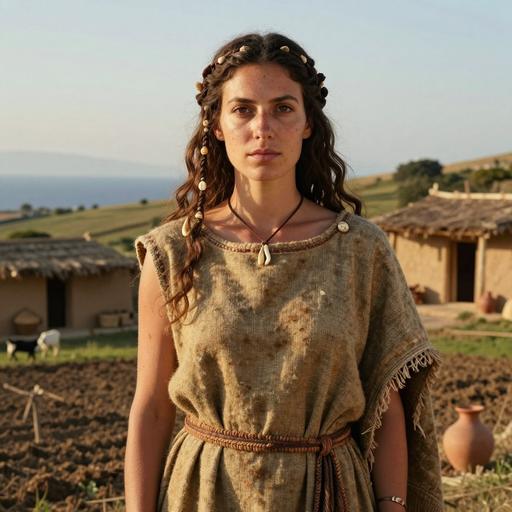
Portrait reconstruction of Pal7
Ancient Individual

A woman buried in Greece in the Late Neolithic era

Pal7
4449 BCE - 4348 BCE
Female
Late Neolithic 2 Greece
Greece
Scroll to begin
Chapter I

Identity

The biological and cultural markers that define this ancient individual

Sample ID

Pal7

Date Range

4449 BCE - 4348 BCE

Biological Sex

Female

mtDNA Haplogroup

J1c1

Cultural Period

Late Neolithic 2 Greece

Chapter II

Place

Where this individual was discovered

Country Greece
Locality Paliambela
Coordinates 39.7517, 22.0096
Chapter III

Time

When this individual lived in the broader context of human history

Pal7 4449 BCE - 4348 BCE
Chapter IV

Story

The narrative of this ancient life

The Late Neolithic 2 period in Greece, spanning approximately 5300 to 4500 BCE, represents a significant era in the prehistoric Aegean civilization. This era is crucial for understanding the socio-cultural and technological transformations that set the stage for the subsequent Bronze Age Aegean cultures, including the Minoans and Mycenaeans.

Geographical Context

Late Neolithic 2 Greece was primarily centered in the Aegean region, which included both mainland Greece and various islands like Crete and the Cyclades. The geography of the Aegean Sea contributed to the development of maritime skills among the inhabitants and facilitated interactions between different communities, laying an early foundation for the complex trading networks of the Bronze Age.

Settlements and Architecture

Settlements during the Late Neolithic 2 became more permanent and elaborate compared to earlier periods. Villages were typically located in fertile plains or near crucial resources like water bodies. Dwellings were often rectangular or circular, with mud-brick or stone foundations and thatched roofs, reflecting advances in building techniques. Some settlements, such as those found at sites like Dimini and Sesklo, began to exhibit proto-urban characteristics with organized layout, communal spaces, and evidence of social stratification.

Economy and Subsistence

The economy was primarily agrarian, with farming, herding, and fishing as the core activities. People cultivated crops like wheat, barley, lentils, and peas, using simple but effective agricultural tools. Animal husbandry included the domestication of sheep, goats, pigs, and cattle. These practices not only ensured food security but also facilitated trade, as surplus goods could be exchanged with neighboring communities for other resources or exotic items.

Tools and Technology

Technological advancements during this period included the development of new stone tools, such as sickles, grinding stones, and axes, reflecting an increasingly sophisticated approach to agriculture. Pottery became more refined, with diverse shapes and decorative motifs, including geometric patterns and representations of fauna and flora. This pottery evolution provides critical insights into symbolic communication and aesthetic preferences.

Art and Culture

Artistic expression saw a significant rise during the Late Neolithic 2 era, with evidence of both utilitarian and ceremonial artifacts. Figurines, often crafted from clay or marble, depicted human and animal forms and likely held religious or ritualistic significance. These artifacts suggest a complex belief system, possibly centered around fertility cults or ancestor worship.

Social Structure and Organization

Society during this era appeared to be clan-based with emerging social stratification. Evidence points towards the existence of a form of social hierarchy or leaders who may have held both religious and political power. This is inferred from the differential burial practices, where some individuals were interred with more elaborate grave goods than others, indicating status differences.

Trade and Interaction

The Late Neolithic 2 period saw an increase in long-distance trade, facilitated by the Aegean's maritime nature. This included the exchange of materials like obsidian, sourced from Melos, and possibly ideas and technological know-how. Such interactions contributed to cultural convergence across the Aegean, as seen in shared artistic styles and technological methods.

Conclusion

The Late Neolithic 2 era in Greece was a dynamic precursor to later Aegean civilizations. It was characterized by significant developments in settlement patterns, economic practices, technological innovation, and social structures. The cultural and technological advancements of this period laid crucial groundwork for the emergence of the complex societies of the Early Bronze Age and ultimately the sophisticated civilizations like the Minoans and Mycenaeans that followed. Overall, the Late Neolithic 2 period represents a pivotal moment of transition and transformation in prehistoric Greece, marked by increasing complexity and interconnectedness among its communities.

Chapter V

Genetics

The genetic ancestry of this ancient individual

Ancient Genetic Admixture

This analysis compares the DNA profile of Pal7 with ancient reference populations, showing the genetic composition in terms of prehistoric ancestral groups.

Neolithic Farmers 76.7%
European Hunter-Gatherers 23.3%

Modern Genetic Admixture

This analysis compares the DNA profile with present-day reference populations, showing what percentage of genetic makeup resembles modern populations from different regions.

Europe 68.0%
Southern European 68.0%
Sardinian 26.3%
Italian 23.9%
Iberian 17.7%
Asia 27.2%
Arab, Egyptian & Levantine 22.7%
Levantine 15.5%
Arabian 7.1%
Northern West Asian 4.5%
Cypriot 4.5%
Africa 4.9%
North African 4.9%
North African 3.8%
Egyptian 1.0%

Closest Modern Populations

These are the modern populations showing the closest statistical alignment to A woman buried in Greece in the Late Neolithic era, ranked by genetic distance. Lower distance values indicate closer statistical similarity.

1
Sardinian
3.7619
2
Belmonte Jew
6.8528
3
French Corsica
7.2124
4
Spanish Canarias
8.1303
5
Italian Lazio
8.2206
6
Sicilian West
8.3299
7
Spanish Murcia
8.4162
8
Italian Umbria
8.4420
9
Spanish Andalucia
8.5211
10
Spanish Extremadura
8.5759
Chapter VI

Context

Other ancient individuals connected to this sample

Sources

References

Scientific publications and genetic data

Scientific Publication

Early farmers from across Europe directly descended from Neolithic Aegeans

Authors Hofmanová Z, Kreutzer S, Hellenthal G
Abstract

Farming and sedentism first appeared in southwestern Asia during the early Holocene and later spread to neighboring regions, including Europe, along multiple dispersal routes. Conspicuous uncertainties remain about the relative roles of migration, cultural diffusion, and admixture with local foragers in the early Neolithization of Europe. Here we present paleogenomic data for five Neolithic individuals from northern Greece and northwestern Turkey spanning the time and region of the earliest spread of farming into Europe. We use a novel approach to recalibrate raw reads and call genotypes from ancient DNA and observe striking genetic similarity both among Aegean early farmers and with those from across Europe. Our study demonstrates a direct genetic link between Mediterranean and Central European early farmers and those of Greece and Anatolia, extending the European Neolithic migratory chain all the way back to southwestern Asia.

G25 Coordinates

The G25 coordinates for sample Pal7 can be used for detailed admixture analysis in our G25 Studio tool.

Pal7,0.097627,0.15818928,0.0139956,-0.0562097,0.05321688,-0.02706,-0.0056143,0.00521868,0.0431337,0.0703919,-0.00146394,0.01112946,-0.01978718,-0.0149671,-0.01181042,0.0044038,0.01600158,-0.00122448,-0.00576924,-0.0030448,-0.0025392,-0.00084578,-0.00766368,-0.01828846,0.00417181
Analyze in G25 Studio
Use code for 40% off Expires Feb 26